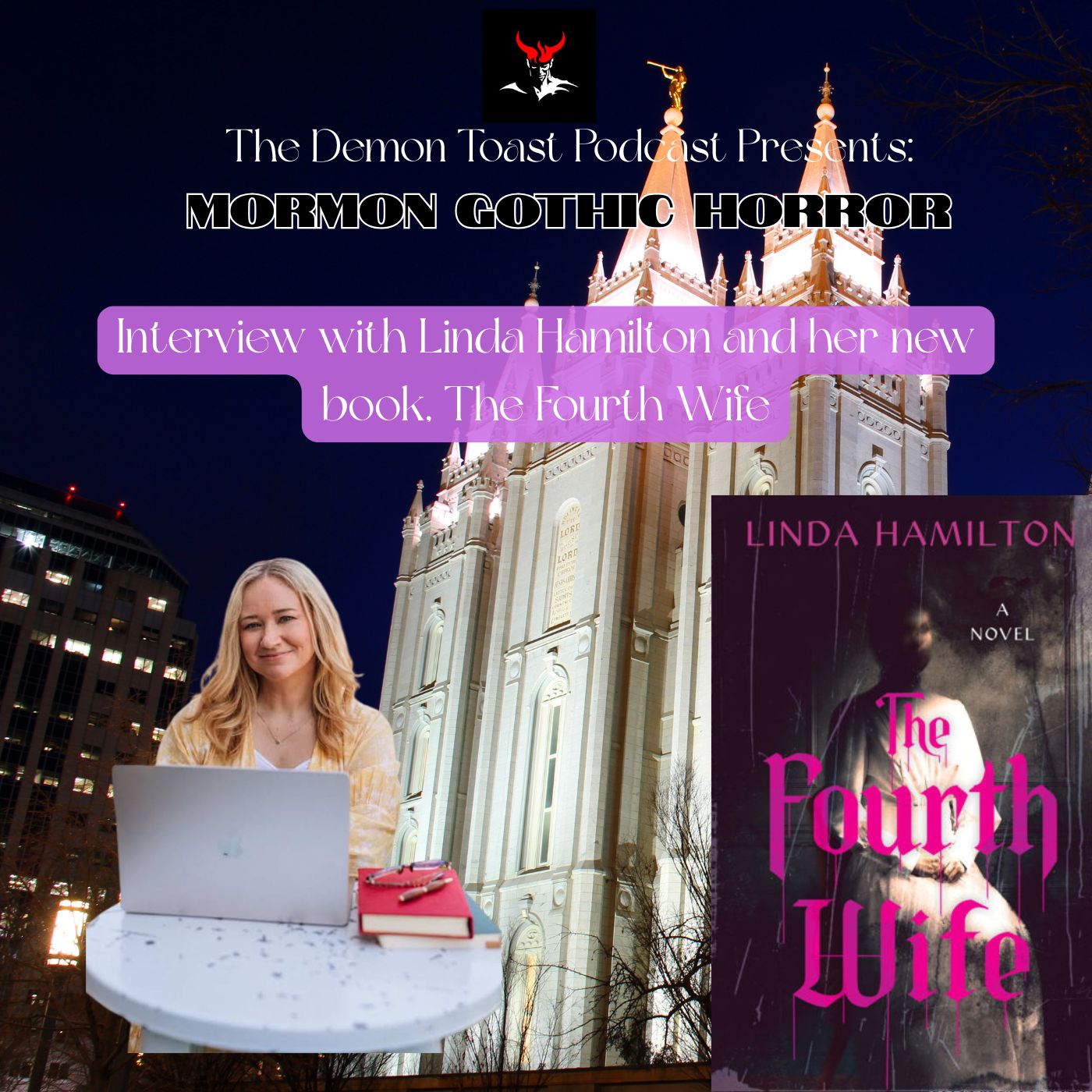
[00:00:00] Speaker A: Hey, everyone. I'm King Loki, the editor of Death Wish Poetry magazine. And this is Demon Toast, the official podcast of, well, Death Wish Poetry magazine. We cover gothic and horrific literature and the awesome people behind it. And today we've got Linda Hamilton, the novelist, author, genius behind the upcoming novel. It's not out yet. Right.
[00:00:21] Speaker B: It comes out in March 2026.
[00:00:24] Speaker A: Okay. The fourth wife, which is a Mormon gothic novel about. Well, the Fourth wife. Right. Of a Mormon and. Linda. How you doing?
[00:00:35] Speaker B: I'm good. How are you?
[00:00:37] Speaker A: I can't complain. I've just been.
When it comes to your novel, I've just been like.
I feel like I've just been. I've stepped into, like, a horrific puritanical world that really wasn't too far away because, like, you set the tone immediately. This novel set 1882.
Yes.
[00:00:57] Speaker B: Yeah.
[00:00:57] Speaker A: Yeah.
And I mean, Mormons are something that has really hit the mainstream in a massive way since, I guess, Mitt Romney's election, right?
[00:01:08] Speaker B: Yes, since the Mormon moment.
[00:01:10] Speaker A: The Mormon moment.
[00:01:12] Speaker B: That's what they officially called it.
[00:01:14] Speaker A: That's amazing. Yeah. And, like, you know, I think a lot of people, myself included, just saw them as like another sect of Christianity. I mean, I. I come from a Jewish background. Christians all look the same to me, but Mormons are very much not the same type of thing. Right.
[00:01:29] Speaker B: Yes. It's a. It is a Christian religion in that, you know, the belief in Jesus Christ. But it is very high demand and very fundamentalist.
[00:01:41] Speaker A: Very fundamentalist, yeah. That's the key thing. Right.
Like, I remember after Mitt Romney was, during his election, the Mormon Church was running all kinds of ads. Like, there was my favorite one was this guy on a motorcycle, and he's like, I like to ride my motorcycle and drink my beer and shoot my guns. I'm a Mormon, you know.
[00:01:58] Speaker B: Yep. The I'm a Mormon campaign. Which is hilarious because now saying the word Mormon is considered a victory for Satan in Mormonism.
[00:02:08] Speaker A: Oh, fascinating.
[00:02:10] Speaker B: That's a whole nother rabbit hole, but.
[00:02:12] Speaker A: Yeah, I guess it is. Yeah.
So you're from Utah?
[00:02:16] Speaker B: I'm actually from California.
[00:02:18] Speaker A: Wow. Okay.
[00:02:19] Speaker B: But I. I was a, you know, born and raised Southern California Mormon.
And so even though I. I lived in Utah for about two years in college, but other than that, it was.
Utah is just a huge part of Latter Day Saint culture. And so even though I didn't grow up there, a lot of the culture transferred to Southern California Mormon bubble. And of course, we spent a lot of time there as a family, visiting family or visiting historical sites. Things. Things like that? Yeah, yeah, yeah, yeah. So the. The basic plot of the book is there is a woman named Hazel in 1880s Utah. She is told by an apostle of the Latter Day Saint Church, also known as the Mormon Church, to become the fourth wife of a man she's never met.
She agrees. She becomes the fourth wife. He takes her to his, like, crumbling manor on the edge of Salt Lake City, where she meets his three other wives, all of whom have different agendas. And she's not sure who to trust. She starts to learn things about her husband that she did not know before and maybe could be potential red flags.
And she starts to hear this ghostly music in the house. The house seems to move and breathe. It becomes this animated character, and she starts seeing this ghostly figure in the house.
[00:03:45] Speaker A: And.
[00:03:45] Speaker B: And she needs to figure out basically what happened in this house. And is whatever happened in this house going to happen to me next.
[00:03:58] Speaker A: Wow. So I want to get into your book, but I just wanted to point. I made this, like, note here that I notice your characters don't quote the Book of Mormon. They don't use idioms the way, like, we do. Just nor, you know, like what I wrote. I wrote, reap what you sow. That's from the Bible, right? Like, we just sort of use it in common parlance. They don't seem to do that. Is it.
[00:04:21] Speaker B: Is.
[00:04:21] Speaker A: Is there. Do people not read the Book of Mormon? Is it taboo to quote it? Like, is it not as well written? I mean, I know he just sort of made things up because Joseph Smith was a fraud. But, you know, so one of the.
[00:04:34] Speaker B: Interesting things that's actually a really interesting thing to me in the history is Joseph Smith himself. So he writes the Book of Mormon and he puts all this, you know, gets someone else to put up all this money in order to publish it.
[00:04:48] Speaker A: Right.
[00:04:48] Speaker B: And then he never really spends a lot of time in the Book of Mormon. When you read through his actual sermons and things that he talked about, he doesn't actually spend a lot of time in Book of Mormon lore.
And that's because, I think, because he was just so much more into the Bible, he. He was really a very fascinated by Old Testament God and a lot of these concepts that he was raised on. And so it's not that people don't quote the Book of Mormon. I mean, today, absolutely, lots of quotes from the Book of Mormon and some of the phrases in the. In the Fourth Wife that people, probably some people may not pick up on are kind of inspired by the Book of Mormon. But the Book of Mormon is not.
I don't want to say it's not quotable because it is, but it's.
It's a very different book than the Book of Mormon, than the Bible. When you actually read it in terms of its story, it uses like King James version English style writing, but a lot of phrases like. And it came to pass, that's used a hundred times.
I think that just the way 19th century Mormonism was informed by the Bible as well is gonna infiltrate into the way that they speak.
[00:06:17] Speaker A: Okay. Fascinating. Yeah, there were some quotations that I was like, oh, that might be like from the Book of Mormon, but yeah, it's just not written like that. I think the, the term we're looking for is it's not as poetic as the Bible. Right. Like, all those manuscripts are written in a very like, florid way. Right.
[00:06:36] Speaker B: I think there are actually some very poetic verses of the Book of Mormon.
I think that the Book of Mormon, I think it just sort of has different narratives going on. When you're in more of like the storytelling narratives of it, it's a little weirder. And then when you're in more of like the religious pontification ones, those sound a little bit more like the Bible.
[00:07:00] Speaker A: Okay. I mean, getting just to, you know, put a button on this, there's a lot of Mormon stuff. Right. You mentioned the Mormon moment. Right.
I have here a couple things under the banner of heaven which I haven't gotten to yet. The secret lives of Mormon wives, which I've heard is, you know, mostly fabricated from one of my Mormon friend. Ex Mormon friends, I should say.
And this thing called Keep Sweet, Pray and obey. Right. Like, why do you think it's being so closely examined? And it's kind of in the public eye at the moment.
[00:07:34] Speaker B: I think there is a lot of public discussion about fundamentalist religions in general with like the rise of evangelicalism and Christian nationalism.
[00:07:43] Speaker A: Right.
[00:07:44] Speaker B: I also think that Mormons historically have always been so othered. It's always been viewed as this weird, exotic thing. In the 19th century with polygamy and its practice, it wasn't really. Mormons weren't considered white.
They were considered this a racial other along with other more exotic religious practices.
And so as Mormonism has, I think Mormonism continues to capture imagination because it's. It just feels so different.
And then at the same time, you have in the rise of the 1950s and 60s, this Mormonism that strongly reflects American anti communist values.
And so you get this kind of weird, like, where are your neighbors Next door, you know, like, that are baking you Rice Krispies treats, but at the same time, you are doing weird, secret things in a temple, and we want to know what you are doing.
I think. I think it kind of speaks to both of, like, here's these, like, super nice people. Every time people talk about Mormons, generally, they're going to say, oh, they're really, really nice.
But also, what the heck do they believe? Why do they used to have wild. These wives? Why do they have these secret temples? There's an. They're an era of mystery and intrigue to that.
[00:09:09] Speaker A: Yeah. And on that note, I mean, one of the first things I encountered in regards to Mormons was, of course, that south park episode where, yeah. There are Mormons and they're making fun of Joseph Smith and all. All that stuff about him. And, like, that's kind of where they land that they're just very nice and it kind of doesn't matter what they believe. Right. And that is a kind of a fascinating stereotype.
But, yeah, getting into that, there were certain peculiarities about their culture as it was in 1882 and maybe still today. Right.
You know, our protagonist Hazel is, I'm gonna say, of marriageable age. I don't think I picked. Picked up on her age. Is she like, 18, 16?
[00:09:51] Speaker B: She's 20.
[00:09:52] Speaker A: She's 20. Okay, got it.
And she refers to the woman she's living with. I assume her mother has passed as Aunt Emma. And Aunt Emma is actually her father's other wife, right?
[00:10:05] Speaker B: Yes. So they would use the term aunt to refer to their other wives.
[00:10:11] Speaker A: That's crazy.
That's crazy. Like, I picked. It took me a minute, but I was like, oh.
Because she was referring to Ammon as her brother. And that was Emma's child. That was Emma's son.
[00:10:24] Speaker B: Yep.
[00:10:24] Speaker A: And actually, one of the most shocking parts of the book. I can't say that because there's. There's. There's spooky stuff that happens. I don't want to give anything away about, like, the. The middle to late part of the book. Parts of the book. But, like, one of the more shocking things that happens early on is she's awoken by one of the other wives's sons, Edward, and he calls her Aunt Hazel. And it's so creepy because she isn't introduced to him, you know?
Yep.
[00:10:53] Speaker B: That's just sort. I think that's just sort of the nature. If you grew up in polygamy, those were the norms.
[00:10:59] Speaker A: Oh. Something else that's fascinating to me is a gentile. Right. Like, you Know, as a Jew, Gentiles, everyone else in the world, but yet you have them refer to non Mormons as Gentiles. That's fascinating.
[00:11:12] Speaker B: Yes. 19th century Mormonism, that was.
That was the way they spoke. Anyone who wasn't Mormon was a gentile because they had very strong beliefs in Mormonism being like part of the House of Israel and going to redeem the house of Israel.
[00:11:31] Speaker A: And it wasn't like in a 12 tribes kind of thing. It was more so that like they were rejoining the tribes of Israel. Right.
[00:11:39] Speaker B: Actually.
[00:11:42] Speaker A: The 10 lost tribes or something.
[00:11:45] Speaker B: Literally. So in Mormonism, you get something called your patriarchal blessing. And in your patriarchal blessing, one of the things that happens is they tell you what tribe you're from.
So in case you want to know, I'm from the tribe of Ephraim, apparently.
[00:12:05] Speaker A: Okay, that's. That's cool. Good. I'm glad for you.
[00:12:11] Speaker B: Growing up, I was like, yeah, sure. That just like, seems so normal because I just grew up in it. But like, as an adult, I'm like, what the heck?
[00:12:18] Speaker A: Yeah, like, most Jews don't even pull that. Like, you know, we don't know what tribe we're from. It's whatever, you know.
[00:12:24] Speaker B: Yeah, it's. It's some scary religious and cultural appropriation and it. But it's. It's very interesting. Yeah. Most Mormons who are born and bred Mormons are from the tribe of Ephraim or Manasseh, and they're. Yeah, it's.
And you can be adopted into a tribe if you're not actually descended. I.
It's some very interesting stuff there.
[00:12:53] Speaker A: That is interesting. Yeah. Like, wow. I have so many questions, I don't even know where to start. I guess the logic though is that like, if they were picking those two tribes, they were like, oh, well, our British colonialist ancestors were actually the descendants of such and such tribe, you know, like Ephraim or Menashe or whatever. So.
[00:13:11] Speaker B: Yeah.
[00:13:11] Speaker A: Yeah. Okay. At least there was a logic to it.
Let's see, what else did I write? Oh, yeah. Brigham Young. Brigham Young. He's the one who took over after. Right. I know. There's like a college in Salt Lake City, right?
[00:13:23] Speaker B: Yes. So after Joseph Smith was murdered, Brigham Young became the next leader and prophet of the church. He was until his death in the 1870s.
So when this book takes place is just a few years after Brigham Young has died.
[00:13:39] Speaker A: And.
[00:13:41] Speaker B: But Brigham Young is an extremely important character in 19th century Utah because his. His hands were in everything.
And if you've seen American Primeval, which is another current, you know, depiction of Mormonism. And it portrays Brigham Young really as like a mob boss.
And I would argue that's actually pretty historically accurate. Nothing really happened in Utah territory without him knowing about it. And, and he influenced a lot of things, including a lot of atrocities.
[00:14:14] Speaker A: He sounds a lot like L. Ron Hubbard, you know, in a lot of ways. Very similar mentality, I think, you know, holding this group together through force and coercion.
Gosh, there's so much here. So, yeah, our protagonist has a.
She's, she had this very intense, emotional. And I, I want to say at the top, this novel is called the Fourth Wife. This is not pornographic. There's no explicit sex scene. So if you're listening to this, you know, we publish erotica in our magazine. That's not what this is. This is a very emotionally driven horror novel.
So. But she has this, this, this relationship, emotional, romantic relationship with this guy named Elijah and she feels horrible about it.
There's this thing you wrote. A Mormon woman is supposed to be submissive, faithful and joyful.
[00:15:11] Speaker B: Yes.
[00:15:12] Speaker A: And like, there are parts where, when she. So should we just go straight? You know what, when she, when she's brought. What's his name? Crowther. Elder Crowther. Right.
[00:15:23] Speaker B: Yeah.
And that is a made up apostle, by the way.
[00:15:27] Speaker A: Oh, I, I assume so.
You know, you don't need no trouble.
[00:15:31] Speaker B: Just so I don't offend any Mormons, I did not choose a real apostle.
[00:15:36] Speaker A: Yeah, there's enough for them to be upset with, but yeah, Elder Crowther brings her in and Elijah was her son. And she's like, he's like, yeah, his. Oh, my God, what's wrong with me? I can't pronoun right now.
Elder Crowther brings her in and is like, you know, that's actually his son, Elijah. And he's like, listen, you're not going to be seeing my son anymore. He's not going to be marrying you. He said he's done his. Been called to something better.
I've got a husband for you.
And she's horrified.
And like, she has no. Like, like she's given a choice. Right. But it's the illusion of choice.
[00:16:11] Speaker B: Yeah.
[00:16:12] Speaker A: He says you could take some time to ask God what he thinks. You know, ask God for a sign.
But he makes her feel dirty for having danced with her.
His son. Right.
[00:16:23] Speaker B: Yes, definitely.
She feels a lot of pressure to become a polygamist and her and Elijah secretly don't want to be polygamists, which would in itself be, you know, frowned upon. By a leader of the church who had multiple wives himself.
[00:16:45] Speaker A: Yeah, definitely. So, you know, I was raised in an Orthodox Jewish community, and we were taught that a man could have as many wives as he wants. And, like, when I asked, like, what if. You know, like, what if a woman doesn't want her husband to get married again? And the rabbis would be like, it's too bad that's not her. Right. Like, you know, very patriarchal. Like, we're now. It wasn't like the husband is the prophet. It was more so that the woman is the property of the husband. Right.
In Judaism, now in Mormonism, like, Crowther talks about getting messages from God. You've been called to go be this man's wife.
Is that how all of this is it? It seems like the other wives. We'll get to that, but it seems like the other wives are kind of skeptical of that, to say, to say the least.
[00:17:30] Speaker B: Yeah. So with I. One thing I want to be very clear is that everything I use in the story is just an example of something that happened, but not universal for polygamy, because there were definitely people who had all kinds of experiences with polygamy. It is definitely not a monolith, but leaders saying, hey, I. You know, putting pressure on their members to marry specific people for certain reasons is definitely something that happened.
And I wanted to use this as an example of. One of the issues of polygamy is that women are really reduced to items that you can be gifted, traded, coerced.
They were often viewed as, you know, a reward, like, you're for being righteous, therefore, you deserve more wives.
And unfortunately, that's something that's kind of trickled down in Mormon culture to today, where while there isn't discussion of, like, people of men having multiple wives because that's not something the current LDS church practices. There is a lot of, like, just, like, wink, wink, nudge, nudge jokes, like, hey, if you go on a mission, your wife's gonna be super hot. Oh, you better say those prayers. The more prayers you say, the hotter your wife gets. There is a lot of implicit belief that women are still a reward in some ways. And my husband can tell Zoomy all sorts of things he heard growing up as a young man in the church that made him really, without even realizing it, thinking that a wife was something he was sort of owed in the end.
[00:19:18] Speaker A: Yeah, I got the sense that she was called because she was attractive and whatever, and this guy was in the upper crust. You know, it was just like, okay, we need, we need, we need the Rich people making more babies. It was kind of along those lines, right?
[00:19:33] Speaker B: I mean, yeah. And a big thing was that most of, like, the average members would only probably have, like, one, maybe two wives. But people who had higher callings were expected to have multiple wives. And so the character of Jacob Manwaring, who she marries, is someone that Elder Crowther wants to make into a leader. And so he needs to have. And he deserves to have many beautiful wives.
[00:20:04] Speaker A: Yes. And I'm kind of shocked when she gets to. When she gets to Jacob's house.
They're all living in the same house.
[00:20:11] Speaker B: Yes.
[00:20:12] Speaker A: That's horrific to me. That's. And, like, the way they react to her. They didn't know the one. I believe it's Abby, the oldest one. She says, oh, looks like you brought home another wife.
[00:20:22] Speaker B: Yep, it's. And, yeah, that.
[00:20:26] Speaker A: That's a.
[00:20:27] Speaker B: That's a reflection of something that was also, unfortunately, very common in practice or in theory. The church practiced something called the Law of Sarah, which was that a first wife has to approve second wives and future wives.
However, it also says in Doctrine Covenants 132, which is the section that Joseph Smith wrote about polygamy, it also says that if the wife says no, you can do it anyway because you're entitled to virgins.
And so Joseph F. Smith, who was a later prophet in the Reed Smoot hearings, he was, like, testifying in front of Congress about polygamy, and they said, so what. What is a wife's consent? And he said, a wife's consent is nothing other than it just amounts to her consent. That's it. You can. She'll be destroyed if she doesn't do it.
So in theory, really bending the definition.
[00:21:29] Speaker A: There of consent, you know?
[00:21:30] Speaker B: Yeah. And so men marrying women without the women even knowing was something that happened. I'm not trying to say that every single man did that, but it was certainly something that did and could happen under this practice. Because if the scriptures say, ask your wife, and if she says no, you can do it anyways or she'll be destroyed.
What. What. What does your wife's consent really mean?
[00:21:58] Speaker A: Right, Exactly. I. I find it fascinating that the Mormon Church, and it's probably because they have a history of doing it, but I find it fascinating that they aren't part of the weird Christian nationalist movement in America that, like, there. There are fringe elements that really hate that women vote, have, say, can. Can work jobs and all that stuff. Like, I'm surprised that Mormons aren't like, hey, yeah, we used to do that. Things were great, you know, but I guess it's a PR thing, right?
[00:22:29] Speaker B: So this is super. It's really complicated. I will say that just so you know that Mormon women were the. Actually the very first women to vote in the country.
Wyoming granted the right for women in their territory to vote, and then very soon after, Utah granted women the right to vote. And women were actually the very white. Utah women were actually the very first ones to actually cast a ballot in the state in. In the United States.
But they granted. The federal government granted them that right because they thought that the women would all vote against polygamy because they'd be like, oh, well, they're all oppressed, so they'll all go vote against polygamy if we give them the right to vote. However, the exact opposite happens, because these women were like, no, we're going to defend our way of life and our religion come hell or high water. And so they use their vote to support polygamy. And the patriarchs. It's kind of a. It's a very fascinating thing. There's a really great book called A House Full of Females by Laurel Thatcher Ulrich. If anyone out there is like a history nerd and wants to read about that.
[00:23:38] Speaker A: Yeah, I think I might grab that because I really, really, really want to cover Handmaid's Tale on the show, and that'd be a great companion piece, you know. Mm.
Interestingly enough.
Well, yeah, you actually do address that. You have the character of Prudence.
She, like, when. When Hazel says, I really want to play the piano, that's what I like to do. She goes, oh, wow, you should meet. I can't remember the lady's name.
[00:24:02] Speaker B: Yeah. Emmaline B. Wells.
[00:24:04] Speaker A: Thank you, Emmaline. You would love Emmaline. She's like, oh, is that the.
Is that. Is that your. I can't remember. I'm so sorry.
[00:24:11] Speaker B: She thinks it's. It's okay. There's a lot of Mormon terms. She thinks. She's like, oh, is that like Release Society?
[00:24:15] Speaker A: Exactly.
[00:24:15] Speaker B: Women's organization, yeah.
[00:24:17] Speaker A: She's like, is it like Relief Society where we talk about our thing? And she goes, no, it's the suffrage movement. I'm like, what?
But. But, yeah, I wrote here that they want it for the worst possible reason because they want to defend their right to be plural wives.
And like, it. You know, it reminds me of. You know, it reminds me of the women in Iran marching to take away their own rights. It reminds me of the Handmaid's Tale where the enforcers are women with cattle prods.
[00:24:46] Speaker B: You know, yeah, It's. It's definitely an interesting contradiction.
And there. There's just a lot of different experiences in polygamy. And so one of the reasons why I have prudence to do that. And you also have another character, Flora and Abby, who all kind of have different personalities.
They all represent different interpretations of polygamy that people actually lived.
[00:25:13] Speaker A: Yeah, I get the sense that someone as wealthy as Jacob probably normally wouldn't have them all in one house. Right. They would have had multiple houses.
[00:25:24] Speaker B: Typically, yeah. Most. Most families did not all live together. They would. Sometimes they were neighbors, sometimes they would live together, like, temporarily.
But there was also, like, women in totally different states. They would just basically, like, drop off a wife in Idaho and come back every year or two to get her pregnant and then go visit another wife in Provo. Like, there was a lot of issues, a lot of poverty, a lot of women being forced to be independent where. And having basically no relationship with their husband and the father of their children.
[00:26:02] Speaker A: Insane.
Okay.
Yeah. So obviously you mentioned blood atonement.
Yeah. I mean, polygamy is definitely a taboo that LDS used to be into.
These things have a huge stigma. How have they created a wider cultural imagining of Mormonism? Like, how have they contributed to the way we look at them and the way they are now?
[00:26:29] Speaker B: So the legacy of polygamy in mainstream Mormonism is huge on both, like, the way I think popular culture views them and the way, like, Mormonism informs itself.
I remember as a kid growing up, the first time another kid in school came up to me and goes, how many moms do you have?
And I was like, what?
Like, I was so confused.
And then I realized he was asking about polygamy. Yeah.
[00:27:01] Speaker A: Yeah.
[00:27:01] Speaker B: There is still a lot of people who don't know that it stopped or don't differentiate between Mormons and, like, the flds that do still practice polygamy.
It's.
I think that there's a lot of perception that polygamy is still there for people who are uninformed about kind of, like, the differences between the different sects of Mormonism. And that's not something, you know, that's not uncommon, which is also kind of one of the reasons why they tried to. They're trying to drop the nickname Mormonism to no avail. The other interesting thing about polygamy is that polygamy is still very much alive and well, doctrinally in Mormonism.
So Mormons believe that men can be sealed, which is their word for married to multiple women. So, like, if. Let's say you are a Husband, your wife dies, you can go and get sealed to another woman, and in the next life, you will have both those women as your wives.
Women, however, cannot do that. So if I am married and my husband dies, I cannot be sealed to another man. I have to cancel my sealing to my first husband, which then makes him alone in the next world.
So it is this weird, eternal polygamy. There's also a lot of cultural beliefs because the church has never clarified specifically whether or not polygamy is going to be an eternal practice.
Growing up, I was told that I would be a polygamist in the next life no matter what. Like, if I was going to go to the highest degree of heaven, I had to become a polygamist because that's what Brigham Young taught and other leaders and the church has never directly stated whether or not that's true or not.
They've kind of been like, we shouldn't speculate about the next world, and no one will ever be forced into marriages they don't want to be in. But kind of like the situation of Hazel in the setup of this book, like, how much choice is there, really, when it's like, okay, you can be with your family forever and have this great, happy life forever with God if you're a polygamist, or you can go to hell and not be a polygamist. Like, what.
What kind of a choice is that?
[00:29:22] Speaker A: That's crazy. Yeah. I also have. I have here that you have ancestors, two sisters who were both married to the Same men in 1800s, Utah.
[00:29:34] Speaker B: Yes. That was actually also very common, was for men to marry sisters or to marry mothers and daughters.
I know, right? There are some people who would marry the mom and then marry her teenage daughter.
[00:29:49] Speaker A: So I have four sisters, and I. For a minute there, I thought about one guy just marrying both of them, and I was like, ew, that's disgusting.
Marrying mothers, that's like guinea pig stuff.
[00:30:03] Speaker B: It's. It is totally wild. I think there was some. There was some belief that if you marry sisters, they're already used to sharing everything. They're already used to living together and being together, so therefore, it'll be easier for them to become polygamists. And. Yes. So my third great grandfather married Mary in 1872, and then in 1875, he married Sarah, who was his.
The. The biological sister.
And when you look at pictures of them, they. They look like twins.
[00:30:38] Speaker A: Yeah. I mean, they were sisters, Right. They were probably two or three years apart at most.
[00:30:42] Speaker B: Right. Yeah, that was. That was actually very typical.
[00:30:48] Speaker A: Okay.
[00:30:48] Speaker B: And A lot of people don't realize that.
[00:30:50] Speaker A: Well, that's what happens when you commodify people. You know, things like that happen.
I'm sorry that. That's kind of shattering. Oh, by the way, I wanted to ask. This is kind of a pithy thing. Did you name him Jacob? Because Jacob is the progenitor of a lot of these rationalization. I know that Abraham had Hogar as his wife, but, you know.
[00:31:09] Speaker B: You know, I actually did not. I just, like, I just thought the name Jacob would be a good name. I was like, what's the name? Man Wearing is actually a culturally Mormon name.
[00:31:19] Speaker A: Okay.
[00:31:20] Speaker B: And so I was like, what sounds good with man, where Jacob sounds good?
[00:31:23] Speaker A: Because Jacob had the two wives. He had Leia and. And Rachel. Rachel. And then he married their fucking handmaids, which. Yeah, yeah, yeah. Okay. Okay. And you're right, it is a very classy, classic name. It is a very, you know, strong biblical name.
[00:31:37] Speaker B: So, yeah, I just.
His character. His character is. He is a very sturdy. He projects to be a very sturdy, well, you know, good Mormon man, you know. So Jacob is kind of a solid name.
[00:31:54] Speaker A: Very solid name. Yeah. I wrote down the ceiling. Like, again, like, I'm very impressed with the world building you do in this book. Like, I know a little about Mormonism, you know, like, I sometimes co host over on rfrx, which is Recovering from Religions podcast, and we've had a few talks from.
I can't remember her name at the moment. I'll throw it in the. I'll throw it in the description of the video. But, like, you know, it's hard to keep track of all the stuff because Mormonism is its own world. You have the ceiling in there. You talk, you describe the world that they're living in as a spider's web, you know, kind of put out by prophet Brigham Young, because he really expanded things in a dramatic way.
I guess a lot of the persecution was in the. In the past. And something I was wondering about. Okay. Is your character, for a young girl, she's very. Knowledge. Knowledgeable about the inner work, the outer workings, the inner workings of, you know, the country and the time that she's living in. She uses phrases like Eastern sensitives. Sensitives and the federal government.
Would she know about all that?
[00:33:04] Speaker B: Yes. So for one, her dad is a newspaper man, so she's going to be very familiar. And she works in the newspaper. I mentioned that she works in the newspaper. Things like doing typesetting and stuff. So she is familiar with news in general.
But this is a common Mormon cultural thing that is actually preached over the pulpit. This, that the. And known that the federal government doesn't want the Mormons practicing police polygamy in their territory.
And they are having a power struggle basically, over who's in charge of this territory. Is it the church and the church leaders, or is it the United States and the United States government?
And so this was something that Mormons were very aware of, that and knowing that there were what they call persecutions of the government passing laws to try and arrest polygamists.
And that this time period. I chose this time period of 1882 because this is right on the cusp of when all of these, you know, federal government laws are going to start really ramping up, which is why in 1890, only eight years later, the church says, we're done with polygamy.
[00:34:16] Speaker A: Yeah. It just caused too much trouble for them.
This is.
This is long after, though, the. The big, like, you know, attacks on their little town. Right. Like Novu, I'm pretty sure, was destroyed, wasn't it?
[00:34:31] Speaker B: Nauvoo was not destroyed, but it was. They. That is where they murder. Murdered Joseph Smith in Carthage Jail nearby. And they did drive them out. They. The. The early Latter Day Saints did receive very real religious persecution, and they were chased out from place to place. Now, there's definitely a level of some of the choices that they made, and particularly that Joseph Smith made that made them unfavorable for wanting for others and outsiders to want them there. But there was definitely. Yes, there was murder, rape, burning down buildings, stealing things, mobs chasing. Chasing these people out. And that is why they moved to Utah, is because at the time when they left, it was Mexico. They were literally fleeing the country.
[00:35:24] Speaker A: Yeah. And.
And those are very real things. Those are. That's recent history for our characters. And I wrote down here that the persecution, the past persecution that they were facing down was kind of projected onto their women. Right. Because they. They reflect these things. They're like, yeah, they want to get us. We got to. We got to do polygamy and be good wives for God and for our people. Right.
[00:35:48] Speaker B: Yep. And that. And that the memory of persecution, of that persecution has a long afterlife. It is still something that Mormonism wears on its shoulder.
[00:36:00] Speaker A: Yeah.
[00:36:00] Speaker B: It is still something culturally that like, don't you remember, we were. We were murdered and kicked out. And it's. It's a strong persecution complex, which is.
It's weird, right? Because on the one hand, I'm like, yeah, this is really valid. And this is something that's Important for us to understand in American history about how we. Other people and the failings of early democracy.
But at the same time, on the other flip side, I'm like, Mormons, we have got to move on.
[00:36:27] Speaker A: Yeah, it's fascinating. Like, you know those people I talked about, they talk about how they really hope, you know, they're always following the news, hoping the church reforms. And I'm thinking, like, don't you wish they'd just stop being a church? But that's not realistic. Right? You know?
[00:36:40] Speaker B: No, I. I'm. Yeah, I think that's why I'm on, like, I'm on Team Reform. Right? Because I just. When you have $300 billion, I don't think you're going anywhere.
[00:36:49] Speaker A: So. Yeah, that'll keep you around. Right? That's. That's. That's staying money.
Okay.
[00:36:55] Speaker B: I.
[00:36:55] Speaker A: So I wanted to talk about this, right? Because religious trauma, it's everywhere. We all have it to a degree. Those of us who aren't religious anymore were religious. We're in repressive religious settings.
Was this book. Did this book help you exercise any of that? And do you still carry some of that? And do you have anything you want to say to your writers in regards to your readers? In regards to that?
[00:37:20] Speaker B: Yeah, well, absolutely. This book is full of my trauma. The main character, Hazel, has anxiety and panic attacks in the book, and that's informed by my own experiences with anxiety, undiagnosed anxiety and panic attacks for the majority of my life.
And she has a lot of religious scrupulosity and thoughts. A lot of those reflect exactly how I felt at my. More. My most orthodox.
So that's. That's definitely infused in there a lot.
And I think that for me, writing it helped a lot of it. It brought up some new things, and it definitely was a huge part of my deconstruction journey. Because when I started this book, I was on the very beginning of my religious deconstruction journey. And so I was kind of only, like, dipping my toes in it. And then as I was doing the research for this book, I was like, what the heck?
Like, oh, my gosh, nobody told me all of these things.
And kind of simultaneously with other things going on in my life, I was deconstructing writing this book. And so it's all sort of tied up together for sure.
I also. But I also really strongly believe, because I always wanted to be a writer ever since I was a little girl, but I put that dream down in college because I was like, no, I need to be a Good wife and mother and stay home with my kids. Very, very indoctrinated.
And sometimes I get a little sad. I'm like, oh, I gave up that dream. And I didn't write in my early 20s when I, you know, I could have been having this huge career.
I'm actually really glad I didn't because I think my writing is significantly more mature on this end.
Having lived these things, having realized a lot of these things without, I think without really be able, being able to start processing religious trauma, I would not have been able to write this book or any book in a really meaningful way because this, my writing now has so much more emotional depth to it because I've been through things and my characters can really live in that world.
[00:39:40] Speaker A: Yeah. And before we move on, I would like to just say that scroope, religious scrupulosity is, it's like religious ocd. It's where you spend your whole, all your time worrying over whether you're a good person or you're offending God. And stuff like that can linger long after you've dispelled those, those, those beliefs. There are people I talk to every day on the RFR helpline who are like, I'm afraid I'm going to hell. I'm an atheist, by the way. I've been atheist for like 20 years. And I'm like, I know. I'm so sorry that you're, you're experiencing that, you know, because these things get ingrained in you, you know. Do you still struggle with scrupulosity?
[00:40:14] Speaker B: No.
[00:40:15] Speaker A: Okay, good. I'm glad to hear it.
[00:40:17] Speaker B: It's never like super full blown, like, okay, but definitely one of the fun things that my husband and I do, sometimes we compare our religious memories, you know, and it's so funny because it's always things where I'm like, well, didn't you believe this and didn't it make you do this? And he's like, no, that did not. Like, I, I have found that a lot of the people who deconstruct religion are the people who were the most devout and the people who really took it seriously. And so for me, like, when people, when my teachers told me that I was going to practice polygamy in the next life, whereas someone like my husband who was like, yeah, I don't think that's true and would be able to be like, whatever, I was like, I am going to be a polygamist wife in the next life. Like, this was reality for me. And so I collected, I think, some extra fun trauma because I basically. You told me this was true. I took it very seriously.
[00:41:18] Speaker A: Right, right. You weren't just following the script. You were like, I care about this. And I think it's that. It's that devoutness that leads you to really exist, examine the things that you're being told, and leads a lot of people to walk away from the path. I mean, that's what happened with me. You know, I was, like, really into this stuff. And then you find out the Bible isn't historical, and it's like, oh, okay.
Well, that sucks.
Yeah, I wanted to ask, too. Like, this is a book about Mormons. God's not really a character here. Right. You know, it's all human and supernatural forces that are not God that are moving things along.
Did you separate that. Separate the deity of God from the horrors in the novel?
[00:42:03] Speaker B: I think one of the big things that. Like that rec. You know, my personal beliefs is that God is not a God of Mormonism or of polygamy, if that makes sense. And so, you know, if there is a God, I don't think that they're playing in polygamy in these patriarchal structures.
[00:42:25] Speaker A: Right, right.
[00:42:27] Speaker B: And so that's why. Yeah. You're not going to see them directly reflected too much as a character, because I don't. I don't believe that they would be there.
[00:42:36] Speaker A: Yeah, they. They would have more important things to worry about, I would think, you know? Yeah, right. Like, you know, what did I want to say?
You know, there's so many things about your writing that I just love. I wrote down here Abby. She calls her Jacob's new Cinderella. And at first I'm like, oh, that's kind of cute. Then I'm like, oh, no, Cinderella is the one who cleans the toilets. And, you know, because she's straightening up her room.
[00:43:04] Speaker B: So there is.
This is not something that is, like, proven written down. Someone wrote it in stone kind of thing. But there is strong implication that for some men, not all. Again, just some men may have acquired wives to fill different needs.
[00:43:23] Speaker A: Yeah.
[00:43:23] Speaker B: There are strong rumors that, for instance, Brigham Young may have married a specific wife because he needed a cook.
[00:43:30] Speaker A: That's in your book, too. That's crazy.
[00:43:33] Speaker B: And so I think I was kind of trying to reflect this idea that they're, you know, women.
The polygamous women can all fill different roles in the household for good.
Like, there are, like, some of the arguments for polygamy were that, like, hey, if we all lean into our strengths, and then we can all run the household together without having to like, focus on our weaknesses.
But at. On the flip side of that. Right. Is this idea that you can now fall into a role, and this is your prescribed role in the household to uplift your husband and kind of his, like, you know, little kingdom slavery with extra steps. Yeah, it could. It could be. Yes, could be.
[00:44:17] Speaker A: Right, Exactly. I. You know, her interactions with the other wives kind of reminded me of this comic book story where Venom, you know, the character of Venom, he's getting pulled through time by a future Venom who's like this giant God Venom. And there's four other Venoms there, and they're all him at different points in his life, and they're all talking to each other and.
And I just kind of felt that way because, like, you had the older one who was like, oh, he's got someone else to fondle now. And then you have the one that's just above her who's kind of like, oh, this is all great. It's all gonna work out. And she's, you know, she's on baby number three over there. You know, she still thinks she's the favorite or that he still loves her enough. Then you have the one just above her, the second wife, who's like, she's just accepted that this is what it is. And she's a lot more cynical than the others. I think Abby is the worst, right, in regards to that, right? Yeah, yeah.
[00:45:08] Speaker B: Abby is definitely the most cynical, but she hides it in this kind of like, mercurial personality. And Flora, the second wife, is very much like, I am here because I am going to be saved. I am getting my salvation.
[00:45:23] Speaker A: She says that. She says love has nothing to do with it, you know?
[00:45:25] Speaker B: Yeah, exactly. And that is actually a I that is derived from an actual Brigham Young quote about how women are always complaining to him that their husbands don't love them. And he says, you should not care one bit if your husband cares about you. You should say, hallelujah, I have a man of God and I'm a mom.
[00:45:48] Speaker A: I gotta watch that American Primeval show. I think that'll be my new favorite thing. That's crazy. These guys are freaking crazy.
Yeah.
[00:45:56] Speaker B: Yeah.
[00:45:59] Speaker A: It's a fascinating book, let's put it that way.
I don't want to talk about.
You know what? There's something we haven't touched on that we really should before we go into our wrap up.
It's Hazel's love of music, how all she wants to do is play the piano.
And her aunt Emma, her husband's husband, her father's Other wife telling her, like, you only need to know what you need to play. You don't need to enjoy the music.
When she gets there, she, you know, she wants so badly for Jacob to give her a piano. And she keeps having these wonderful visions of a piano and playing it. And she keeps hearing ghostly music coming from up above. And there's this piano, and I'm just the motif of the piano, you know.
Do you want to speak to that a bit?
[00:46:48] Speaker B: Yeah. So it speaks to a few different things. One, I wanted it to represent the idea of a woman who has ambitions but feels that she cannot. That this is something she needs to put on the altar of sacrifice to God and to the church in order for her to be righteous. So when Aunt Emma says, you don't. You only need to know how to play the hymns for, like, church. Like, you're never going to do anything else with it. And she feels shame because she's like, I have this secret dream of playing this magnificent organ in the tabernacle.
And she feels like, oh, there's shame because she has, like, this ambition and she has this, like, ideal of wanting to be idealized for her music. And she's like, oh, I need to be this, like, better woman.
And that is kind of my way of representing the many ways that women, not just Mormon women or fundamentalist, religionless women, but women in general, often feel that they need to take their own needs and their wants and their dreams and squish them down because they have to. There's some other role they have to play, like being a mom or being a, you know, whatever it is that they have to, like, suppress their dreams.
That was a part of it. Another part of it is just that it's a very classic, fun, gothic trope of, like, this idea of, like, there's disembodied music in the household. Old.
[00:48:09] Speaker A: Yeah.
[00:48:10] Speaker B: And I also. It also ties a lot into Mormon culture because music is a huge part of Latter Day Saint culture today. And, like, the idea that all your kids will play the piano or we'll all play the violin, or, like, we'll all play instruments and read music. Like, we read music from a hymnal that is like a real. Like a hymnal with music and lyrics. And, like, you have to know how to kind of basically read music a little bit in order to be able to sing the hymns along with the congregation.
And so kind of the idea of, like, this music and something that's so integral and fun part of Mormon culture being something that's actually sinister and Something that can kind of turn on you.
[00:48:55] Speaker A: Yeah. Is.
[00:48:56] Speaker B: Is very interesting. And I. I went to the Daughters of the Pioneers Museum in Utah, and they have just this enormous collection of things from the 19th century. Just, like, the amount of hair art in that museum is insane.
So if anyone's ever, like, in Salt Lake and they're like, I want to see a bunch of really old things, you can go to the Pioneer Museum. But they have a huge collection of pianos and specifically box pianos.
[00:49:25] Speaker A: Right.
[00:49:26] Speaker B: Which were smaller pianos.
Yeah. And so the pianos and music were definitely a really big part of 19th century latter day Saint culture. And so I wanted to incorporate that. I, like, took all these pictures of these pianos, and there's actually a piano in the museum that I based my piano in the book off of and things like that.
[00:49:50] Speaker A: Okay, that's really cool. Wow. Yeah, because I was wondering about that because it felt like such a distinct thing to have your character be interested in, you know? And I think a lot of Christian cultures are at least nominally, like, musically focused. I mean, if you look at, like, again, I'm talking as someone who has barely been in a church, so.
But, like, if you look at, like, old medieval depictions of heaven, it's all angels and choirs playing instruments, you know, it's what they. Yeah, it's an easy way to evoke emotions, to make people think they're feeling the Holy Spirit, you know?
[00:50:24] Speaker B: So, yeah, there's. And. And there's some really. There's some really beautiful Latter Day Saint hymns, and they sing them at the speed of a funeral dirge most times. But that is, like, a stereotype. But it is so true. Like, they recently added this. This little light of mine into the Mormon, like, music cannon.
[00:50:47] Speaker A: Okay.
[00:50:48] Speaker B: But I'm hearing, like, reports online of people of, like, my ward sang it today, and it was like a funeral dirge. I was like, what are we even doing with this song?
[00:50:58] Speaker A: Easier to follow along, I guess. I don't know.
[00:51:01] Speaker B: Yeah.
[00:51:05] Speaker A: Yes.
[00:51:06] Speaker B: There's also a romance for my friends of romance, because all my books have to have kissing is there is a romantic subplot of her childhood best friend Elijah, who comes back from his mission and comes back into her life, and we have a lovely love triangle start to sprout up.
[00:51:23] Speaker A: Yes.
It is very spooky. It is very, very, very emotionally gripping. It's very sad, and it's very intriguing. I found myself just turning the pages and thinking about it, like, when I wasn't reading it. I loved it personally.
[00:51:40] Speaker B: Thank you.
[00:51:41] Speaker A: Yeah, it's a great book.
And when does it come out?
[00:51:44] Speaker B: It comes out March 31, 2026.
[00:51:47] Speaker A: There you go.
[00:51:48] Speaker B: You can pre order it now at any major bookstore.
My hope is that even people. So if people want to read it, you know, I think a lot of people, because they're so intrigued by Mormonism and these things, and I'm really excited to share with you a lot of this darker history that the Mormon Church does not like to talk about.
And I also hope it will speak to people.
Even if you've never been a member of the Mormon Church or any church, there's a lot of strong themes about finding yourself, understanding your own voice and choices. Feminism, overcoming patriarchy. Because that's, that's really why I wrote it as a gothic horror because I could have just written historical fiction about Mormon polygamists, but I wrote it as a gothic horror specifically because the horrors represent the real terror, which is patriarchy.
[00:52:43] Speaker A: Yeah. As a poet myself, I think metaphors are excellent because they engage people and help people understand what you're trying to say, you know.
[00:52:53] Speaker B: Oh, yeah, yeah.
[00:52:54] Speaker A: Art is our salvation.
It's my favorite language to speak personally.
What did I want? What did I want to say? Yeah, religious repression looks the same no matter what. And I think that, I mean, it takes different forms, of course, but we who have felt it definitely recognize it when we see it. And I think it's fascinating how, how things like feminism, women's suffrage, can be co opted by the very people that are putting their boot on your neck, you know, because that's very much what happens here, right? To a degree. I mean, yeah, not everyone's on board with Prudence's, you know, association with the suffragette movement. I think it's Flora who tells her, like, yo, keep your suffragette in Irish kite to yourself, you know? Right.
[00:53:42] Speaker B: Yeah. And I think it also, Spinks, speaks to how complicated historical figures and history really is, because there is a level of, of course, you know, patriarchy kind of co opting women's suffrage for their own benefit. But there's also this really just unique religious expression of these women who very honestly believed that they could be feminists and be in this patriarchal system that treated them like objects.
And while we may look at that and be like, are you insane? Insane? Like, how does that even make any sense?
We all kind of, as human beings live in these weird gray areas, right, where we support things and we don't support other things. And maybe they actually make a lot of contradictions. And I think that that's a good example. That is you know, looking at this like group of Mormon women, like why was it that they were both suffragists and early feminists while not like tearing down the patriarchy of this church around them? And I think it speaks, speaks to a lot of things. Religious indoctrination, their beliefs, their sacred held thoughts. And I think it just makes a very rich human being. Right. The picture of someone who is so many things at once, even when it doesn't make sense.
[00:55:02] Speaker A: Yeah. Your characters are very compelling and I think people will. Will all have different favorites. I think they'll see shades of themselves in at least.
[00:55:09] Speaker B: Yes.
[00:55:10] Speaker A: More than one of the four wives we have. Right.
Yeah. So definitely check out the book or I'll come get you. I'm just kidding.
Yeah, no, do check it out. It's really good, it's really interesting and it's educational in its way. So is there anything else you want to talk about before we go into our wrap up?
[00:55:30] Speaker B: I think that's good.
[00:55:32] Speaker A: Okay. So Linda, where else can people find the rest of your work? Where can they engage with you? Where can they connect with. With you?
Your social medias and all that? All that. Miss you, Goss.
[00:55:43] Speaker B: Yeah. So Fourth Wife is my debut book coming out from Kensington.
I do have a second book contracted with them that I have already turned in and we are currently working on edits on. I can't say what it is yet. But if you like the Fourth Wife, you will find similar themes of religion, magic, speculative and weird, weird Mormon history in it as well.
And so stay tuned for that. You can follow me on TikTok and Instagram at lindahamiltonwriter.
I talk a lot about my books. I talk about history, I talk about Mormonism. I also do a lot of book reviews and like recommendations. So if you just like book recommendations, I've got you.
And I have a website. Right. Readlindahamilton.com as well.
[00:56:38] Speaker A: Yeah, sure. For sure. Yeah. All links are below.
If you watch this and don't follow them, I will come after you. I will haunt your dreams.
But that being said.
Yeah. Yeah, I'm really excited for your next book.
That's about all we have for you, Linda. Thanks for being with us.
Of course. I'm. I'm King Loki. I. That's old Norse for Daniel Sokolov. Read my
[email protected] or don't. I don't care. Deathwishpoetry.com the Fall Edition is out. So you know, pick that up for, I don't know, gothic, morbid and erotic literature and make art, write poetry and love your demons. Ave Satanas.
[00:57:21] Speaker B: Thank you so much.