[00:00:01] Speaker A: Okay. Hey, you like my Venom shirt? Pretty cool, right?
[00:00:05] Speaker B: Nice. I love it.
[00:00:07] Speaker C: My daughter has the exact same one.
[00:00:09] Speaker A: Your daughter has. Has impeccable taste in T shirts.
Yeah. It's amazing that Target had this shirt, you know?
So is Venom a black character or what?
[00:00:22] Speaker D: I think so.
[00:00:24] Speaker C: I claim him.
[00:00:26] Speaker A: You cl. You claim him? Okay.
[00:00:27] Speaker C: Claim him. Claim him. Girl.
[00:00:32] Speaker B: I never thought about it. I never thought about it like that. I thought of. I. I think of Venom as just an alien. I know. I never thought of him as a black character.
[00:00:40] Speaker A: So there.
[00:00:40] Speaker D: I. I think those people that assigns race kind of arbitrarily to cartoon characters, too. Like, Chowder is black.
Who else? Who else?
[00:00:51] Speaker A: Oh, well, there was a.
[00:00:54] Speaker C: Like, on the spot.
[00:00:55] Speaker D: I can't think about it, but I've got a nice little handful of. Yes, Darwin is canonically black, in my opinion.
[00:01:02] Speaker A: Well, there's like. Well, there's like, Garnet, but she's, like, coated black, you know, Like, Garnet's hot.
So I only. I only. I only say that about Venom because, like, I saw a TikTok of a black comedian, and he has this, like, phenomenal makeup. I don't know how he did it. I guess it's all concealer, but he has, like, a. A farmer's tan and stuff. And he's wearing, like, an overalls, and he's just out there going, woo, boy. He's at. He's at NASCAR and stuff. And you think he, like. Everyone just thinks he's white, like, and it's. It's so funny how arbitrary race really is. It's just like, oh, your skin color is a certain color.
[00:01:37] Speaker C: It's stupid.
[00:01:39] Speaker A: We're going to assign all these assumptions to you.
So. So is Venom the first, like, inter. Interracial, like, gay marriage in comic books or, you know, Eddie Brock and Venom.
[00:01:51] Speaker C: Position should be asked.
Oh, my God. I'm, like, literally sitting here like.
Yeah. Because they act like a fucking.
[00:01:59] Speaker B: I thought about that. Yeah.
[00:02:00] Speaker C: Ridiculous married couple. That makes total sense. They fight like a married couple. They're assholes to each other. Like a married couple. They also help each other out. Like a married couple. They're totally married. Oh, my God. Venom and Eddie Brock are married now.
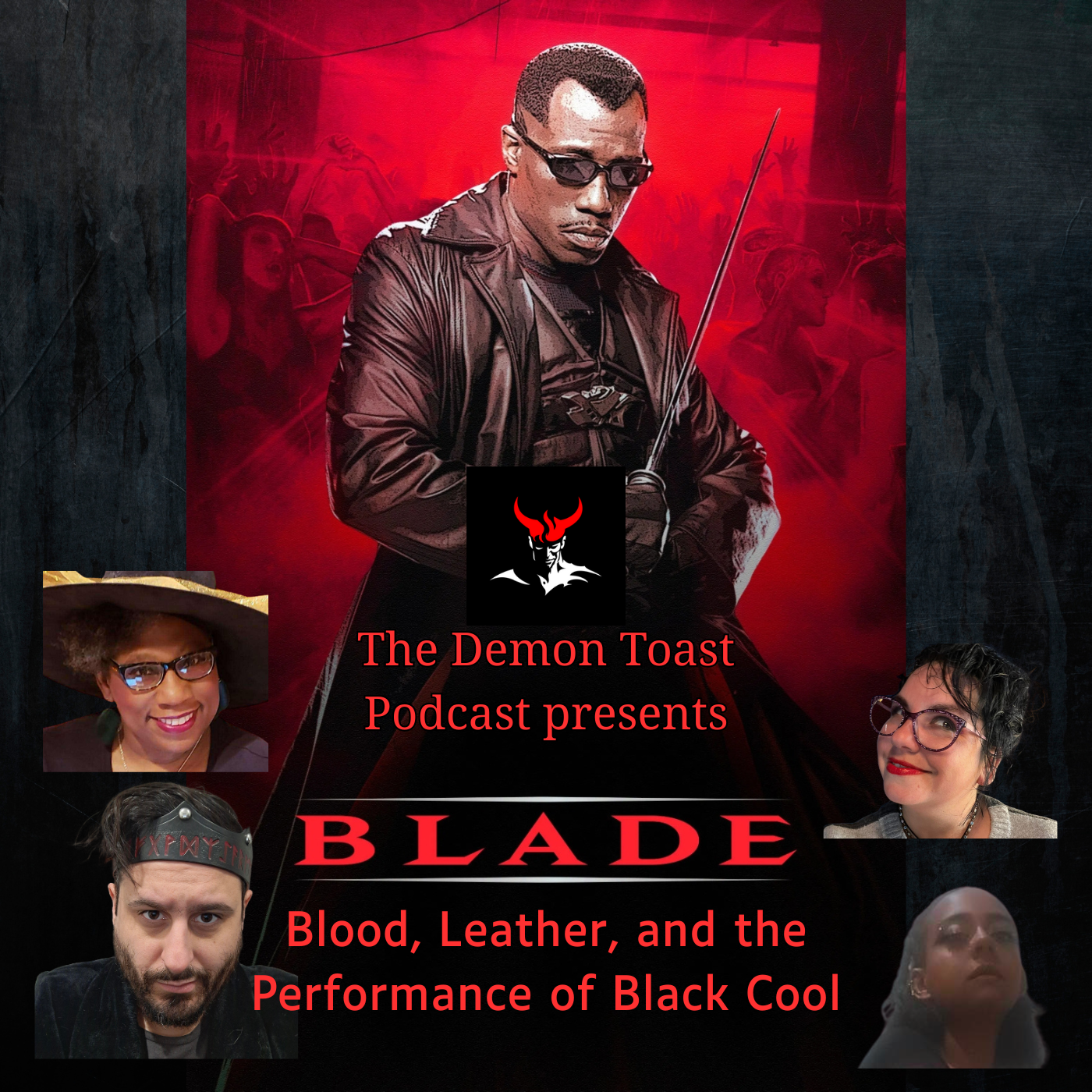
[00:02:16] Speaker A: All right. So, yeah. Welcome back to Demon Toast, the podcast for gothic and horrific literature. I am King Loki, the editor of Death Wish Poetry magazine, of which this is a subsidiary of. We're back to talk about Blade. Sadly, not the Blade from the Puppet Master series. I'm very. I'm heartbroken that we're doing not that Blade.
[00:02:36] Speaker C: We have or Blade the Immortal, which I'm just saying is phenomenal. It's one of my favorite.
You love me, you also hate me. It's fair.
[00:02:48] Speaker A: So we have Adrian, our co host, and we have Erica, our other co host and special guest, Miracle Austin.
[00:02:56] Speaker B: Hello. So happy to be here. Thank y'. All.
[00:02:59] Speaker A: Yeah.
So, yeah, I want to open up with this essay I found from a website called we are Parable, which I don't me believe is run by black people. This essay in particular is about Blade and his roots in exploitation genre movies. Blade's characterization also vastly differed from the traditional good superhero that we have seen so many times before. Traditionally, the male superhero is a hyper masculine figure. He is the defender of the damned and quintessentially masculine, meaning hard, strong, reserved and active, defined by their toughness and an overwhelming loyalty to whatever community they have vowed to protect. They are selfless, messianic cis, straight, and more often than not, white.
These masculine tropes are slightly problematized with black male superheroes. Even without superpowers, the black male body has always been regarded as a site of hyper masculinity, characterized by sexual veracity and intimidation.
And more often than not, black male bodies have been seen as both perpetrating and enduring tremendous violence.
The blaxploitation era that began in the 70s ushered a new type of black action hero on screen.
These action stars were unapologetically black, brimming with machismo, fighting against the system. Right. And he's talking like, not just the comic characters he's about to list, but like Shaft and I. I guess Dolomite. Dolomite's kind of ridiculous, but you know, Luke Cage, the first black Marvel character, That's not, that's not correct. That is wrong in 72 and directly channels energy of the blaxploitation genre. Similarly, the first Blade comics came out a year after the blaxploitation horror film film Blacula was released. One of the better entries into the blaxploitation canon, Blackula followed another enigmatic black vampire that ostensibly fought against a corrupt white police force.
Vampirism was a lens that explored Blade's duality, his in betweenness and otherness. Blade's own resistance to bloodlust comes from a serum that was developed by a serum. And this is in the movie created by a sickle cell researcher, a condition that predominantly affects the black community.
You know, blood acted as a metaphor for other anxieties. He goes on to talk about HIV drugs. That's and other things. But, you know, Blade's own form of racialized vengeance acts as a prototype for the angry anti heroes Killmonger and Candyman. The fearless genre blending of horror and action is one of the key components of its success. And it's something that can be seen in the most successful modern superhero films.
So he goes on to talk about black horror and its resurgence with, you know, the Jordan Peele produced stuff. But what do we think about that essay and its summation of Blade, the new Blade, the third incarnation.
Right. As we said before, the first incarnation is that guy that looks like Jim Brown from the tomb of Dracula. The second one is that angry, pissed off 90s guy with the motorcycle jacket. The third is Wesley Snipes. Adrian, you want to say something?
[00:06:08] Speaker C: I do.
[00:06:10] Speaker A: Explode.
[00:06:12] Speaker C: I'm not going to explode. It's fine. The fact that he's bringing up the Jordan Peele stuff, so get out is literally dealing with people's obsession with black bodies and, like, how we perceive them and like their idealistic idea, like how athletic, how this, how that. That's literally what the entire movie was about. So Jordan Peele really, like, keyed into that because, I mean, he's lived it, so it's. It's important. That's all I'm going to say.
[00:06:48] Speaker A: Fair enough. Erica.
[00:06:50] Speaker D: Just kind of bouncing off that last little bit there that Adrian was talking about with, like, the sensationalization of black bodies. I think part of the reason that was so important is because it's not something that affects just him in terms of the black community. It is something that affects all of us pretty deeply because, like, our ancestors were bred for the best genetic outcome.
And I feel like that hyper fixation has just kind of carried on and changed form a little bit in modern day. It's less so about, like, breeding in the best characteristics for working hands. Right. And like, aesthetics, what's going to be the most physically appealing to people both in and out of our communities? Because, like, racism is this big overt thing. Right. Like, I've heard on more than one occasion from people outside of the community, like, you're pretty for a black girl.
Colorism is equally difficult in that regard. Right.
Like, black people are also very conscious of their own bodies and other black people's bodies. And I think that's something that's also kind of important in the Blade franchise. Like, I really appreciated that essay for that reason because if you're thinking outside of just the, oh, this is like a vampire story with some fun action bits thrown in right there. Is a lot of kind of on the nose things that affect our community and were, like, big points of contention at the time, especially concerning, like, drugs and physicality.
[00:08:32] Speaker A: Drugs and physicality, yes.
[00:08:35] Speaker C: I will also say, like, I've had friends tell me that, like, usually in Hollywood and stuff like that, they cast lighter skin, dark people.
[00:08:48] Speaker B: Right.
[00:08:50] Speaker C: Wesley Snipes was not that he is black as midnight black as pitch. And it's fucking beautiful. Right? Like, he didn't even try to pretend to be anything that he wasn't in Blade.
And it's. It's a celebration of that in a way. And it's like, look at this hardcore motherfucking badass. He's. He's very obviously dark, and there is beauty in that darkness. And they use that darkness as kind of like a metaphor in the film in a way, like, it's magic.
[00:09:25] Speaker A: So no shade to Michael J. White, but, you know. Yeah. Spawn is, like, embarrassed to be black, you know, like.
[00:09:35] Speaker D: Yeah.
[00:09:35] Speaker A: He said he yells damn at one point just to let you know he's black. And, you know, it's like. It's like having to tell people you're the king.
[00:09:44] Speaker C: Yeah. Like, you shouldn't have to tell people you're the king. You should just know it.
Like, it's a thing.
Wesley Snipes, I'm sure, would have something to say about that. And this guy, like, I mean, he's super talented. He was very highly martial arts trained. And we're about to talk about the second one, and I have a lot of things to say about that because.
[00:10:09] Speaker A: Right.
Yeah.
[00:10:12] Speaker B: I wanted to weigh in a little bit both what Adrienne shared and Erica about colorism. You know, I was really shocked that Leslie Snipes was cast because of the shade of his skin.
I was like, oh, goodness of what's going to come of this. But I was so happy that he was to knock out that. How should I say? Assumption to have someone who was more.
Less darker than him. So it was beautiful to see that on screen.
I was so happy that they went that direction and also that he collaborated with the movie, with the producer. That made a huge impact. So I just want to add that.
[00:10:58] Speaker D: Huge point of empowerment. I think that's why it was so important to me as a kid and definitely so important for my dad to show me because it was like a direct representation for him that he had never gotten before then. It was something he got to share with me growing up and be like, this is what you have to look forward to.
Times are changing and they're not the greatest now, but, like, there's potential, there's hope.
[00:11:23] Speaker B: Hope.
[00:11:23] Speaker C: As a parent, I literally show my kids certain movies, like we literally just watched get out very recently because, like, I want them to see what hope looks like.
You know what I mean? And that's what Wesley Snipes was in Blade. He was literally like. I remember because this was like. Like I said, like, I was in high school when the first one came out. I was in college when the second one came out, and I thought, oh, my God, like, the world is getting better. It's so awesome.
[00:11:55] Speaker A: So I do want to say now that we're moving on to Blade two, I just want to say that Blade is the movie. It is the one that is the most magical for me, because it is the most love this character has ever gotten.
Like Thor, right? In the 80s, Thor had this wonderful run by Walter Simonson where his world exploded with life and color, and he came to life like never before. And the character has never died since then.
You know, characters sometimes have a seminal run. Blade has not had that in the comic books. In my oh so humble opinion is close. It's close. We'll talk about that. But Blade one, it sets up a world. It establishes him. And as I said in the first episode, it was his Robert Downey Jr. Moment where he's moved away from the Wesley Snipes a bit, you know, but it's still there. It was a push in the right direction.
With that said, Blade two, it's my favorite.
[00:12:55] Speaker C: It is my favorite of the franchise. I can't help myself.
[00:12:59] Speaker A: Fair. It is fair. It is. It has the highest production value. It's very good. And it's made by another beloved, you know, of. Of this show, Guillermo del Toro. I just fucked up his name. That's okay. I'm an idiot.
[00:13:13] Speaker C: Del Toro.
[00:13:14] Speaker A: Thank you.
He is one of my favorite directors.
I've got Hellboy behind me. Hellboy is my favorite comic book. Well, it's one of my favorite top three.
He is a very, very, very, very, very talented visual director.
I believe Cronus and Mimic were out at the time, and David Goyer, being a movie guy, knew those things and knew him and was like, direct this movie, you know? And the goal, once again, was to make the vampires more frightening. And this movie does edge very deep into the. Into horror imagery, as Adrian pointed out. And I saw when I rewatched the movie, it's very obvious this is a precursor to what del Toro would go on to do with the TV show the Strain.
If you haven't watched the Strain. Go watch the Strain. I have some issues with it as a Jewish person. They have an old man who isn't Jewish playing a Holocaust survivor. It's. It's fine. Whatever.
[00:14:11] Speaker C: But it's not fine. It's actually really gross. But the show has some qualities that are worth watching.
[00:14:18] Speaker A: It's a good show, so.
But Del Toro brought a lot of things to this movie. It's not my favorite, but it's fucking great. So Blade, I noticed, has red lining in his jacket, like Dracula's cape, and it gives him that extra shade of majesty to his baddest. Holy.
[00:14:39] Speaker C: She's got it, honey. She's got it. I told you.
[00:14:42] Speaker A: I think I need that.
Not really. Like, I have dolls. Hang on, hang on.
[00:14:49] Speaker C: So does she.
It's literally her favorite.
[00:14:53] Speaker A: Here's my Michelle Piper. Yeah.
[00:14:55] Speaker B: Oh, that's nice. Yeah.
[00:14:57] Speaker A: Yeah.
And so here's my Barbie. Here's my David Bowie Barbie.
[00:15:01] Speaker B: Yeah.
[00:15:02] Speaker A: I love. I love this Barbie.
[00:15:04] Speaker C: Why can't I steal that from you? If I'm gonna steal your hat, why can't I steal David Bowie?
[00:15:09] Speaker A: I don't know, Adrian. Why can't you?
[00:15:11] Speaker C: Oh, be careful. Might happen.
[00:15:15] Speaker A: Yeah. Yeah. You try it.
You'll give her a rude awakening.
[00:15:19] Speaker C: That's what you think. But, yeah.
[00:15:22] Speaker A: Yeah. Well, whatever. Miracle wins. Yeah. So, yeah, red cape. Let's see the RE strain. So the Reaper strain, they have, like, a horrible vagina mouth that opens and a tongue that shoots out and drinks blood. It's very cool. It's very neat. And they wisely use a lot of darkness for the cgi. And again, having. Everything I said about the first movie applies to this one in terms of the effects and the writing. 20 years of Marvel movies, right?
More and more CGI as we go along. And this movie, there are. There is a lot of cgi, but, like, they took a lot of influences. Del Toro, in particular, took a lot of influences from samurai movies and anime. There's this epic part where Blade and Whistler and all those motherfuckers are in their little vampire den and they turn on their. Their solar lights because vampires just showed up, and they're wearing, like, full body suits like. Like in the Day Walkers movie, Daybreakers movie. And, like, they pull out swords and they start having this, like, cool samurai fight in front of the bright lights.
And there's CGI for a lot of it, but it's well shot. Yes.
[00:16:29] Speaker C: Donnie Yen choreographed all of that. Donnie Yen is IP Man. He is a historically legendary kung fu artist. He studied under Bruce Lee. And he literally in the movie for a few minutes, the only person he didn't have to coach was fucking Wesley Snipes.
[00:16:49] Speaker A: Wesley Snipes.
[00:16:50] Speaker C: He already had the, like, training, so he's like, I don't need to touch that guy. But every dance in Blade two, every sword dance that they do, that is Donnie Yen's magic. And anyone who watches, like, Chinese beautiful movies like that, you know who I'm talking about? It is.
[00:17:17] Speaker B: It was.
[00:17:17] Speaker C: I had no idea he had done that. I looked it up. And he actually even choreographed the third one, too. He did both of them.
[00:17:25] Speaker A: So Ron Perl. So there. So Del Toro directing this movie. It adds more things. First off, Ron Perlman is here as the muscle. I believe his name is Reinhardt. He's awesome. He's excellent. Hellboy himself is in this movie. I call him Monster Face because, you know, he has a monster face.
And. And most importantly for me, Marco Beltrami, who did the soundtrack for Hellboy 1, does the music here. And he.
[00:17:50] Speaker B: He.
[00:17:50] Speaker A: He turns in. A very good, you know, very good effort. I think it's not as memorable as Blade Trinity, but, you know, That's okay.
Yeah. So I have a lot of things I wanted to say.
Lots of props. There's a gross dissection scene where they're taking the vampire apart and they're pulling his organs out. And, man, it's a great sequence. It's very gross.
The bad guys love blade sword. Interestingly enough, in the comics. In the 90s comics, his sword is made out of wood because he has to stake the vampires with it and cut their heads off.
[00:18:32] Speaker C: I will tell you that. Mythologically, like, I love that they did at least use silver. And if they're going to convert it, they use silver because it does actually kill vampires. And the way that they did that was great. But the whole comic thing with him using wood and whittling wooden knives and shit, that is absolutely the. That is monster hunter, like, mad, right there. The comic books where he does that, it is everything.
Dan had to send me, all the stuff. It is like, it blew my mind because that's, like, really like him just, like, whittling these knives.
It's one of the most beautiful moments in the comic books, but I do understand why. Because they were going for a more modern effect, so they wanted something that didn't. But they still did their research, Right?
[00:19:26] Speaker A: Yeah.
[00:19:27] Speaker C: So even though they didn't want to use wood and, like. Because wood breaks. Right. Like, let's not.
[00:19:33] Speaker A: Wood flakes. Yeah. Like, in the comic Book. He has, like, this huge, like, mound of wooden knives. He just sits and watches TV and whittles for hours on end. You know, it's.
[00:19:42] Speaker B: It's.
[00:19:43] Speaker A: It's in a comic that sadly only ran for three issues. It's heartbreaking.
[00:19:47] Speaker C: It was the best one, though. I did read them. It was the best.
[00:19:52] Speaker A: Incidentally, that is the comic book that proceed directly precedes the first movie. Let me grab. Let me. On the COVID he looks like Wesley Snipes. Here we go. All right, let me share my screen. If you're listening on Spotify, you don't get to see this. So, you know, you just have to take my word for it. But, yeah, some are always ice skating uphill. Yeah. See, as you can see right there. Right there. There he is. There's our boy.
[00:20:18] Speaker B: That's a good one.
[00:20:19] Speaker A: Yes, it is. It really. It really is. I mean, it's great. Yeah. This is the 23 book, the most recent book. This is from Night Stalkers, actually. That was. I think it ran for, like, 10 issues.
Oh, there's my girl again.
[00:20:32] Speaker C: Yeah, she's so hot, though.
[00:20:34] Speaker A: So there's his wooden sword. He. He carves, you know.
How do you say occult symbols onto it, too, because, you know, I don't know. I think it has to do with belief and, you know, the way they approach these things.
[00:20:48] Speaker C: And that's the thing about vampire films, especially recently, and novels as well. Like, they're acknowledging that there's different religions finally. And it's not about what you believe in, it's about your belief. But it's the same with Stephen King's.
Like, those kids literally believe that those things were gonna fight the monster.
It's what's in here that fights the monsters. Like, that's it.
[00:21:14] Speaker A: All right, so moving along, there are other things too. Like, Del Toro is really good at depicting monsters. There's a part where they have one of the reaper vampires, and they. They have to drink blood, right? Or they die. And they have him locked up, and he starts eating himself, and he looks so sad when he looks at them. It's this moment of. Of humility and humanity. And what. What you're. You take as a mindless monster, you know? And that comes from Del Toro's treatment of if you've seen the shape of water, you know what I'm talking about? That's his masterpiece, you know?
[00:21:46] Speaker C: Well, I hate to go back to the strain again, but it's like the Rupert Penny Jones character, who is, you know, the vampire that hunts vampires and that's literally what he does. He literally based that entire character off of what he did.
[00:22:04] Speaker A: So this is also the movie where Blade's glasses are kind of like Indiana Jones's hat. Like, at the end, I think Whistler tosses him his glasses, and he just catches them epically puts them on. Miracle. You want Miracle? You want to tell me about blade two and how you feel about it? 2002 is blade two.
[00:22:19] Speaker B: You know, I. You know, that was amazing. Just the vampires themselves and then introducing, you know, a new breed of vampires. You know, the Reapers and how they were so, you know, feral and, you know, cannibalistic and, you know, they. They crave blood. And not only did they, you know, feed on humans, they fed on vampires as well. And, you know, their population was just getting out of hand. And, you know, it was amazing. And the martial arts, you know, like, Adrian was talking about, you know, the choreography with that. Just to see that beauty on screen and. And more so in Blade two than Blade one. You know, I love that. I love to see that. And, you know, thinking, I can't think of the reapers, the. The main Reaper's name. I cannot recall his name right now.
You know, initially, I thought he was, you know, the antagonist, but in the end, it wasn't him. I don't want to ruin it for anybody, in my opinion, but it was this very powerful movie and just evolved from Blade one to Blade two and all the different characters and the personalities and everything that Blade had to deal with, you know, with that new vampire group.
You know, he was constantly, you know, on guard, but he knew what was going on. So, you know, that was amazing.
[00:23:46] Speaker C: I feel like there was a romanticism in that movie that was lacking in any of the other ones like, there. And, you know, like, I think that's one of the reasons why that one resonated so hard with me. Like, number two is my favorite there. This, like, morbidly romantic.
[00:24:04] Speaker B: Yes.
[00:24:05] Speaker C: Feel to the entire movie.
[00:24:07] Speaker B: Yes.
[00:24:07] Speaker C: It's super stylized.
It was, you know, like Matrix style. Like, super cool, but also, like, there's this heart in it that is missing from all the other ones. Like, it's not just an action film.
[00:24:24] Speaker B: You know, Adrienne, I was gonna share, you know, to see that soft side of Blade, you know, that's why I included my song when you asked me for my three songs for. For Blade, you know, sitting on the dock of the bay.
[00:24:37] Speaker C: But I knew that was the one, and I knew what movie it was.
[00:24:40] Speaker B: For, and that's why, because I knew his relationship and that end scene, just to see that, you know, I was, like, not expecting to see that from Blade, but to see that perspective, that was beautiful.
You'll know when you watch it.
[00:24:57] Speaker C: Yes, Erica. Blade two. Honey, that's the one.
[00:25:02] Speaker A: So, yeah, fair enough. I do. I do have a hard time with this movie because I do like it for its horror elements. I like it for its action. I do appreciate that there are some moments for Blade, but I feel like structurally and existentially, there isn't much that really happens for Blade and Whistler. There's nothing. There's not a true second act for this movie. Like, the movie itself has a second act. But for a second movie and what became a trilogy, we don't really move. He's a. Blade is a static character in this movie. And that's fine. This is. This ultimately boils down to a Blade adventure with the beginning and middle and end. And that'll bring us the Blade trinity, but we're not there yet.
Personally, I like this movie a lot, but, you know, I was looking for a little more characterization with the character and, like, characterization with the character. Anyway. Characterization from Blade. So I'm wondering if.
If you guys feel similarly.
[00:26:02] Speaker C: No, I feel like it added dimensions to the character that weren't there before.
[00:26:07] Speaker B: Yes.
[00:26:08] Speaker C: A romantic quality without the romance even. Like, that does not exist in any other Blade thing. It was really.
And I think this is a female perspective. Yeah, it was beautiful.
Also, I would like to add that Norman Reedus is in this movie. You know Daryl Dixon from the Walking Dead? Like, he's Scud. Like, Scud. We got him.
[00:26:39] Speaker B: Little mole.
[00:26:41] Speaker C: You know, it.
[00:26:43] Speaker A: It's very sad.
Slay Trinity is my favorite one. It feels like a true sequel to the first movie.
It's also the first. The only Blade movie that has the Marvel logo that I think appeared first in front of X Men. X Men or Spider Man?
[00:26:57] Speaker C: It was X Men.
[00:26:58] Speaker A: It was X Men. Okay. Yeah. X Men came out in 2000.
Okay. So this movie concerns the return of Dracula, who in this movie is an ancient Sumerian warrior who's a mortal and a vampire. He's played by Heat Wave from the Flash.
He has hair.
[00:27:14] Speaker B: He was an air.
Got that. Yeah.
[00:27:17] Speaker C: He's not entirely unattractive. But my favorite. I have two favorite parts, and it was Parker Posey being Parker Posey and fucking Natasha Leone, who I did not know is in that movie.
[00:27:32] Speaker B: Thought it was.
[00:27:32] Speaker A: I thought it was kind of funny that Blade was concerned with what the public thought of him. Like, he killed a human. He Gets tricked into killing a human and he's like, motherfucker. Like he's so upset and it's like I'm like, you kill people every day. Like you're just shooting on the street. Like, I don't. You know, it's like the Punisher.
[00:27:50] Speaker C: I think that actually was commentary.
[00:27:53] Speaker A: Sure.
[00:27:54] Speaker B: Okay.
[00:27:55] Speaker C: What do you got, a miracle.
[00:27:57] Speaker B: Well, you know, I'm trying to. Because it's been a while since I've watched Blade 3 Trinity and I'm trying to remember. I'm trying to remember there was a scene with a. With a baby, right?
Yeah.
And that.
[00:28:13] Speaker A: Dracula throws him a baby or steals.
[00:28:16] Speaker B: Yeah, it's right there.
[00:28:18] Speaker C: Book of Dracula. Like, it's fine.
[00:28:21] Speaker B: No, but I thought that showed another side of Blade. It did, it did. And I thought it was enduring to see that part of him because of who we know who Blade is.
[00:28:34] Speaker C: But, you know, they played way more human, like flawed. He's way more funny.
He interacts with people. He does sometimes some things that he wouldn't normally do to like, protect people.
Like. Yes, you are completely correct.
[00:28:55] Speaker A: Well, he's more of a superhero in this movie. You know, saving babies is something they do. Right.
So I also wanted to point out that Triple H from WWE is in this movie. He. I always thought Triple H looked like Lestat. So him playing a vampire, he's the muscle in this movie. There's always, always a muscle character in these Blade movies.
And it's Triple H in this movie. And he's. He's cool. I like him.
Let's see, what did I write here? Oh. So, yeah, this movie. Spoilers for, you know, a 20 year old movie.
The Death of Whistler, which I feel like really should have been the linchpin for the second movie. That is a classic second act thing. That's why I like this movie a lot.
[00:29:39] Speaker C: You know, what they did with his death and then making him this dark, evil, dark past kind of character was phenomenal. Actually. He's legit scary. Like when he shows up with the blind Natasha Leone trying to protect the little girl and everything. And you see him and you're like.
I feel like this is the first one that actually had like real horror elements as opposed to.
[00:30:11] Speaker A: Act Second one.
Second one had a lot of horror. Second one had a lot of horror.
[00:30:16] Speaker C: I mean, the second one had horror visuals, but it didn't have any of that emotional horror, which is what I look for in a good horror film. But this one, number three, with Whistler being like. And like you're terrified of him, but you also love him. And it's like, conflict.
Yes.
That was it.
[00:30:39] Speaker B: It.
[00:30:40] Speaker C: That was. That was it. And it's like, oh, no, don't kill the little girl. No, don't do it. But.
[00:30:48] Speaker A: Yeah. So that's the stuff I was looking for in the second movie that wasn't there. You know, those character dynamics, they were not there to the same degree as this movie. This movie ratcheted that stuff up. Also, this movie felt very much like.
It felt like what I kind of wish the MCU felt like. That's a big reason why I liked it. I connected hard with this movie. Like, there's that wonderful scene where Dracula goes into.
It's like a. Like a vampire souvenir store. They have, like, vampire vibrators. They're still in Count Chocula. Like, it is such a dumb scene. And I. I really wish that Dracula was wearing the cape and had the thing like in the comic book. But you can't have everything, right? You know, you get heat wave or you get that. And we got heat wave, so.
Right. So my other big note is that. Oh, there's a part where.
So Ryan Reynolds is in this movie, and he is a wonderful, wonderful foil for Blade, because Blade is. He's hard as nails. He doesn't take anyone's. He's aloof, he's cold, he's calculating. And Ryan Reynolds is cracking jokes.
He's. He's just as sharp as Blade.
Yes. Miracle. What are you trying to say?
[00:32:02] Speaker B: No, it was just a nice balance to see that.
[00:32:04] Speaker A: Nice balance, right.
Yeah. It's like when Thor teams up with Hercules because Hercules is a goofball. And Thor as well. He's Thor. Right. You know, so he's playing the character of Hannibal King in the comic books. Looks a bit like John Constantine. Even though he's older than John Constantine. He has turned into a vampire and then cured, but still keeps his powers. It's very weird. Comics are stupid.
He could turn into mist. He doesn't have to drink blood. He can go in the sunlight, and he can command the creatures of the night like any vampire. He's very cool. Looks a lot like that. Yeah, right.
What did I write? Hannibal King, He. Oh. He appeared in the Tomb of Dracula, issue 25.
[00:32:49] Speaker B: So I would love to see a story on him, too. I don't know if they'll ever do it, but.
[00:32:55] Speaker C: Well, no. Ryan Riddles has an interesting sense of humor.
[00:33:00] Speaker A: He's great.
He's truly great. I love Ryan Reynolds. I love him in this movie, too.
[00:33:06] Speaker C: Oh, it's Ryan Reynolds movie that I remember seeing. It's the first time he ever made an impression on me.
[00:33:14] Speaker B: Oh, okay.
[00:33:17] Speaker C: He was, like, sassy and funny, and the juxtaposition between him and Blade's.
[00:33:24] Speaker B: Cool.
[00:33:25] Speaker C: Cool. You know, it was amazing.
[00:33:28] Speaker B: Yeah.
[00:33:28] Speaker A: I mean, he was really good in X Men Origins. Wolverine.
Yeah. Yeah. I'm just joking. So anyway, yeah, and there's a wonderful sequence where Ryan Reynolds is like, you got to understand Dracula's back. And Blade just goes, huh.
So then Ryan Reynolds hands him.
[00:33:46] Speaker C: Probably my favorite part. I will say Parker Posey is an epic vampire badass chick, but also she's hilarious. She has that sense of humor with her dogs, the vampire dogs. And I know they were just going off of Resident Evil with the zombie dogs, but it was still kind of cool in the way that Ryan Reynolds, like, made the dogs go away.
[00:34:18] Speaker B: Yeah, that was neat, huh?
[00:34:20] Speaker A: So, yeah. So Ryan Reynolds hands Blade.
He says, dracula's back, and Blade goes, are you kidding me? And he hands him a Tomb of Dracula comic book, and he looks at it and just throws it.
Great.
[00:34:34] Speaker B: Great about that. Oh, my gosh. I'm gonna have to. I'm gonna have to rewatch that.
[00:34:37] Speaker A: Please re. Watch it. So what I love about this movie is it was directed by David Goyer. And again, this movie is punchy. It's exciting. It's fun.
I do think it's funny that. So they. They say, oh, Blade, Blade. Dracula is a Sumerian warrior. They called him Dagon. Also they called him Drake. And I'm like, did they?
[00:35:01] Speaker C: Drake?
[00:35:03] Speaker A: I also like that he's like, he's from Sumer, but he's like some white guy. Like, you know, I mean, he's not white.
[00:35:09] Speaker C: He's Latino.
[00:35:10] Speaker A: Dominic Purcell. Oh, Dominic Purcell is Latino.
[00:35:14] Speaker C: Listen to his name. And then you tell me, I don't know.
[00:35:17] Speaker A: I don't know things. Okay, okay, okay, question.
[00:35:21] Speaker B: Do y' all think Dan and Adrian, do y' all think Blade three should have happened before Blade two?
[00:35:30] Speaker C: Yes. Hundred percent.
[00:35:32] Speaker A: I do. I do. I do. I just feel like there's so much character development in this movie, and the world really explodes, and the way that the second movie didn't. The second movie is so good. It's so gothic. It's so fun. It's so well done. It adds so much to the character, but at the same time, it feels very localized.
Yeah.
And like, if each movie was its own little world, that would be fine. That's what Mad Max does. Right.
But this movie feels like a direct continuation of that first movie. And it's so good.
Flip to cat. Oh, he does this epic flip flip. So Dracula steals a baby on the roof and he throws it and it's Blade can't just catch the baby. He has to do an epic flip and then catch the baby.
Doctor. Oh, Dr. Vance. Yeah. This psychologist has a huge office. What's up with that? Like, you know.
[00:36:24] Speaker C: Okay, the blind, played by Natasha Leone. And I'm just gonna say that, like, she's probably one of my favorite actresses on the entire world. And I guess this is the first time I saw her, but I did not remember that it was her. But I knew, like, she was my favorite character in the third film.
[00:36:41] Speaker B: Okay.
[00:36:42] Speaker C: Forgot it even existed until I rewatched it. And I was like, oh, my God. Of course she was like, of course she was my favorite because it's Natasha Leone.
[00:36:54] Speaker A: So there's a scene where he's talking. The little girl is on a little girl. He's taking his medicine because Blade doesn't drink blood.
[00:36:58] Speaker B: He has a.
[00:36:59] Speaker A: He has a serum he takes. And the little girl says, why are you doing that? And he says, you know, because if I don't take it.
Yeah, you know, you won't like what happens. And she goes, why can't you just be nice? And he goes, the world isn't nice.
[00:37:13] Speaker C: That I feel, is a commentary on the whole fucking world.
[00:37:17] Speaker B: Yes, that is true. Also.
[00:37:20] Speaker A: Also.
So my, my favorite quote from the movie is where they're. They have. They have the bad cop. And he's like, tell me what's in that building. And he goes, I can't. Don't kill me.
They'll kill you.
I'll kill you.
It's great. It's so funny. It's so frank. It's on the point, you know.
[00:37:40] Speaker B: Okay. When he said, you know, he had like 10 seconds. Is that you have, you know, count to 10.
[00:37:45] Speaker A: Yeah.
[00:37:46] Speaker B: One, two, 10. I love it.
[00:37:48] Speaker A: Right in the head. Yeah. Great.
I like Dita Von Teese Lady Zettle. Natasha Leone.
[00:37:55] Speaker C: No, she's the blind chick. Natasha Leone is the blind chick that protects.
[00:37:58] Speaker B: Okay. Yes.
[00:37:59] Speaker A: All right.
[00:38:00] Speaker C: Super sex. Like, no. Yeah.
[00:38:03] Speaker A: All right, well, I like when Ryan Reynolds calls the Dita Von Teese lady a horse humping bitch in a juggling thundercunt. That's.
[00:38:10] Speaker C: That's Parker that he's talking to. And she is iconically strange and wonderful. And I just suggest everyone go watch Party Girl or I White Lotus. She's just phenomenal.
[00:38:29] Speaker A: So my last note, My last note before we discuss the movie in more detail is the soundtrack.
[00:38:38] Speaker B: I have not listened to the entire soundtrack.
[00:38:40] Speaker A: Look, I got two. I got one big song. RZA from Wu Tang Clan, he has a song called Fatal and it's about Blade. It plays at key points in the movie and it plays during the end credits. It's like, try to say my name. That's fatal. Bite through your jugular, that's fatal. It's really cool.
[00:38:59] Speaker B: I'll listen. I'll definitely listen to it.
[00:39:02] Speaker A: Yeah, it's really good. Also, Raymond Jawadi, who did music for Game of Thrones, he also did a song. This has probably my second favorite soundtrack, right behind the Crow.
[00:39:12] Speaker C: So I will say one of my favorite bands that is very not known, Black Lab actually did the music for the scene during the motorcycle chase in the beginning of the third movie. Like, they literally made the song specifically for that. And I was talking to them when they were making the song, and it was so cool. But the song is fantastic. But they're like a gothic dark band anyway. So the fact that they mix like the. The epic, like hardcore rap, Wu Tang Clan, which is like, iconic, and then like weird stuff like Black Lab.
[00:39:55] Speaker A: Yeah, yeah, it's.
[00:39:56] Speaker B: Well, it's. It's.
[00:39:56] Speaker A: What it is is it's the genius of David Goyer and Wesley Snipes because David Goyer understands the comic book and the horror element, and Wesley Snipes understands Blade and what he's doing. So, yes, they bring in all these people and they're like, you know what we're doing too, don't you?
[00:40:14] Speaker C: I actually own the Blade.
[00:40:17] Speaker A: Let me, let. Let me read the. The lyrics because it's. It's really good. This is for Fatal. All right, so they. They chant Day Walker. First they. They open with Blade. Ready to die. I was born ready.
It's the feast of blood with sin. Unleash the beast within. I walk around with the strength of a hundred men. You best to run before I count to 10. Blood dripping from my canine like a fountain pen. It seems I've been asleep for a thousand years. The way my world has changed it. Bring me a thousand tears printed darkness. They walk through the rays of light to this breed of vampire I'm the prototype. The shape shifting mirror image flash phototype to everlasting last and original red blood O type. He was born perfect like the great white shark. This guy has never had to evolve, right? Quote and then they chant daywalker. Try to use my name, that's fatal. Tried to claim my fame but that's fatal. About to bring the pain that's Fatal bite through your jugular vein, that's fatal. Try to use my name, that's fatal. Tried to claim my fame, but that's fatal. Right, and that's largely the song. Oh, wait, hang on.
They have blades. Quote, you're not immortal. I must have heard hundreds of rodents make the same claim. And each one of them tasted the bitter end of my sword. I strike back with the vengeance the father of your descendants. And I can't be deflected by your silver cross pendants blurry holy water. You make the false images. One swing from the sickle, your life diminishes. Stinging like the scorpion strike with the force of 10. 10. My blood is known to revitalize corpse of men. In the last days they said the dead would walk again. The blind, the deaf and the dumb will talk again, Daywalker. And obviously.
[00:42:00] Speaker C: Because that's got, like, real mythology in it, and that's.
[00:42:05] Speaker A: It's about Dracula, obviously.
[00:42:08] Speaker C: Like, so. Obviously. But also, like.
[00:42:11] Speaker A: Yeah, so this is rza, the master of the Wu Tang Clan. So, yeah, I. I'm not as. I. I've been listening to the song, like, obsessively since I watched the movie.
[00:42:22] Speaker B: So I love. I'll definitely be listening to it later.
[00:42:26] Speaker C: Yeah, me too.
[00:42:28] Speaker B: You too, Adrian. Yeah.
[00:42:30] Speaker C: Oh, yeah. 100.
That's gonna. Oh, my God. I think it's actually gonna go on my Halloween mix this year. Oh, listen to it.
[00:42:38] Speaker A: Yeah, yeah. It's on Spotify and stuff. So. Okay, so those are my notes for Blade Trinity. Now I want to talk a little bit about the future. I want to talk a little bit about your feelings. Right? All right, so, yeah, Blade Trinity. Very cool. Do check it out.
[00:42:55] Speaker D: Yeah.
[00:42:56] Speaker B: So.
[00:42:56] Speaker A: So Blade would be seen in comic books here and there over the years. I mean, you know, there was the Blood Hunt crossover, which. It's only four issues. Go read it.
Now, there's been talk about, as we said in Part one, Mashallah Ali playing Blade didn't happen. Right.
But it might still happen someday.
[00:43:15] Speaker C: Who the knows recently about Michael B. Jordan playing Blade?
[00:43:21] Speaker B: I know, right? You know what? Someone was.
Someone was talking about that. I can't remember where were they really?
Sit one more time.
[00:43:30] Speaker C: Were they really talking about that? Because I feel like on Facebook.
[00:43:34] Speaker B: Facebook, not like, not gonna happen.
[00:43:36] Speaker A: Yeah, it's. It's all cake. It's all fake.
[00:43:38] Speaker B: But I know I would love to see that. But he's good.
[00:43:43] Speaker C: Michael B. Jordan.
Make a Blade movie. Ryan Coogler, you could do Blade and you could rock it.
[00:43:50] Speaker B: Yes. Now, that's what I do agree. I would love to see a collaboration with Coogler and Goyer.
[00:43:56] Speaker A: Coogler.
[00:43:57] Speaker B: Coogler.
[00:43:58] Speaker A: Coogler is a. Is a.
What's my word? He's a.
He's an auteur. He's a brilliant filmmaker.
[00:44:05] Speaker C: He's a savant. He's just.
[00:44:07] Speaker A: Now, let's talk about Deadpool and Wolverine. Okay.
We don't have a lot to say about Deadpool and Wolverine. It is not relevant to our vibe. It is off brand.
[00:44:17] Speaker C: It is minus, minus one moment in Deadpool and Wolverine.
[00:44:23] Speaker A: Quiet, quiet, quiet. Let me do my thing. Come on. Stop it. Let me introduce it.
It's not on brand for Demon Toast, but it has Blade in it. So we're here to talk about it.
Yeah. So because of multiversal shenanigans, Deadpool and Wolverine wind up in some, you know, liminal space where forgotten movie franchises go to die. And he meets several people. He meets the. The Chris Evans, Johnny Storm. He meets Jennifer Garner's Elektra.
He meets the Gambit that never was. I don't know why they didn't use Taylor Kitsch. It's fucking bullshit. But they have Channing Tatum as Gambit and they have our own Wesley Snipes as Blade.
And Deadpool says, you know, you're very well regarded. And he replies, retarded. And he goes, no, well regarded. He goes, okay.
Like, you can't hear him. Like, he's not that old.
So I don't know. How about it?
[00:45:28] Speaker C: My favorite part of that whole thing was he was like, I don't like you.
It's Ryan who is in the Blade movies. And he's like, yeah, you never did.
[00:45:43] Speaker A: You never did.
[00:45:45] Speaker B: Yeah, that was classic.
[00:45:47] Speaker A: It's really funny. Yeah, it's really funny.
[00:45:51] Speaker B: I like that.
[00:45:51] Speaker A: The other hilarious part is where they're talking, oh, you know, there have been so many Punishers and Deadpools that have come through here. And Wesley Snipes goes, there's only one Blade.
And Deadpool looks at the camera like, because there's supposed to be a Marvel Blade the next year.
[00:46:08] Speaker C: He is Blade. He's literally.
[00:46:10] Speaker B: Yeah.
[00:46:11] Speaker C: At least he embodies.
[00:46:13] Speaker A: Yeah, yeah, yeah.
You know, so that's all we have to say about Deadpool. Wolverine. I mean, there's also the TV show starring Sticky Fingas. It is very good. It's my favorite Blade ever.
His tattoos are awful, his hair is non existent, and his coolness is. I really hate to trash the guy, but, you know, it's such a bad show. It's like worse Than that CW garbage. That Arrow, Flash stuff, you know, you.
[00:46:41] Speaker C: Should just say Supernatural, because at least that one's, like, mildly watchable. And by mildly.
[00:46:48] Speaker A: Yeah, but I'm not talking about the good ones. I'm talking about, like, the superhero trash. Like, the Flash is good for, like, two seasons maybe. Then, you know, everything else is so, like. Yeah, yeah, yeah. So this was on Spike tv. It is not really worth your time. It's supposed to be a follow up to Blade Trinity. I don't know how.
My last bit of trivia is that Blade two was supposed to have Morbius in it, but Marvel said no.
We are developing a movie about Morbius, and we don't want it to be influenced by this. And I'm glad they did that because we got a great Morbius movie.
[00:47:23] Speaker B: And you know what? I'm just kidding.
[00:47:25] Speaker A: I'm just kidding. I fucking hate that movie.
[00:47:26] Speaker C: Yes.
What were you say?
[00:47:33] Speaker B: Just real quick, at the end. Was it the end of Blade one? Yeah, I'm trying to remember. They were saying something about Morbius on that at the very end.
[00:47:41] Speaker C: They literally were. You are not that totally happy.
[00:47:45] Speaker B: Yeah.
[00:47:45] Speaker A: He's played by the director of the movie, incidentally.
[00:47:48] Speaker B: Oh, yeah.
[00:47:49] Speaker A: They don't name him Morbius, though. It's just vampire in Romania or something. Or wherever the hell they are. Yeah. I love Morbius, by the way.
[00:47:57] Speaker C: Romania is like the birthplace of the modern vampire, like the European vampire that we have. That's. It will always be Roman, of course.
[00:48:07] Speaker A: Morbius is not.
Is not a. Remain a Romanian vampire or really a vampire. He's a living vampire. He's a science vampire. And it's a shame that movie never got made because I love Morbius, and someday maybe we'll get a Morbius movie, you know? Adrian, what do you want to say?
[00:48:23] Speaker C: Because we're completely like. The other thing that you guys are gonna say, and all of you guys are gonna, like, be like, no, that doesn't exist. It just doesn't exist.
[00:48:32] Speaker A: What are you talking about?
[00:48:34] Speaker C: I'm talking about nothing. There's nothing.
[00:48:36] Speaker B: There's no.
[00:48:37] Speaker A: There's no more. Marvel was gonna make one, and then they didn't. And then. Sony, I think they. They cast. I don't know. It never happened. I don't know. Whatever.
Oh, God. We didn't say this in the first episode. Blade's mother was attacked by a vampire and.
Yeah. It wasn't. It wasn't Morbius. Is that what you meant?
[00:48:55] Speaker C: Someone that is half human and half vampire. Very rare thing. And that is what a damn Fear is that's.
[00:49:02] Speaker A: I don't think Morbius can turn people into vampires.
[00:49:04] Speaker C: He's not a real vampire because he's a scientific vampire, kind of.
[00:49:08] Speaker A: He's a science. He's a science pyre.
[00:49:10] Speaker C: Yeah, he is a science pyre. But that's also part of the thing because Morbius is also part human and part vampire in a way. And that's why Blade and him are like sides of the same coin.
Like, they're literally like Blur. Yin and yang.
[00:49:29] Speaker A: Yeah. So I do recommend reading the rise of the Midnight Suns storyline. It runs through Ghost Rider comics. Blade comics. Blade had a comic called Night Stalkers with Hannibal King and Frank Drake and Morbius. Morbius had an ongoing in the 90s. It's. It's pretty good. I mean, I love Morbius. I'm a big fan of the character. I love him and.
Well, maybe someday we'll get a live action Midnight Suns. Now there is a Midnight Suns game which I didn't talk about. It has Blade. It has Deadpool. It has fucking Ghost Rider. It has all these characters. It has Morbius, too. And they're all delightful. The writing is excellent. They fight vampires in it.
[00:50:12] Speaker B: They're.
[00:50:12] Speaker A: They're there to fight Lilith. She's the big Bad. That sexy fishnet lady that I keep showing.
Here she is again.
[00:50:19] Speaker C: Horns that are fantastic.
[00:50:22] Speaker A: Makes me horny. Yeah. No. So, no. But yeah. I mean, maybe someday all this stuff will happen. I don't know. But I do recommend playing the Midnight Suns game. Blade is very much the Midnight. He's very much the Wesley Snipes Blade. But you can do much worse.
[00:50:40] Speaker C: No, honestly, I don't think you can do much better.
Wesley Snipes is Blade.
[00:50:47] Speaker A: He's very good.
Now, the. You know that the 2023 Blade book, he seems to have moved beyond being Wesley Snipes, but he acts very much like that character. And the influence is undeniable. And I think that that's a good place to stop because, frankly, the big centerpiece for these episodes are the. Are these three movies. They are brilliant. They define the character in a way that none of his comic books really had. They were edging towards it and kept getting canceled.
Night Stalkers is not bad. But, you know, Blade spends a lot of time fighting demons that. Each one has a different power. One of them looks like a mummy, you know, one of them looks like a zombie. He fights vampires here and there.
It's very trashy stuff. It's very pulpy and it's. It's okay, but it's it feels like filler for a real book, which didn't really come until. Well, we're still waiting for it, but.
[00:51:44] Speaker C: Yeah, about that.
[00:51:47] Speaker B: Yeah.
[00:51:48] Speaker A: I was going to say. I was going to ask if Miracle had any closing thoughts.
[00:51:50] Speaker B: Yeah, I just want to share one of my favorite lines from the Blade series, please. At the end, please.
[00:51:56] Speaker A: I'll cut my last thing.
[00:51:58] Speaker B: My favorite line.
And this is Blade.
There are worse things out tonight than vampires. Like me.
[00:52:07] Speaker A: Me.
[00:52:08] Speaker B: Love that.
[00:52:09] Speaker A: It's pretty cool.
[00:52:11] Speaker C: Because it's.
He's got to wear shades.
[00:52:15] Speaker B: Yes.
[00:52:16] Speaker C: You know what I'm talking about.
[00:52:18] Speaker B: Coolness.
[00:52:19] Speaker C: Yeah, I know.
[00:52:21] Speaker A: Mortal. The mortal power of cool.
The mortal magic of cool. That's it. It's from a Thor comic. Okay.
[00:52:27] Speaker B: Yes. Like that.
[00:52:28] Speaker A: Because they made. They made. They made Sigurd Black in the Thor comic, you know.
[00:52:32] Speaker B: Yeah.
[00:52:33] Speaker A: Yeah.
So. Yeah. So, Miracle, do you want to close us out with some closing thoughts on Mr. Blade?
[00:52:41] Speaker B: I tell you, I've watched a lot of movies over the years, but Blade is one of my favorites of all time, just because of who he is, what he embodies, and he's so strong and powerful, and so he's. He just will always be one of a whole dear to my heart.
Always. And I always talk about them whenever I have the opportunity, whenever I'm at comic cons or book festivals. And, you know, one of my questions that I do, I do this workshop, you know, for teens.
And I have a lot of fandoms. And so the last question that I have been asking, I'm change it up, of course. But I asked them which Marvel characters saved Marvel?
And I can tell you most, no one has got it right yet.
[00:53:36] Speaker A: They all say Spider man, don't they?
[00:53:38] Speaker B: They either. It's Spider man or Iron Man.
[00:53:43] Speaker C: Yep. That was the one I was gonna say.
[00:53:45] Speaker A: Because they're thinking of the movie. Right, right. That was 2008. That's. Yeah. Marvel was in the 90s. Yeah. Yeah.
[00:53:51] Speaker B: So, yeah. So anyways, I always include him however I can.
[00:53:56] Speaker A: So 1.
[00:53:56] Speaker B: That's how much I love him.
[00:53:58] Speaker A: Absolutely.
Absolutely.
Adrian, you have a closing thought about Mr. Blade.
[00:54:05] Speaker C: I just want to say, all of you amazing writers and comic book artists, do something with this character.
Yes, please make something. Make something that matters. Give him the, like, justice he deserves. Like, come on, guys. Your future so bright. You got to wear shades. Like, give us some Blade. Like the real Blade. Like, make it happen. We're here for it.
[00:54:33] Speaker B: Absolutely.
[00:54:34] Speaker A: The Brian Hill book wasn't terrible, but on the other side of that, when you see Blade on the stands. Buy him because you're part of the problem.
You know, like, give it a chance. Like, they gave him a book in 2023. I guess it was just a mini, but he could have gotten an ongoing.
[00:54:50] Speaker C: That said hashtag buyblade.
[00:54:55] Speaker A: Hashtag buyblade, Hashtag by Blade.
Yeah. Yeah. So I have talked a lot. So I think that's. That's it.
I am Daniel Sarkalov. Go read my
[email protected] deathwishpoetry.com check out the brilliant writers we highlight and spotlight and love very much. And Adrian is, of course, the chairperson and founder of the Horror Film Art Society of Amarillo, Texas.
[00:55:23] Speaker C: Adrian, you want to tell us about that this month? Like I said, we are doing she is Conan. But by the time this episode hits, we will be in spooky season. So I'm going to do something really crazy, and we are each going to choose an episode of the podcast Scared to Death.
And I want everyone to do, like, choose an episode, do a painting based on one of the stories in each episode. Because they've got, like, between five and six. Like, let's do it. And we're gonna do this amazing show, and we are going to be sending it to Scared to Death.
It's going to be phenomenal. Guys, this is, like, a huge thing.
So bring on your spooky guys. Bring it on.
[00:56:13] Speaker A: Miracle is of course, an independent writer, much like myself. Miracle, do you want to tell if you'll vet your writing and where you could be found?
[00:56:20] Speaker B: Yes. I'm a young adult, new adult horror supernatural author. You can find me on Amazon.
I am on Facebook as MiracleAulson, author. Instagram mostly. But my Instagram Twitter handles are Iracle Austin number seven.
[00:56:35] Speaker A: So beautiful.
[00:56:36] Speaker B: Check me out. And I appreciate y' all both very much.
[00:56:39] Speaker A: Thank you. Thank you, Miracle.
[00:56:41] Speaker C: Some of Miracle's short stories are some of the most intensely amazing things I've ever read.
So, guys, seriously, go check it out.
[00:56:50] Speaker A: Yeah, maybe we'll cover them on stream. All right, so that said, write poetry, make art, love your demons. Ave Satanas. Blade.
Ready to die?
I was born ready, motherfucker. Sa.
[00:57:28] Speaker B: You.
[00:57:39] Speaker E: It's the feast of the blood for sin. Unleash the beast within. I walk around with a strength of 100 men.
You got to run before I count the 10 blood dripping from my canine like a thousand pen it seems I'm in a sweet 4,000 years the way my world has changed it. Bring me a thousand tears. Prince of darkness they walk through the rays of light to this be the vampire of the prototype the shape shifting mirror image flash prototype? The everlasting division. The red blood type was born perfect.
[00:58:11] Speaker A: And just like the great white shark? The sky has never had to fall.
[00:58:44] Speaker E: Ain't my fam but that's fatal about the reigns of pain that's fatal? Right through your juggle of pain, that's fatal? Try to use my name, that's fatal? Try to claim my fame? But that's fatal about the brain the pain, that's fatal? Bite through your juggle of veins that's fatal?
Come on, walk with me, Come on, walk with me? Come on, walk with me, walk with me? Come on, walk with me? Come on, walk with me, Come on, walk with me, Walk.