Episode Transcript
[00:00:00] Speaker A: So basically what I'm hearing is you're not going to be dancing like Kiddleston's character in Flanagan's hit movie.
You know,
[00:00:07] Speaker B: I'm not even allowed to take hops and jumps and skips.
[00:00:11] Speaker A: Oh, my gosh.
[00:00:12] Speaker C: What was I
[00:00:13] Speaker B: doing? Butt wiggles, though.
[00:00:14] Speaker A: Oh, the Life of Chuck. Yeah. Yeah. My favorite Mike Flanagan product project. Yeah, you know, the classic.
[00:00:20] Speaker B: Hey, I liked it.
[00:00:22] Speaker A: I know, I know. It's very sad.
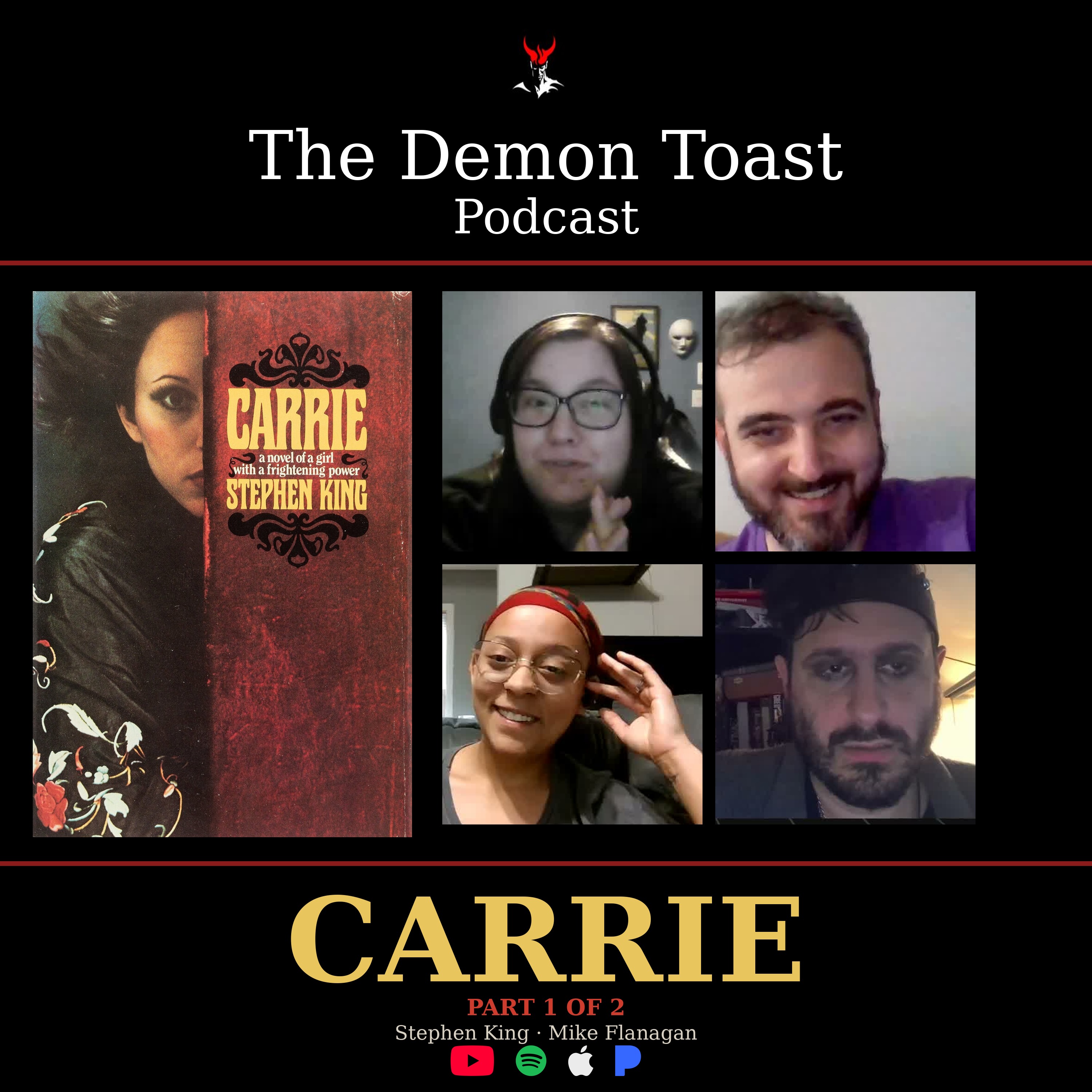
Speaking of Mike Flanagan, welcome to Demon Toast. This is a podcast for Death Wish Poetry magazine. We talk about gothic and horrific literature. I'm your host, King Loki, and let's see, we're going to be talking about Mike Flanagan's newest show, Carrie. Also, we'll touch on the book, I'm sure.
With me are my co hosts, Marissa, Erica, and very special guest, Justin. Marissa is a poet, artist, photographer. Erica is a poet and brilliant person, and Justin is a professional. My boyfriend. Oh, I'm sorry. He evolved recently.
He is my fiance now, so. Yeah. How's everyone doing?
Yeah.
[00:01:07] Speaker D: Congratulations, by the way. I'm so excited for you guys.
[00:01:11] Speaker C: Thank
[00:01:11] Speaker A: you. It's been a while, but. Yeah, it's been like, a few months, but, yeah. Thank you. Thank you. It's great stuff.
Yeah. I'm expecting this to drop around Thanksgiving, so nothing, you know, nothing better to talk about during the holidays than, you know, the. The.
[00:01:25] Speaker B: I'm wearing my Happy Horror Days sweatshirt.
[00:01:29] Speaker A: Very nice.
[00:01:29] Speaker B: I'm ready. I'm ready for.
Let's go.
[00:01:33] Speaker A: Hell, yeah.
Yeah. Talking about misfits. Psychic girls who are villainized, monsterized, splattered with pig's blood.
Yeah. I think everyone knows the story of Carrie at this point. It's like a modern myth or something, you know?
[00:01:51] Speaker C: Yeah.
[00:01:52] Speaker A: It feels as universal as Spider man or that. That dude on the stick. I don't know. I don't know what his deal is, but, you know.
[00:01:59] Speaker B: Well, I mean, there's been so many adaptations at this point.
[00:02:01] Speaker A: Oh, yeah, that's true.
Speaking of which, I actually haven't seen the.
The Chloe Grace Moretz directed by. No one is a remake. I don't know. Has anyone seen that
[00:02:14] Speaker D: since the 2013 movie? I think that was the first. First one that I saw.
[00:02:20] Speaker A: Yeah, naturally.
No love. Was it good?
[00:02:25] Speaker D: It's okay.
I think they're definitely better adaptations.
I don't think it touched on the source material as well as it could have.
[00:02:37] Speaker A: Okay.
Yeah. Back when Chloe's. Chloe Grace Moretz was everywhere.
Justin, I'm gonna guess you haven't seen it, right?
[00:02:45] Speaker C: I haven't seen It. I think the only actual adaptation of Carrie I saw was this show.
[00:02:51] Speaker A: Oh my God.
[00:02:52] Speaker C: And for a while, until I realized it was actually a sequel and not an adaptation of the book, I thought I. The only thing I'd seen before that was Carrie 2 the Rage,
[00:03:05] Speaker A: which is technically officially called the rage Carrie 2. There's a colon in there which is very funny.
She's like, Carrie's like cousin. I don't know. It was the first one I saw and I liked it. It had a very nice, nice lady at the end when she freaks out, her tattoo spreads across her body, which is also very nice. Very into that. She kills a lot of people with CDs because it's set in the 2000s. Marissa, have you seen the Rage Carrie 2?
[00:03:31] Speaker B: I have not seen that one. I have seen two of the movies.
The one we were talking about from 2013, the older one.
And then obviously I watched the show. I also did read the book and I actually personally found the book abhorrent.
[00:03:52] Speaker A: Well, we'll get into that and so much more.
But yeah, yeah, as far. So for my money, it's gonna be the Brian De Palma movie. The classic one From I guess the 80s, you know, where no one is a teenager.
Probably for the best. There's a lot of nudity in it and you don't want to be looking at young girls.
[00:04:11] Speaker B: Right?
[00:04:12] Speaker A: Yeah. That being said, the.
The new Mike Flanagan adaptation is probably the best adaptation until its final episode. So, you know.
[00:04:22] Speaker C: Well,
[00:04:23] Speaker A: yeah,
[00:04:24] Speaker B: I mean, I think that's an opinion based thing.
[00:04:28] Speaker A: Well, we'll get into that and so much more, as I said. But Marisa, why don't you tell us why you dislike the book so much? Cause my friend Liz had a very similar take recently.
[00:04:38] Speaker B: So here's the thing. The Carrie book, I first read that when I snuck it home from the library as a teenager because I was not supposed to read those books.
But a bunch of my friends were like, oh my God, this dude, Stephen King, he's great. And I found that one. And I was like, okay, cool, we'll start with this.
But there are so many things that are just so fucked up. And I know it's horror, I realize that it's supposed to be horror, but there are just so many things that are so fucked up in the portrayal
[00:05:20] Speaker A: in
[00:05:21] Speaker B: that book.
Both. Like, I don't feel like there's a solid understanding and it may have been a man writing women situation for me because I don't feel like there was any grasp of what existence as a woman is. In that book, it all came off to me as an external thing because all the girls in school are pretty girls, and Carrie's the ugly girl, and then she's got this crazy mother that has all these things. But, like, there's no.
There's no true elaboration or character development to explain all of these extremes. It's all very external to me.
Like, there's no emotional tether. And again, I feel like that might just be not knowing what these experiences might be. Like. Like sue, for example, in the book.
She's our nice girl in the book, but he still writes her as this, like, mean girl at the same time. Like, she's our nice girl. She's
[00:06:44] Speaker D: really not that nice.
[00:06:46] Speaker B: No. And it's interesting to me because he, like, almost tries to create psychological thing with her where, like, she wants to be nice and she's aware of what being nice is, but it's almost like.
Like sociopathic, where she is written in a way that she can't emotionally grasp.
And she's mimicking behaviors. But she's aware that she's mimicking behaviors.
[00:07:12] Speaker A: Yeah. Well, if I could cut in very briefly. I mean, the teacher has that element where she is doing her job.
[00:07:18] Speaker B: All of them do.
[00:07:20] Speaker A: Right.
But, like, the thing is, is that, like, I feel like they're repulsed by Carrie.
And to me, that feels very natural because she attracts this. This unwarranted attention because she's othered. And she acts like someone who has an abusive, crazy Christian mother.
And she's out of shape. And like, everybody, even people who want to be nice to her, are repulsed by her. But are you saying that it's just her
[00:07:51] Speaker B: authentically?
And I'm sure Erica has had a similar experience.
No woman has ever not been othered.
It doesn't matter who you are.
And I've never been in a group where something happened.
And every, like, a large group of girls like that all turn on somebody and don't feel empathy at all. And even sue, even though we have this character of sue that mimics empathy, she does not feel it.
And that's.
[00:08:30] Speaker D: That's what I think was lacking. Is that integral? I'm sorry. Go ahead. Yeah.
[00:08:35] Speaker B: No, go ahead.
[00:08:36] Speaker D: For some things to be such integral parts of the story, too, like Carrie's appearance and her relationship with her mother to be, like, a catalyst for her treatment to be also rendered so superficially kind of creates this dichotomy where it's like, okay, I understand how and why these things are manifesting, but there's no real exploration as to, like, how things have developed to begin with and why they are affecting her to that capacity.
And for me, that's why a lot of the adaptations fall so short, too, because Carrie is a heavier set girl. She's not conventionally attractive. She's got a very strange home life.
And then we're presented with very slim, conventionally attractive women.
Even into the modern adaptation, I would argue I still don't feel like the modern Carrie gives the ugly duckling that she's supposed to, and it kind of furthers that issue that's prevalent in the book.
[00:09:43] Speaker A: Yeah, she's. She's very TV ugly, which means she's a pretty girl, but she.
She more acts awkward and strange. Like, I didn't find her to be repulsive the way Stephen King areas, you know, covered in pimples and out of shape. And so, like, basically what I'm hearing is you find the scene in the bathroom where, of course, Carrie gets her period and she thinks she's dying because her mother never told her.
You know, her mother, being a religious freak, thinks that anything related to sex or womanhood is sinful inherently.
So she didn't tell her about her period. And all the other girls see this, and it's just another opportunity to bully Carrie. And they start throwing tampons and napkins and things, screaming, plug it up. Plug it up.
You're saying that's. It's really
[00:10:32] Speaker D: hive Mindy.
[00:10:34] Speaker A: Y. It
[00:10:34] Speaker B: is. And especially because in the book. So in the adaptation, we get she's new, but in the book, she's always been there.
This has always ex. Nobody has ever had a moment, a change, a thought, an empathetic encounter for her entire life. Like, she's 16 in the book. Right?
[00:11:03] Speaker A: Yeah.
You know, what's interesting is, you know, talking about this. Stephen King has a.
He has a tendency to write his bullies in a very sociopathic way, especially these ones.
What's. Chris's. So Chris, the. The main girl who really wants to carry up her boyfriend Billy, here it is like, he is just an absolute monster. I don't even think he's a high school kid.
But yeah, he's not in the. Yeah, he's not in the show, and he's not here either. She dates older guys. That's like her thing.
[00:11:40] Speaker B: Yeah, I think they call him a greaser in the book.
[00:11:43] Speaker A: They call him a greaser. Well, right. The 80s, we're looking back at the 50s, and now we're looking back at the 80s. Well, not so much anymore.
20 years have passed, but yeah, so he has the scene. So obviously they're gonna draw. They're gonna make it. So Carrie becomes prom queen, and then they're gonna dump pig's blood on her. So she sends Billy spoilers for a, I don't know, 50 year old book, by the way.
Yeah, let's see.
They go to kill the pigs, and there's this line from one of his friends, don't worry, piggies. Don't worry. Big Bill's gonna bash your fucking heads in, and you won't have to worry about the bomb anymore.
Here comes Billy remarked, and the sledge flashed down, like, just totally, like, sadistic fucked up. And as he's doing it, he thinks to himself, this is on the book, Higgs blood for a pig.
And it's this big revelation to him, as if he's a caveman. He's like, that's poetic.
And I wonder if this is just Stephen King writing monsters and not necessarily humans. However, the issue really comes in where, as you say, it feels like a superficial depiction of female politics. Right. And I don't want to be too, like, CIS scum about it, but, like, you know, woman's politics. Like, girls. My friend Liz, she said something that made me stop because we were arguing about this over dinner. I. She said, you don't understand, Dan.
Girls, women, we hate each other in ways that men don't hate each other.
And that made me stop. Right. I found Stephen. So he. He highlights the fact that Carrie has had a lifetime of cruelty.
And he says it, like, towards the end where she has her turn, where first she just wants to get them all wet, but then she realizes she can go further.
Is that not enough?
Because here's the thing.
Even when she sees that sue didn't mean to, sue was actually not trying to hurt her. She wasn't involved in the plot. She doesn't care. It doesn't make a difference to her. They're a hive to her.
[00:13:53] Speaker B: Mm.
[00:13:54] Speaker A: But do you think that that's not enough? Like, it still comes off as superficial? Because, again, this is seen by some people as a feminist tract. A moment.
[00:14:03] Speaker B: Yeah.
[00:14:04] Speaker A: Well,
[00:14:04] Speaker B: and that was one of the reasons I wanted to read it when I first found it, because I was like, ooh.
But I mean, I do think it does still come off a little bit superficial. Right. Cause, like, again, the entire story is very hive mind and very almost mechanical.
[00:14:26] Speaker D: There's still a lot of missing nuance.
[00:14:29] Speaker B: Yeah. It's like little toy soldiers that are enacting a play. Like a little child playing with their little Figurines and enacting a play. That's how it comes off to me, to summarize the entire book.
[00:14:46] Speaker C: So
[00:14:47] Speaker B: it lacks layers of emotional and psychological depth. It lacks moments of empathy, moments of actual hatred. Like, real hatred. I would say maybe between Carrie and her mother we get a little bit more. But even some of Carrie's, like, reactions to her mother at the end are still. Still, like, scratching the surface of what I think that emotional experience would actually be.
[00:15:21] Speaker A: Carrie herself doesn't get much Stephen King. So I do wanna say that. I do wanna acknowledge that this was his first book.
He threw this in the trash. He was like, he writes in own writing. I did not care. I did not care. I was writing this book, but I did not care about Carrie. I was done with it. He wrote it. He finished it. He threw it out. His wife mailed it in. I find it to be pretty rough as well, which is interesting. But Stephen King's usually pretty good about his psychological profiling for his characters. She doesn't get much of an inner life, and I wonder if that's by design. You're right, by the way. You're completely right. I have to agree. Unfortunately, I hadn't thought about it like that. But, yeah, like, when Sue's boyfriend asks her to the prom, it's all external.
The scenes with her mom, that's the most we get where she's resisting her.
Like, you get little glimpses. But, you see, I think what made the book feel more complete to me were the epistolary segments.
Segments from books, segments from magazines, interviews.
And I wonder if this is meant to be more of an external kind of thing, you know? Although I do think it might just be up to Stephen King's inexperience as a novelist.
[00:16:38] Speaker C: Well,
[00:16:39] Speaker B: possible.
[00:16:40] Speaker C: So, like, you guys mentioned how the. The. The teenage girl politics felt inauthentic to you guys.
Like, it's like a very, like, surface level thing.
So something that I've kind of come to realize is that there's just, like, this general trope or general fear of the power of teenage girls, specifically, because Stephen King isn't like.
Like, I have not read Carrie. But the way, like, you guys are describing, like, this, the way in which Stephen King wrote his scenes kind of reminds me of. I can't remember if it's Harlan Ellison, who wrote the short story, or Richard Matheson, but it's a short story I read not too long ago about, like, a team of, like, CIA assassins who break into a school to, like, try to assassinate, like, these teenage Preteen girls, and they use their psychic mean girl energy to make them all want to kill themselves.
[00:17:49] Speaker D: That's so funny.
[00:17:51] Speaker C: And then.
[00:17:52] Speaker D: Sounds great.
[00:17:53] Speaker C: It's kind of great. And then on top of that, like, like real world world stuff. And like, I'm only really even bringing this up because ostensibly he was a writer. But, like, do you guys know much about, like, the. The early days of Scientology and L. Ron Hubbard's cult?
[00:18:12] Speaker B: Vaguely.
[00:18:13] Speaker D: Everything I find out about that is against my will.
[00:18:16] Speaker C: So he had. He. He had this thing like in the 60s and 70s where he. Where he like, bought a cruise ship or something and he wanted all of his followers and like, their families to live on the cruise sh.
And in order to keep all of them in line, he took all of, like, the preteen and teenage girls and made them enforcers on the ship because he figured that they were like, the most powerful, the most, like, fearful, like, terrifying group of people that he had in his employ.
And I don't know if that's like, a society thing. I don't know if that's a men thing. I don't even know if that's like a male writer thing where it's just like this idea that, like, a lot of people, like, they can't emotionally, I want to say, mature past, like, their high school, like, modes of thinking where if you're like an awkward, like, nerdy, like, non or really anybody, I guess, but in this way, like, I guess we're kind of talking about like, just like non athletic, like, teenage boys. Like, the thing that you're afraid. Afraid of the most are teenage girls. And it's like a fear that you don't let go of.
[00:19:37] Speaker A: Maybe
[00:19:39] Speaker B: that could be
[00:19:40] Speaker C: because it's weird that like.
Like, I've only encountered it like, three times in, like, various degrees, but it's weird that it's something that keeps coming up.
[00:19:51] Speaker A: Well, I will say that those are both, you know, depictions of their anxiety towards women from a man's perspective. You mentioned whether it's Ellison or Matheson, both notably white men, and then of course, Elrond Hubbard. I mean, need I say more?
[00:20:11] Speaker D: Have you guys ever seen those memes where it's like, girlhood is a spectrum, and on one end you've got, like, fairy princess frolicking through the fields, and the other end is indescribable eldritch horror? Just, I feel like a lot of people operate on that end of the spectrum where it's like they just never grow out of goblin mod.
But the reality is the Majority of us operate in this middle ground and kind of fluctuate.
[00:20:41] Speaker A: I don't think this is unique
[00:20:42] Speaker D: to women though. Fluctuation is missing.
[00:20:44] Speaker A: Yeah, it's not unique to women though, because like, like. Yeah,
[00:20:48] Speaker B: but I think Eric is saying the perception of some men.
[00:20:51] Speaker A: Yes. Yeah. I wonder if that's what's going on though. Because like, you're right. It's like you see this in Carrie.
We see Carrie as this helpless little wounded bird who is given great power, you know, and we have these blood sucking, you know, hell eyed, you know, harpies who all get what's coming to them. Right. For the most part. Including that teacher who I want to point out how much woman slapping there is in this book.
[00:21:22] Speaker B: Right?
[00:21:24] Speaker A: Yeah,
[00:21:24] Speaker B: there's a lot of woman slapping and just general physical abuse.
[00:21:28] Speaker A: Chris gets slapped like two or three times and then she gets, I want to call it rape. It seems like rape. She gets raped by her boyfriend. I can't remember a Billy. You know,
[00:21:38] Speaker C: it's
[00:21:38] Speaker A: pretty
[00:21:38] Speaker C: dark. Stephen King has like some really weird like, relationship and like gender dynamics in his books. Like, it's funny. One of the one thing, one of the things that like, as much as I love the book, one of the things that like stuck out to me like the most about pet cemetery was like the really large age gap between the husband and the wife.
[00:22:01] Speaker A: Yeah.
[00:22:02] Speaker C: Like they're like at least 10 years apart. Like the husband's like a doctor and it's just like he married. I don't know why I can't remember the names of any of the characters, but I just remember he married his wife. Like he either pulled her out of college or like married her right out of
[00:22:18] Speaker A: college. But I mean, like, you know, that, that was a case that might have been thematic. That was a case of like, you know, people playing God, people trying to control life and death. I mean, you know, a bit of that, you know, a bit of the Reed Richards, if you will.
[00:22:30] Speaker C: These are still like just like examples.
[00:22:33] Speaker A: Yeah. We should probably do an episode where we talk about the strange sexual content of Stephen King and his, his works. You know, we're all thinking of the same one right now.
[00:22:42] Speaker C: It's
[00:22:42] Speaker A: unfortunately,
[00:22:43] Speaker C: it's funny because like the. One of the
[00:22:45] Speaker B: few
[00:22:46] Speaker C: times
[00:22:46] Speaker A: I'm thinking of it, I'm thinking of it like I'm always kind of like, man, I really. That sequence wasn't in that book. The,
[00:22:52] Speaker C: the, the. It's.
[00:22:53] Speaker B: I
[00:22:53] Speaker D: never finish it because I don't want to read that.
[00:22:57] Speaker C: You can skip it. Just skip it. Just find out what page it's on and skip it.
[00:23:02] Speaker A: That's
[00:23:03] Speaker B: what I did. I, like, got to the point where I was like, oh, I think this is it.
[00:23:06] Speaker A: Gonna. Just gonna
[00:23:07] Speaker D: do my research.
Dolores Clayborne also has some questionable sexual implications. It's been a while since I've read it, but very inappropriate dynamics.
[00:23:19] Speaker A: Yeah, that's a book. There's
[00:23:20] Speaker B: even some insinuation in Rose Red of, like, oddness.
[00:23:27] Speaker A: Yeah, these are. These are. These are books from his later years where he's not writing, like, supernatural horror anymore. Rose
[00:23:32] Speaker C: Red's not a book. It's just a.
It's just a special.
[00:23:38] Speaker A: It's something.
[00:23:38] Speaker B: Yeah,
[00:23:39] Speaker C: that he wrote.
[00:23:40] Speaker A: It's a Stephen King.
[00:23:41] Speaker C: It gave me
[00:23:41] Speaker B: nightmares when
[00:23:42] Speaker C: I was like, eight.
[00:23:43] Speaker A: It's a kink.
[00:23:44] Speaker B: Facts. I did like. I did like, the adaptation with.
Oh, what's the girl's name? She was Marnie in Halloween Town. I don't know. I can't remember.
[00:23:54] Speaker A: Oh, are you talking about.
Are you Talking about Transformers 3? Dark of the Moon?
That's a Stephen King joint, right?
[00:24:04] Speaker D: Absolutely.
[00:24:05] Speaker C: No, but what I. What I was trying to say is like, one of the only, like, female characters from a Stephen King novel that I can remember that has, like, her own inner life and motivations, like, very prominently is. Again, I'm just blanking on all the names, but it's the girl from the Tommyknockers.
[00:24:24] Speaker A: Oh, you mean the lady, the Doctor.
[00:24:26] Speaker C: Yeah.
[00:24:27] Speaker A: Oh, she's great. Yeah. Yeah, that's a good point.
That's a really good point. So
[00:24:31] Speaker B: he eventually figures it
[00:24:32] Speaker C: out. She starts this whole thing because she's trying to save her dog or something.
[00:24:37] Speaker A: Yeah, yeah, yeah, yeah, yeah. I love that book to death. Let me think. Yeah, I guess there aren't many.
I'm thinking of Father Callahan and the little boys, which, you know, that makes sense. I mean, I tend to write male characters predominantly because that's what I know. You know,
[00:24:52] Speaker C: not every male writer can be.
Can be Terry Pratchett.
[00:24:58] Speaker B: I think it requires a lot of empathy and a lot of willingness to. To seek outside peer review.
[00:25:05] Speaker A: Yeah, well, also, I know this is going to sound funny, but George R.R. martin, you know, he says, you know, federate women as people, despite the show. I do think that his female characters are generally pretty good.
But that's another conversation for another place. So.
Yeah, I would agree. Stephen King is a little fucked.
He does some things really great. He does other things really bad. Maybe we'll have Dustin on to talk about the sexual dynamics of Stephen King products because he loves Stephen King. He's his favorite. He's his hero.
[00:25:42] Speaker B: Yes.
Dustin has an entire bookshelf of multiple copies of several of Stephen King's books, Guys.
[00:25:48] Speaker A: Yeah, he probably has several carries.
This is definitely not my favorite Stephen King book. I think, for my money, it's going to be the stands, personally, just because of the vast assortment of characters and how he brings them together.
I do love the Tommyknockers, though. That is a damn good book.
[00:26:05] Speaker C: I actually think my favorite book of his is Salem's Lot.
[00:26:09] Speaker A: Oh, that's another. That's, like a perfect novel, in my opinion. It's so. I
[00:26:12] Speaker B: was gonna say that one, too. I think that's one of the better. Like, superior. I have very few issues with that one.
[00:26:20] Speaker A: It's a good one. It's a good one.
[00:26:22] Speaker D: I think my favorite Stephen King book, I don't even really classify as a horror.
I really like 1122 63.
[00:26:30] Speaker A: Oh.
[00:26:31] Speaker B: Oh, that's good, too.
[00:26:32] Speaker A: The JFK one. I haven't read that. Yeah, there was an adaptation with the other Harry Osborn. Dave Franco, right?
[00:26:38] Speaker B: Yes. The adaptation was really good. There were a couple scenes in that that I was like, oh, Jesus Christ. And then they were, like, really good scenes.
[00:26:46] Speaker D: I've heard great things. I'm not usually the sort of person who rereads things because it takes me a long time to forget things, and it's like I already know what's happening. Right. I read it for the first time my junior year of high school, and I've read it two or three times since.
[00:27:01] Speaker A: Okay.
[00:27:02] Speaker B: See, my solution is the audiobook version because it feels like a completely different experience if somebody else is reading it to me in voices.
[00:27:12] Speaker A: Wow. That's fair.
[00:27:13] Speaker D: That's good information.
[00:27:15] Speaker A: That's fair. Yeah. Interesting.
[00:27:17] Speaker B: I just did Carmilla that way, and I actually very much enjoyed that adaptation.
[00:27:24] Speaker A: It's a good way to read Carmilla.
That being said, speaking of adaptations. So I think we can all agree that there are issues with the way Stephen King writes his characters and that this isn't a perfect book. But Flanagan's adaptation. Personally, I was with it from Jump Street. The minute it started, I was like, oh, this is fascinating. It was my first brush. I
[00:27:47] Speaker B: would
[00:27:48] Speaker A: agree. I had not watched the De Palma movie. I had not watched Chloe Grace Moretz. I had seen the rage, Carrie 2, which, you know, I'd mostly forgotten, except for that final scene where our. Our very memorable protagonist, you know, has a CGI tattoo spread across her body.
I had not read this book, but I started watching it because Mr. Flanagan, he's a favorite of this show.
Besides the Life of Chuck, he's made several excellent shows and movies. We've talked about doctor Sleep briefly. I love that movie. I hate the book. I think it's trash. But God damn, the movie's good.
So, yeah, he's adapting Carrie. It's like, well, better go see what the hype is all about.
And yeah, they kept the epistolary segments.
It's a documentary, but it's several documentaries. Some of them are about Carrie, like, you know, showing the after effects of what will happen later in the season. Much like the book.
Some of them are documentaries about witches and witchcraft and the women who were blamed for being witches. Because, you know, Carrie in the book and in the show, it leads to. It implies that there is a greater witch hunt that begins looking for these telekinetic psychic girls because they're a danger to society.
Almost like the X Men.
I think the show, because there were parts where I was like, oh, my God, I can't watch this. Where, like, there's a sequence where she goes to a party, she runs away, the mean girl gets her to go to a party.
And it might have been Sue. I don't. People's faces get mixed up for me, so I forget who they are half the time. But she goes to a party, she sneaks out, she makes a dress and she's being herself and she's dancing awkwardly and drinking and people seem to like her. And I'm like, oh, my God, I can't watch this. Like, she's going to have pig's blood dumped on her and she's going to be horrified.
Like they. It's. The actress is relatively small, she's very fragile looking. And when she's being made fun of, I felt really bad for her.
What did you guys think of what I'm saying?
[00:29:57] Speaker D: I definitely agree.
Out of all the adaptations I've seen, I think this one does do the source material the most justice.
And I think that the casting and a lot of the decisions that they made introduced a lot of the lacking nuance.
Like, for example, that party scene. We did get to see people kind of opening up and embracing her in this layered way that we didn't in the book. Because most people don't operate under this hive mind mentality, right? And when they're away from the source of conflict, they're more willing to engage with people in things that they wouldn't have.
And seeing that actually play out, I think made a lot of the other conflict we see later. On feel more substantial.
[00:30:50] Speaker A: Yeah. Also, like, when we get to that final scene. Well, it's not the final scene, unfortunately, but when we get there, not everyone's laughing, which is a good
[00:31:01] Speaker D: thing.
[00:31:02] Speaker A: They're all screaming, but they're not all laughing, which. Yeah, so that's a good point.
[00:31:09] Speaker B: I also think they made her other in a way that was more engageable with the general community.
And not like Carrie from the book is only detestable on a superficial level.
This Carrie is weird. She was homeschooled her entire life.
She does not know how to have friends or function socially.
So there's a reason for them to be like, what the hell is wrong with this kid?
[00:31:49] Speaker A: Yeah, that's a great point. Because, Marissa, me and you, right, like, we were both in these high control situations.
I wasn't just in a yeshiva. My mother also didn't let me leave the house. I wasn't allowed to have hobbies. Everything I had, I had to sneak. And like, all my friends who had Game Boys and social lives and stuff, I didn't know how to relate to them. You were homeschooled, right?
[00:32:11] Speaker B: Yep.
[00:32:11] Speaker A: Yeah,
[00:32:12] Speaker B: I was homeschooled until sophomore year.
[00:32:14] Speaker A: Yeah. So I was able to really relate to the way Carrie just didn't know how to act. She didn't know how to talk to people.
[00:32:21] Speaker B: Agreed. Again, it felt more authentic. It felt more real.
That scene that we talked about in the shower with the period thing, the way that it was visually presented felt more authentic because, yes, a bunch of them joined in, but it wasn't the same black and white mechanical hive mind that is described in the text of the book.
Like, you had some people that kind of, like, joined in later kind of thing.
[00:32:50] Speaker A: Yeah.
[00:32:51] Speaker B: You had these moments of hesitation. You had sue have this pause that was an authentic pause and not a superficial pause where she's annoyed and it's like, what's wrong with this girl? She's genuinely like, hold on, why is this happening?
[00:33:11] Speaker A: Interesting. Yeah, yeah, it's a good point.
[00:33:13] Speaker B: And the teacher's engagement is even.
Like, you still have the teacher get frustrated. Mildly.
But there's no slapping. There's no, like, what's wrong with you? Reaction.
[00:33:26] Speaker A: Yeah. And when you see her in the bar with all the other characters, like, she's like, man, I feel kind of grossed out by Carrie, but I don't like that, you know?
[00:33:34] Speaker B: Yeah, exactly. Like, there's more humanity to it. And part of me wonders if it's because Flanagan also had not one, but four female co producers.
[00:33:46] Speaker A: Ah, that's the difference, isn't
[00:33:48] Speaker C: it?
[00:33:50] Speaker B: I think they all directed different episodes, so I think that some of these layers that were missing, like, you had multiple voices on this project to help kind of give that. Like, oh, don't forget this nuance. And like,
[00:34:06] Speaker A: by the
[00:34:07] Speaker D: way,
[00:34:07] Speaker B: different angles.
[00:34:08] Speaker A: By the way, this isn't a question for Justin, but Carrie's mother, of course, is played by. I don't know her name. Incredible. She's like a Shakespeare villain. Like, this lady is so talented. She plays a very similar character in Midnight Mass, the scary God bothering nun.
How many of you.
How many of your mothers reminded you? How many of you were reminded of your mothers from Carrie's mother? Like, did she trigger anything for any either of you?
[00:34:35] Speaker B: So my mother was never that
[00:34:36] Speaker D: bad. I had a different set of issues with my mom.
[00:34:40] Speaker A: Okay. Cause she remembered my mother was never
[00:34:42] Speaker B: that bad. Like, she might have been like,
[00:34:45] Speaker A: okay,
[00:34:46] Speaker B: where did you get that?
[00:34:48] Speaker A: Okay.
[00:34:49] Speaker B: But, like, there was never the body things. Like, thankfully, I never had to deal with that with my mother. She was very the opposite. Like, almost too much information.
[00:35:02] Speaker A: Oh, no.
[00:35:05] Speaker B: Like, our sex talk was literally like, you're my daughter, so if I tell you abstinence, like I'm supposed to, you're gonna do the opposite. So here's some condoms. And this is how you use them.
And these are tampons. And you determine the size. This way, this way, this way. There's pads, but you're probably going to be allergic to them. Like,
[00:35:24] Speaker A: I mean, that does sound kind of awesome.
[00:35:26] Speaker D: My mom was very much the opposite. We.
So I'm from a pretty big family, a very blended family. Just out of my mom's kids, though. There's only one boy, and he was the youngest until I was born. So there was a lot of liberalism for him in that regard.
All of the girls got the abstinence only talk. Basically. I didn't have any sex talks until I got, like, puberty education at school.
My mom was in her 40s when she had me, so I got to watch her go through menopause. And when I was starting to go through puberty, she did not prepare me for my period whatsoever. Like, we had nothing in the house. I could not rely on her to, like, consistently keep products in the house because in her mind, she didn't have to worry about it.
And she never had the same issues that I did, so I shouldn't be having them anyway.
My mom told me that she thought my sisters were lying about the severity of their cramps when they were in high school until she had me because I got so bad that I would start puking.
[00:36:37] Speaker C: Aww.
[00:36:39] Speaker D: And she was like, I just thought period cramps weren't actually a thing. I made your sisters go to school anyway.
[00:36:44] Speaker C: Oh, my gosh.
[00:36:47] Speaker B: Yeah, no, see, I'm, I'm lucky. And my mother had a horrible, horrible, heavy period like I did.
So I think that's why she was like, I know that you're only 10, but we're gonna have this conversation right now.
[00:37:01] Speaker C: Yeah, it's funny.
[00:37:02] Speaker B: It was more the, it was more the pastor in the, the church that was like, abstinence. Your flower is sacred.
[00:37:10] Speaker D: Don't
[00:37:10] Speaker A: want to be chewed gum. Right?
[00:37:12] Speaker C: It's, it's, it's funny. My mom, like, for her part. Do
[00:37:15] Speaker B: you want the flower now?
[00:37:19] Speaker C: My, my mom, for her part, like, when it came to the sex talk and like, the discussions about, like, how our bodies change and where babies come from, she just did it stepwise and she did it based on, like, what questions I had for what I was exposed to at the time.
Like, my friend's mom got pregnant with her sister, so she told me that babies grow in mom's bellies.
I asked her how they get out. She said, they get pushed out through your vagina unless it gets stuck, then they cut it out of your stomach.
I asked them how babies get in there. She said, they have sex, but I'm not going to tell you.
Moms and dads have sex, but she's like, but I'm not going to tell you the mechanics of that until you're older. And, and then one day, which I'm gonna call it, we. I, I guess there must have been like a parents discussion because I was like in like third grade or whatever, and we were all like throwing theories that were going around as to what sex was and how you do it. So she just decided to like sit me down and tell me what the mechanics were and then say that like, you can't do it. None of your friends can do it because you're not going to be able to do it until you're done with puberty.
But she also told me
[00:38:36] Speaker D: we're getting ahead of that curve.
[00:38:38] Speaker C: She said that, like, I remember she said that like, like sometimes like grown ups will have sex for pleasure because it feels good, but it's not.
But don't go thinking that you can go do it because it's not something that's gonna come for you until you're done going through puberty, which you're not at yet.
[00:39:01] Speaker A: So, yeah,
[00:39:02] Speaker C: like, my mom was More or less, like annoyed sometimes with some of the things she had to either show me, do for me, or like sit and explain for me because my dad wasn't around
[00:39:14] Speaker A: to
[00:39:15] Speaker C: teach me how to shave.
[00:39:17] Speaker A: Yeah. So just. I do want to say Justin's mom, as far as single moms go, she might be the best mom.
I say this is someone who had a single mom for a while. So I think that the male version of this, because we're talking about the sex talk, but like, part of sexuality is of course masturbation.
And we all know about the cliche with men, teenage boys in particular.
I wasn't sneaking Playboys. I was watching porn on the Internet because I was 13 and the Internet existed. You know, it wasn't, I should say, for the people who weren't born in 1990, who were born after 9, 11 and so on. I should say that we didn't have the exciting world of free porn that we have today where you could just punch in. Yeah, like, pornhub didn't exist. All these free tube sites weren't around. So you were watching. Like you were going on the private website or the. The was bad angel around, Evil angel around. I don't know, you were going on porn studios websites and watching trailers or you were just looking at pictures. But there was plenty there for me
[00:40:22] Speaker C: and
[00:40:22] Speaker A: my mother. My mother caught me doing it all the time. And she was not cool. She was not chill. Like, she would throw a punch, she would grab me by the hair, she would throw me down the stairs, she would tell me I was disgusting like my father. Like, so it wasn't great, you know, it definitely left a mark.
And Carrie's mother reminded me of that because of. I mean, is sex negative the right word?
She shames her horrifically. And again, in a way that men's bodies are not shamed. Women can't help having breasts, curves, hips. They can't help having that. And they're treated like monsters because of it. That's probably a big part of the whole witch thing. Oh, she bewitched me. She walked past me, you know, like.
So again, I do think Harry's mother is, if nothing else, the standout character in the book, in the show. I mean, I'm surprised there hasn't been a spin off show, but I said it. This is going on the Internet.
[00:41:28] Speaker B: They might do a season two. They set it up so that they could.
[00:41:31] Speaker A: No, yeah, season two. Yeah. We have so much more to talk about, but let's wrap up for now.
Tune in next time for discussions of the end of the show and what we thought about it and where they're probably going next.
But that said, Marissa, I think you might have some plugs.
[00:41:52] Speaker B: I do.
I am on Instagram and Substack.
Dan will have the username below. Yeah,
[00:42:03] Speaker A: it's all below.
[00:42:03] Speaker B: Yes, I do photography. I do character art. Dan and I work together Nightcap for editing and cover art and all that other stuff.
I also write a bunch of stuff if you want to read it, it's on my substack and I will have more coming soon.
[00:42:22] Speaker A: It's all below. Yeah, Very cool.
Erica, did you want to plug anything
[00:42:28] Speaker D: you can find me on Instagram and substack both@monstrumexemplum. I'm not posting as frequently on Substack, but it exists.
If you so please. You can also find my cats on Instagram at Double Chunk Oreos. I love my fat babies.
[00:42:46] Speaker A: That's
[00:42:47] Speaker B: excellent. Subscription would recommend.
[00:42:49] Speaker A: Absolutely. Justin, did you want to plug anything?
[00:42:53] Speaker C: No.
Plug plug. Giving food to the homeless for Thanksgiving if you
[00:43:02] Speaker A: were doing that
[00:43:03] Speaker C: tomorrow.
We are.
And you can find me at. At the dog park with this one. If. If you're.
[00:43:12] Speaker B: No,
[00:43:13] Speaker A: this is true. This is a truism.
Yeah, I. I am King Loki. Go to my website, demonlightbooks.com check out deathwishpoetry.com yeah, as Marissa mentioned, you can hire us to edit your book or do cover art, or if you just want to talk to a writing coach, hit us up. Nightcapright.com, links are below.
Also, we also edit a magazine called Goblin Crypt, which is primarily an art magazine.
And yeah, we are accepting submissions on a rolling basis. So if you have anything, preferably if it matches the current theme, which. Is it still werewolves?
[00:43:53] Speaker B: Yes, the month of November is Werewolves.
[00:43:56] Speaker A: Werewolf month is Werewolf coming out.
[00:43:59] Speaker B: There's a couple of werewolf movies coming out.
[00:44:02] Speaker A: Hell yeah. Okay, yeah, hit us up.
Otherwise, come back for the next discussion on Carrie, which is next week, or whenever the fuck I release this. And yeah, write poetry, make art. Love your demons. Ave Saitanas.