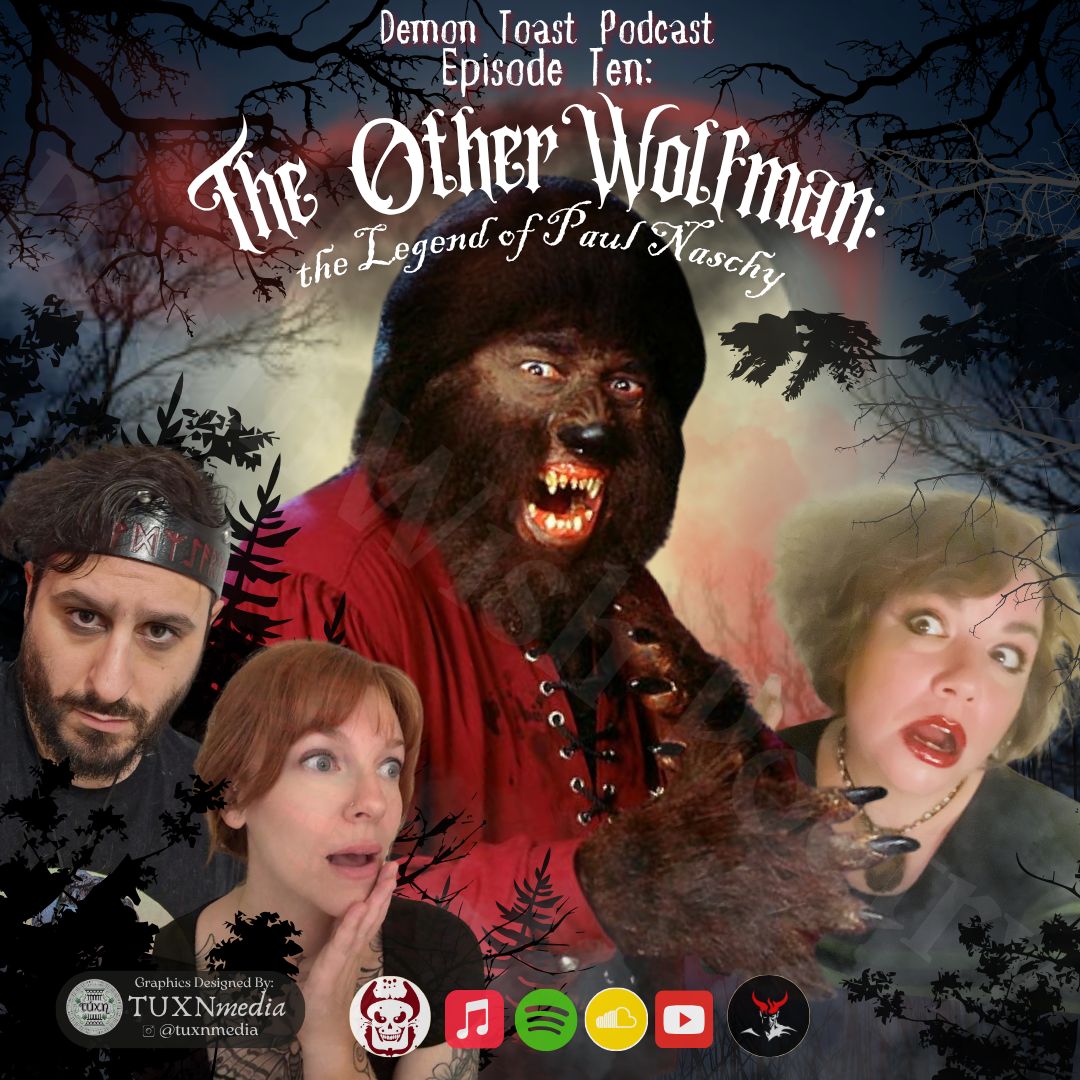
[00:00:00] Speaker A: Did you guys have, like, a favorite classic monster?
[00:00:03] Speaker B: A favorite classic monster.
[00:00:05] Speaker C: We know that Dracula is my favorite.
[00:00:07] Speaker A: Is it Bel Lugosi or is it Gary Oldman?
[00:00:10] Speaker C: Chris, it's, it's Christopher Lee.
[00:00:13] Speaker A: Christopher Lee.
I mean, he's a man of few words. I mean, I, I, I like Frankenstein, you know, played by Boris Karloff.
Okay.
[00:00:25] Speaker B: I don't know if I have a favorite.
[00:00:28] Speaker A: Adrian didn't take the bait, Okay?
[00:00:29] Speaker C: I didn't. I'm not taking your bait anymore. I'm not.
[00:00:34] Speaker A: So ca. There's a, There's a Dracula 3000. Do you think they'll ever make a Frankenstein 3000?
[00:00:39] Speaker B: Hell, yeah. Let's go.
[00:00:41] Speaker A: Yeah, like where he's in, yeah, but like, where he's in space and fighting Ice Cube and stuff.
[00:00:45] Speaker B: You know, I would be so here for that, right?
[00:00:50] Speaker A: I mean, it was so great when Dracula did it and Ice Cube beat him by flying the spaceship. Well, he flies the spaceship into the sun because that's how you kill Dracula in space.
[00:00:57] Speaker B: You know, I'm actually, I'm like a huge Ice Cube fan.
Dead ass. Like, I love Ice Cube. Yeah, it's a great dramatic actor.
[00:01:08] Speaker A: I mean, he was in War of the Worlds. That was really good. It's probably my favorite version of that story, you know? Mm.
[00:01:12] Speaker C: Ghost of Mars.
[00:01:15] Speaker A: He's sitting in an office, like, all alone, and, like, the aliens are eating data or whatever. It's great.
All right, KFAB aside, we're actually so, you know, this is part of.
I really want to do, like, episodes about each of the classic monster archetypes. You know, Frankenstein, monster, the Wolfman, you know, the Mummy, all that stuff, because there's different dimensions, different ways to talk about them.
And we figured that there's no better place to start than with the Wolf Man. But we're not here to talk about Lon Chaney Jr. We're not here to talk about Benicio Del Toro. Not here to talk about Chris Abbott. We're here to talk about the other wolfman. Well, the other other wolfman. None other than Paul.
Bodybuilder, circus strongman. Writer, director.
Actor. Actor, Werewolf producer.
[00:02:05] Speaker C: He did all the things. He checked all the boxes.
[00:02:09] Speaker A: Checked all the boxes.
Paul Nashi is, of course. Well, he's Spanish and grew up watching the.
Well, I guess. Adrian, would it be accurate to say the fallout of the Spanish Civil War?
[00:02:25] Speaker C: I mean, he lived through the Spanish Civil War, so yes. But he fell in love with cinema because of Frankenstein versus the Wolf Man.
He begged his mom to go in to see it, and she wouldn't let him. And then, like, he finally went in there by himself and begged the guy because he was too young to see it. To see it. And he won and got to go see it, and it changed his life.
[00:02:53] Speaker A: It's just like with Paul Nashi, it's. It's important to, like, think about the world he grew up in. He describes, like, the town square where he saw people shot by the army, and the bullet holes remained for years afterwards.
There was a river he would go swimming in, and there were there, he called it the forest of skeletons, because there were people that the army had tied weights around their neck and pushed them in and just left them to drown. You know, as someone living in a country falling to fascism, you know, I can't imagine growing up in it.
[00:03:26] Speaker B: No, seriously, that's traumatic.
[00:03:28] Speaker C: It was horrifying. He thought his father was dead for years.
[00:03:32] Speaker A: True.
[00:03:32] Speaker C: Because he was on, like, the list.
And then he randomly was like, oh, my God, that's my dad. And then his dad came and stayed with them again. But it was, like, horrific. Like, the things that that man went through. And then he still, like, maintained this amazing sense of humor and sarcasm that, like, everyone comments on. He was beautiful.
[00:03:58] Speaker B: I mean, I feel like I can relate to that. Like, holding on to your humor amidst living through traumatic experiences is a valid coping mechanism.
[00:04:09] Speaker C: You know, this is why all three of us are the way we are.
[00:04:14] Speaker A: Here. I found it. So this is his uncle. His uncle Angel, I think, telling him this.
So he said, you know, he told me a lot of things. For instance, that his father had been executed by Franco's troops. He also told me about a ship which used to berth at the dockside in Santander. Many of those sentenced to summary execution by local people's tribunals would be weighted down with great stones tied around their necks and thrown overboard.
It was, in his own words, a filthy trick. Later, he told me that when Santander had fallen to Franco's forces, a couple of divers went down at the spot and were horrified to discover a forest of cadavers rising from the depths, many of them still floating in the murky waters on the end of their ropes. According to Roque, one of the divers went out of his mind. This is the world he lived in.
[00:04:59] Speaker C: Well, and he thought his father drowned in that river.
Yeah, it was a big thing.
[00:05:07] Speaker A: It's pretty horrifying, isn't it?
[00:05:10] Speaker C: Like, it's insane.
[00:05:11] Speaker A: He talks also about, like, how.
How, like, when they saw the Nazis, like, their.
The. The stark, like, nastiness of it appealed to him because he liked the gothic aesthetic that he lived in. He. There, there's that famous.
That famous church. Adrian, what's it called? The cathedral, with the. The guy ringing the bell.
[00:05:37] Speaker C: I cannot remember.
[00:05:41] Speaker B: You talking about a cathedral in Spain or in Germany.
[00:05:46] Speaker C: It's in Spain. Barcelona. It's.
It's one of the most phenomenal art nouveau gothic artists.
[00:05:54] Speaker A: So the. So the statue. It's not a statue. It's.
It's a little guy. It's called the flycatcher.
That, that. That cathedral had the flycatcher, which is a little guy that would ring the bell at the hour. And like, it was creepy. The whole thing was creepy. It was an old, old, old, old little town.
I mean, watching soldiers march through it and execute people.
I mean, that's not normal, right? And it's. It's so funny to me that he could see something like Frankenstein meets the Wolfman and still be thrilled by that, because, like, you know, it's always been my understanding that movies in the 70s took on a particularly nasty bend, you know, with stuff like the Last House on the Left and Bonnie and Clyde being. No, you know, also exploitation movies, you know, really taking off in the 70s because the thrills and chills of yesteryear just weren't as scary as the stuff coming out of Vietnam. But I mean, apparently stuff he was.
[00:06:59] Speaker C: Doing was actually kind of like to go against what was going on in his world.
[00:07:09] Speaker A: I think it's important to point out that he came of age at a point where the Universal monsters, right, Boris Karloff, Lon Chaney Jr.
Poor Bela Lugosi, all those, they were in the rear view. They were in the past. They were touchstones of pop culture, right?
And like, think there was a resurgence of that kind of classic horror, as Nashi called it, horror fantasy, right?
The vampires, the werewolves, the mummies, all that stuff. But a lot of it was happening, what, in Britain and Italy, right, with the Hammer. Horror movies, which, you know, I mean, if you're familiar with Christopher Lee as Dracula, that's Hammer. If you're familiar with Peter Cushing as Dr. Frankenstein and von Helsing Hammer, right?
[00:07:58] Speaker C: Peter Cushing literally gave him an award and he looked at him like. Like he was the most beautiful human on the planet. It was amazing.
[00:08:06] Speaker A: So someday we will talk about Christopher Lee, Dracula. We will talk about Peter Cushing. Today we're talking about Paul Nashi, because nobody knows Paul Nashi except people like us.
[00:08:15] Speaker B: Paul Nashley didn't know him until you guys told me about him. And so I'm so happy because now.
[00:08:25] Speaker A: Yeah, she did. I. I was like, on. I was on Old Tubby and I was like, adrian, me and Justin just found, like, this terrible werewolf movie with, like, amazing makeup and cool effects. And she's like, it's Paul Nashi. And I was like, oh, good.
And then she sent me. She had already shown me the painting. She's like, I painted him on this book cover I designed that this person didn't want. And I was like, oh, that's Paul Nashi. That is Paul Nashi. Facial blindness came into focus. And I was like, whoa, there he is. Yeah, so very true. Adrian does love Paul Nashi.
He's cool. Here's the thing about the Hammer stuff. For those of us who love werewolves, like myself, you know, I do have a little wolfman figure. He stands next to the undertaker on my little set back there. The wolfman is great. I love the Wolf man to death.
Paul Nashi did, too. Those people over at Hammer, there's like a werewolf movie, right? But they didn't make like eight of them like they did with Frankenstein and Dracula.
The Dracula ones are great, though, right?
Like, we like that. We like the Hammer Dracula. We like the Hammer Frankenstein because they're. They're dark, they're sexy, they're low budget, but they've got a lot of production value. They shoot in real castles.
They have fucking Christopher Lee, like, just standing there, like fucking Darth Vader. Like, they're fantastic. They're bloody, they're gory, they're sexy.
So, you know, for. For a lot of people, that is the true Dracula. You know, when Christopher Lee died that day, I did not watch the Lord of the Rings like everyone else was doing. I watched Dracula has Risen from the Grave and the Howling. Your sister is a werewolf. Because, you know, to me, that's Christopher Lee. I mean, he's giving a billion. Yeah, yeah.
So, like, you know, like, there's elements of, like Giallo. There's elements of classic Universal style gothic horror, and there's whatever was going on in the 50s, 60s and 70s too, because that's when they were made.
Now, the launch, indeed, Junior movies launching the junior Werewolf movies probably don't have that aspect, right? They probably. Right there, right? You can look at the Frankenstein movies and be like, holy fuck, that was like legit.
Like, right? You can look at any one of the. Well, almost any one of the Dracula movies and be like, that might be my favorite Dracula.
So Hammer didn't really have that. They got Loncini Jr. When he was older, probably not in his prime. And you know, he's fighting Billy the Kid. I mean, I'm here for that, but, you know, it's not.
It's not your top shelf material.
No, right.
[00:10:57] Speaker C: They had the rubber bats that you love, though.
[00:11:00] Speaker A: Yeah, no, I do love rubber bats. I'm. That there's a strong tradition of Dracula movies having bad rubber bats, you know? Ca. Do you. Do you like a bad rubber bats and Dracula movies?
[00:11:09] Speaker B: Oh, yeah.
It's not, it's not a. It's not a true Dracula movie without it. Come on.
[00:11:15] Speaker A: Yeah, I know the 90s Dracula really dropped the ball on the rubber bats department, you know.
[00:11:19] Speaker C: Well, the 1979.
[00:11:24] Speaker A: Would you say.
[00:11:24] Speaker C: Would you say, Adrian, the 1979 Nosferatu also did because they had real bats instead of rubber ones.
[00:11:31] Speaker A: I know it's garbage. Like Klaus, Klaus Kinski. Go.
[00:11:34] Speaker B: I mean like, you can have some real bats, but like, give us some rubber bats too, somewhere, please.
[00:11:39] Speaker C: Like, for real.
Ca. You so right. You so right.
[00:11:45] Speaker A: It's like, why are you wasting my time with these real bats and these great, like, groundbreaking effects? Like, go yourself. Fucking Coppola and Werner Herzog. Like, what?
[00:11:54] Speaker C: Seriously? That and Youth Without Youth are my two favorite Coppola movies ever made.
[00:12:01] Speaker B: Actually, there is some. Something. I know we're being silly and joking right now, but like, there is like a commentary to be made here about like low production. Budget. Like low budget horror films are like, they're just. They exist in their own, like, world and there's really nothing like them. And like, it's almost like you can't even compare, like, how higher budget horror and like more modern horror, like, to this era of film. Because it was so, I don't know, like, formative, special set apart. Like there was just something about it that it has this like, je ne sais quoi, you know, it's because they were experimental.
[00:12:47] Speaker A: They were experimental. Like I think about the, the. The stupid IT movies they made, right? $100 million or something with the state of the art, like, clown effect or whatever, you know, and it's like, yeah, you look at something like, you know, like the Wolf man, like the original Wolf man or even like 70s Dracula and like, yeah, like when he stabs that girl, he's stabbing a bag of blood that explodes. You know what I mean? Like, that's amazing.
[00:13:12] Speaker B: It's. I know.
[00:13:13] Speaker A: Like me. I think you can, like, we were watching them.
[00:13:16] Speaker B: You really can like, energetically feel that at the time, like a lot of these movies were cutting edge or you Know, like you said, experimental and, you know, trying to create effects of, you know, electric shock or effects of, like, blood and guts and stuff. And it's like. Because you could feel that they were really, like, pushing the bounds. Like, it just. It has this, like, grit to it that is just endearing.
[00:13:45] Speaker A: Yeah, yeah. Grit and realism. Realism, you know? Go ahead, Adrian.
[00:13:52] Speaker C: It's like when you're a child and you're playing pretend kind of, but, like, you get really lost in it. I don't know if you guys ever did that as a child, but, like, you make up stories and all of these things. The rubber bat is no longer a rubber bat. Like, it's the suspension of belief in awakens something in your imagination. Like that childish sense of wonder that, like, very few things capture like that.
[00:14:26] Speaker B: I actually agree that big part of it is the imagination piece because it forces the viewer. We have to suspend reality a little bit to buy in. Right? And when that happens, we're now in relationship with the story less so than with the visual. You know what I mean? Like, the visual effects, like, we're just like. We suspend our reality to be like, oh, yeah, that's blood, even though it's clearly corn syrup. You know what I mean? Like, but we're just, like. We're, like, in it with them. And there's a sincerity to it that draws the viewer in, in a way that you're connecting really, with the, like, story of what's going on.
[00:15:05] Speaker A: So. So there's a comic book artist and writer that I love. His name is Walter Simonson.
He designed the character you may have seen. I'll flash him up here. His name's Beta Ray Bill. He's a Thor character. He's an alien, and his face looks like a horse skull. Right?
And the. The. The concept of Beta Ray Bill is that he's this noble alien warrior who beats Thor's ass and takes Mjolnir from him and starts beating him with it and then finds that he has the power of Thor because he was worthy. Story is like, what the fuck are you talking about?
And Walter was like, you can do whatever you want. You can do whatever you want. You love this story, this ridiculous story, because I kept a straight face when I wrote it.
It's sincere.
So, like, yeah, like, playing into what Ca was saying. When you're watching, like, the original Dracula from the 30s with Bela Lugosi, and you see, like, the spirit Halloween spider skitter by. It's clearly a puppet, a terrible puppet. And there's, like, you know, the Rubber bats and stuff. But then Belugosi walks up, goes, welcome to my home. And he's horrifying. It's like, oh, God.
Or, you know, Christopher Lee Dracula comes through the window and stares at the girl with those murder, I'm gonna murder you eyes.
You're right. It's. It's told with a straight face. And, you know, there's a verisimilitude that comes with inviting the viewer in, you know, but at the same time, yeah, I mean, I think at the same time it's nice when these things don't look completely real because they are constructions. It's a movie, it's art, you know, and like, look, I mean, like, there are different ways to do this. There's the. There's the wonderful American Werewolf in London, which has probably the most horrific and real looking werewolf transformation to this day. You know what I mean?
[00:16:56] Speaker C: Eight hours.
[00:16:56] Speaker A: It's a brilliant scene.
[00:16:57] Speaker C: Eight hour werewolf transformation scene.
[00:17:02] Speaker A: That was the legendary Rick Baker, right?
[00:17:05] Speaker C: Yes.
[00:17:07] Speaker A: Yeah. And like, that's one way to do it. Or you could do what Paul Nashi does. And that is different.
Which brings me back, brings us back to the, to the subject at hand. Because whereas Hammer may have, you know, tried to fill that, that void with an aging Lon Chaney Jr. Paul Nashi over in Spain and I guess Italy, I mean, Adrian, he shot all over, right?
[00:17:30] Speaker C: So he was mostly based in Spain at first. Then he shot in Japan. He spot. He shot in Spain, France.
Like, it was hard.
[00:17:40] Speaker A: It was, it was hard to get this stuff done in Spain because at the time Spanish movies were mostly exploitation movies with like, you know, nice ladies with low cut dresses doing things. And.
[00:17:51] Speaker C: Okay, so he was able to do what he did because it was actually run by a German Nazi affiliated company.
And he did not like that.
And he had to do it since he was a little boy, like before he was getting into film. And then because he was such a good athlete, he was a soccer star, he was a wrestler.
Like he was a luchador. Like, it was amazing. This guy was cool. So.
[00:18:23] Speaker A: So here's him posing with his sports trophies.
He's older here, but there's a lot of trophies there. There's a lot of gold.
I have my trophies.
[00:18:33] Speaker C: And because he was a winner, Germany wanted to sponsor him. So he's like, okay, you want to sponsor me, that's fine.
Here's what I'm gonna make. And they funded it for 10 years.
Like, Paul Nashi literally got to do some of the craziest movies. And they were like, really? Like, we don't. But they couldn't say anything because it was in this horror fantasy genre. So.
[00:19:05] Speaker A: Okay, so I want to draw your attention to a quote that he included in his book. Okay. Because fantasy. Yes. And like, me and Ca. Like, we were talking about the cheesiness, the cheese factor and why that might work for some horror movies. Right. He has this quote from.
From. From Herman Brock, right.
About kitsch. Kitsch doesn't only mean marbled coffins, wedding cakes, red satin shoes, ashtrays shaped like snails, Eiffel Tower paperweights, garden gnomes, pantheons, piggy banks, golden statues with painted genitals, tinted picture postcards. Kitsch can also apply to Gota Wagner, Walter Scott Moreau, the playwright, the Symbolists, the Pre Raphaelites, Adrian.
The ancient Egyptians who painted. Painted their huge temples in bright colors, the ancient Greeks who did the same, the legendary film director D.W. griffith, and anything you like. Kitsch is a part bourgeois, part nonconformist invention which seeks to reconcile aesthetic virtues with the love of decoration. The great cathedrals were originally multicolored. Could they be considered kitsch? But this tendency also combines puritanism with sex.
In short, not to put too fine a point on it, the merging of heaven and hell.
And to put a finer point on it, right, low art with the guilt, the gildings of higher art aspirations. You know, a comic book with really good writing, you know, or a werewolf movie with pretty good direction and decent writing and really good effects.
[00:20:49] Speaker C: He was also the guy. They would be like, you have to make this movie in 26 days.
And he'd be like, I can make two movies in 48 days. Like, and he would do it. Like, he literally was like, I'm the dude. I got this. I'm gonna make the movies.
[00:21:08] Speaker A: He says that, you know, my movies may be kitsch. I accept that in the sense of a guilty pleasure. I see myself as a Gothic expressionist. To quote K. Edschmidt, this is Paul Nashi. The expressionist artist does not look, he sees. He does not tell. He lives, he does not reproduce. He recreates, he does not find. He seeks.
In other words, the expressionist artist takes things that already exist and repurposes them for his own needs.
[00:21:36] Speaker C: You know, I mean, I call myself a romantic expressionist, so, like, I 100% understand where he's coming from.
[00:21:46] Speaker A: Fair enough. I mean, I used to consider myself a romanticist until I realized that my stylings were a little. A bit more postmodern, to my chagrin.
So, whatever.
But, like, that Brings us to, I think, our first movie. Where the hell my notebook go. Assignment Terror.
Right. I don't know if any movie exemplifies kitsch and possibly cringe as MA as much as Assignment Terror.
Adrian, tell us about. Actually ca. You want to tell us?
[00:22:16] Speaker C: No, let's say. Do it. Cas laughing.
[00:22:19] Speaker A: Can you do it? I can't.
[00:22:21] Speaker C: All right.
[00:22:22] Speaker B: I mean, I. What I said. The first thing I observation I made about this film was if there was a plot. I never met her the whole film. I don't know where she was. She kept running away from me. I kept trying to find it, and it was elusive. Let's just say that there was.
[00:22:41] Speaker C: There was.
[00:22:42] Speaker B: There was aliens, there was a mummy, there was a Frankenstein, there was a. Where there was every, like, horror trope imaginable and, you know, some, like, futuristic, like, tech thing going on with this alien race, but they just looked like people. So keeping straight who was an alien and who wasn't was also kind of challenging.
You know, notably, there was, like, several, like, torture scenes that had to do with, like, sonic, like, supersonic sound waves or something. And I literally, like, as a neurodivergent person, I literally muted my TV because I was like, I can't listen to this sound. This actually is torture. This is a torture.
[00:23:31] Speaker A: So anyway, it doesn't help. It doesn't help that the movie was not very well preserved. Like. No, it's just falling apart as you watch it.
[00:23:38] Speaker B: It really is. Yeah.
Hilarious, though. I mean, what else do you guys want to say about it?
[00:23:46] Speaker A: I think that. Oh, I think I found it. So I think that the.
Yeah, this movie is also called Dracula vs. Frankenstein. It's also called Las Monstros del Terror. And this is a running theme with these movies where they get released under different titles in different countries.
[00:24:02] Speaker C: That's why when I was recommending them and you couldn't find one of the titles, but it be because it was under a different name. Like, each movie has, like, five different names. It's ridiculous.
[00:24:14] Speaker B: Okay. I think if I had to try. I think the plot of Assignment Terror was that, like, the aliens wanted to take over Earth because their planet was dying. And they were like, I know what we'll do. We'll terrorize the humans with monsters.
So they were trying to, like, wake up and, like, unlock different versions of monsters so that they could remotely control them from their spaceship somehow.
Am I getting that? Is it roughly, something along.
[00:24:42] Speaker A: They went to a lot of trouble. They went to a lot of trouble to find these monsters. So this was basically a rehash of House of Frankenstein where some traveling circus guy or scientist, I can't remember, he's played by Boris Karloff. Karloff is very sexy in House of Frankenstein, by the way. He's got a beard in that movie. And that fucking hat. Like, whoa, dude, that tall hat. Anyway, yeah, like he, he buys Frank, he buys Dracula from like a circus he, cat. He.
I think he catches Lawrence Talbot, the Wolf man. And it all boils down to them fighting at the end. It's not very good, but Karl Up's good in it, but. Yeah, so that's basically what it is. They go to a lot of trouble to find monsters and I, I think they want human women. It's from that era where that's what the aliens want instead of gold. I'm gonna read this. I got a call from the producer, an excellent fellow named Raymond Planas. At the request of Jaime Pradas, the last survivor of the. Of the formidable Samuel Bronston empire, the production company wanted me to write a script for a big budget horror movie. I penned an outlandish story which involved Dracula, Frankenstein's monster. By the way, he doesn't say Frankenstein like many people do.
The Wolfman, the Mummy, and even the Golem, as well as aliens and flying saucers. La Los Monstros del Terror was originally to be helmed by a great director from Hollywood, Hugo Fregonesi. I've never heard of him. I had to go in. I had to go to his house in Rome and get him to agree to the project. We argued over the final draft of the script for several days.
The film has a double climax. The Wolfman, Valdemar Daninski, who is the werewolf in all these movies, engages in surreal combats with the Mummy and the Frankenstein monster in two scenes which clearly pay homage to the. The classic Frankenstein meets the Wolfman.
So there's a lot about this movie. Like, we could talk about this movie for like hours. But, like, the funniest thing to me is that the Frankenstein monster looks awful. Like, I don't know what happened. Like, their makeup guy didn't know what he was.
[00:26:46] Speaker C: They had no funding. They literally just had to make it work. Like, when I talked to Sybil Danning, she literally was talking to me about that. Like, they literally, like, give you nothing for special effects whatsoever and you just have to like, make it work. Christopher Lee was fantastic at that, and.
[00:27:05] Speaker A: So was, yeah, Paul Nashi does his thing. I. I'm pretty sure he plays Voldemir in this movie. For Some reason I remember him playing Frankenstein, but I think that's just because I have facial blindness and I get people mixed up.
[00:27:17] Speaker C: Yeah, he did play in a later movie.
[00:27:21] Speaker A: Later movie. Okay.
[00:27:23] Speaker C: Yes.
[00:27:23] Speaker A: Okay, fair enough. I. I would like to mention, however, that, you know, his first movie was so low budget that Voldemort Daninsky, his. His werewolf character. His teeth, by the way, the first werewolf to have actual fangs sticking out of the mouth like that Paul Nashi. And they were made out of a potato because. Out of potatoes because the budget was so fucking low.
[00:27:46] Speaker C: Oh, my God, I love him so much.
[00:27:48] Speaker B: He was like, kind of a genius solution, though.
Yeah, kind of a genius solution.
I'm not gonna lie.
[00:27:55] Speaker C: Yeah, I didn't realize.
[00:27:57] Speaker A: I didn't realize they were potatoes when I watched it. We didn't watch it for this, obviously. I watched it a long time ago. I think it's like the mark of the Wolf man or something.
[00:28:05] Speaker C: But probably the name of one of his. Dude, they changed the name so much, I cannot keep track.
[00:28:11] Speaker A: Yeah, if you want to get into this, just. Just watch random ones. But I. I want to focus on Assignment Terror for, like, another second, because to me, it typifies what he was into, which is those old Universal movies at their core. He loved what was going on over at Hammer, but he was like, oh, but I love. I love the Monster Mash.
So he made one that he figured the 70 would have been cool with the 70s. Also, he had kind of. Childish.
That's the wrong word. He had kitschy taste, you know, so of course there were aliens in his version.
[00:28:45] Speaker C: He had an overactive imagination.
[00:28:50] Speaker A: He had a great imagination.
Yeah. Overactive is what you say when you want someone to stop being, you know, imaginative.
Yeah. Ca. Would you recommend Los Monstros de Terror or whatever the. The Spanish title is. Would you recommend Assignment Terror?
[00:29:09] Speaker B: Not to the general public, no. This is a very niche for. Very niche film for a very small audience that could handle it and appreciate it.
[00:29:22] Speaker A: Okay, I'll flash up a clip here.
[00:29:25] Speaker C: You're not wrong.
[00:29:29] Speaker A: Right, Right. You know, Adrian, you did tell me to watch this one in particular.
Oh, Adrian did tell me to watch this one.
Yeah.
Okay.
[00:29:38] Speaker B: I mean, it's. It's so cheesy. It's borderline worth it if you like the cheesiest things ever.
[00:29:44] Speaker C: And when you find out what inspired him to even make films, which is when he, like, begged his mom and then he had to fight with the freaking Usher to, like, go into the, like, Frankenstein versus Wolfman. Of course he wanted a monster Mash, like, that's. That was his dream. Right? And if he was gonna do. Because he didn't know he was gonna be a famous filmmaker, if he got one chance ever, dude, he's gonna do the monster mash.
[00:30:10] Speaker B: Yeah, it's true. It's almost a shame, because I wish he would have had the chance to do a monster mash, like, later in his career. Later, a little bit more, because it probably would have slapped.
[00:30:23] Speaker C: It would have slapped so hard.
[00:30:25] Speaker A: Yeah. When he could have gotten a little.
[00:30:26] Speaker C: Like, he just get. He just gets better.
[00:30:28] Speaker B: Yeah.
Yeah, exactly.
[00:30:31] Speaker A: Yeah. And, you know, I mean. Yeah. So as we wrap up our first episode here, I just want to show his picture that he drew and back in 44 as a child after. After watching the movie. I mean, there's Frankenstein fighting the wolfman.
[00:30:45] Speaker B: And he brought it to life.
[00:30:46] Speaker C: I mean that for himself.
[00:30:48] Speaker B: Yeah.
[00:30:48] Speaker A: He brought it to life.
That movie. That movie was the Avengers back then. It was a huge fucking deal. You know, the wolfman had appeared in, well, one movie, and Frankenstein had appeared in several. And these were things that people thought about, and it was a pop cultural touchstone, and they crossed them over in a movie. It's crazy.
[00:31:09] Speaker B: Mm.
[00:31:10] Speaker C: It's like, literally, it's.
He had to fight to get to even make movies. His parents didn't want him to do it. He had to fight to get to do it. His mom was, like, super against it, and his dad was like, maybe you should do this. Okay, we'll secretly give you this, like, schooling. And then finally his mom was like, oh, my God, I give up. Just do your.
And then they were really proud of him.
[00:31:35] Speaker A: So. Okay.
[00:31:36] Speaker C: Winning.
[00:31:37] Speaker A: So.
[00:31:38] Speaker C: Yeah.
[00:31:38] Speaker A: True, true, true. He had. He had a good relationship with his parents, which isn't very typical of people like us, you know?
[00:31:46] Speaker C: Well, his dad wasn't there half of it. He thought his dad. His dad got killed. You know what I mean? And then his dad shows back up, and his mom was, like, super rigid because, of course, there's a war, and she just wants her kids to survive at that point. You know what I mean?
Like, it's weird. The whole thing is crazy.
[00:32:08] Speaker A: Well, with that said, I think that's a good place to stop. With the first episode, we have four more movies to talk about.
Pole Nashi is a big fucking deal. And if you haven't. If you consider yourself a connoisseur of monsters and horror movies and things like this, you should really be watching these. They're on Tubi. They're on Folsom, whatever.
[00:32:34] Speaker C: There's Check your. Literally over movies on Tubi for free right now. They're dubbed, which is not great. There's like two on Shutter that are in the original Spanish.
Finding them in the original Spanish is really hard. You can look some up on YouTube and watch them for free, but the ones on tubi right now are kind of like slapping SCA would say, like, it's really good. It's stuff you don't get to see. This guy did over a hundred movies.
[00:33:05] Speaker A: Spaghetti and the Werewolf, the Hunchback of the Morgue, which is not a werewolf movie, but it's on our list anyway because it's cool.
[00:33:10] Speaker C: It's my favorite. It's my favorite.
[00:33:14] Speaker A: It's cool. It's a cool movie.
Wait, who's. What was that?
So that's episode one of Paul Nashi. We will be back next week talking about Dr. Jekyll and the Wolfman and. Or the Wolfman and Dr. Jekyll, whatever the hell they call it. And I guess the Return of the Wolfman and probably the Yeti and the Werewolf and Hunchback movie. So, yeah, we didn't do our intro because we're frauds, but this is Demon Toast, the podcast for gothic and horrific literature. I'm King Loki. Read my books
[email protected] deathwishpoetry.com CA, do you still do your podcast?
[00:33:56] Speaker B: Nope.
This is it for me, baby. This is my. This is my main. My main podcast right now. You get all my attention from now on.
[00:34:04] Speaker A: Do you want to plug anything?
[00:34:06] Speaker B: I have nothing to plug right now, but hopefully soon I will. So we'll stay tuned for that. But for right now, I am.
I am. What do they say? Pulling back like the slingshot before we can slingshot something else forward.
[00:34:22] Speaker A: Well, listen, listen. You're one of our main hosts here. I'm very happy you're back, and it's so cool to see you follow CA on Instagram. What's your.
[00:34:30] Speaker B: What's your Instagram?
[00:34:33] Speaker A: It's below.
[00:34:34] Speaker B: It's pinned down below. Follow me for all of my weird personality because I don't have a niche. I'm a person, not a niche.
[00:34:43] Speaker A: Cas. Cas. Reels on Instagram are great. I love seeing them. They always, like you, always make my day a little brighter.
Adrian is, of course. Yes.
Adrian, of course, is the chairperson and founder of the Horror Film Art Society.
Adrian, you want to talk about that?
[00:35:03] Speaker C: No, it's fine.
[00:35:06] Speaker A: Okay. Yeah.
Every month they pick a horror movie and solicit art. If you're an artist and you like to paint monsters.
Do follow Adrienne at her thing down below. Links to the Horror Film Art Society are below and also her Instagram page. And yeah, they, you know, they, they do showcase the art that is sent in, sent in digitally usually, so, you know, with a physical location. So if you want to be part of that, check it out. And yeah, other than that, come back next week and make art, Write poetry. Love your demons. Ave Saitanas.