Episode Transcript
[00:00:00] Speaker A: Yeah, and that
[00:00:01] Speaker B: was an impetus.
[00:00:07] Speaker A: All right, well, anyway, we're assembled again today. We're talking about something very special. It's not the hamburger.
It's because
[00:00:18] Speaker C: Dan is the Hamburglar.
Haven't seen y' all in the same room.
[00:00:24] Speaker A: We've been over this. I'm not the.
I'm not the Hamburglar. I have
[00:00:29] Speaker C: pictures.
[00:00:32] Speaker A: I
[00:00:32] Speaker C: need proof, Dan.
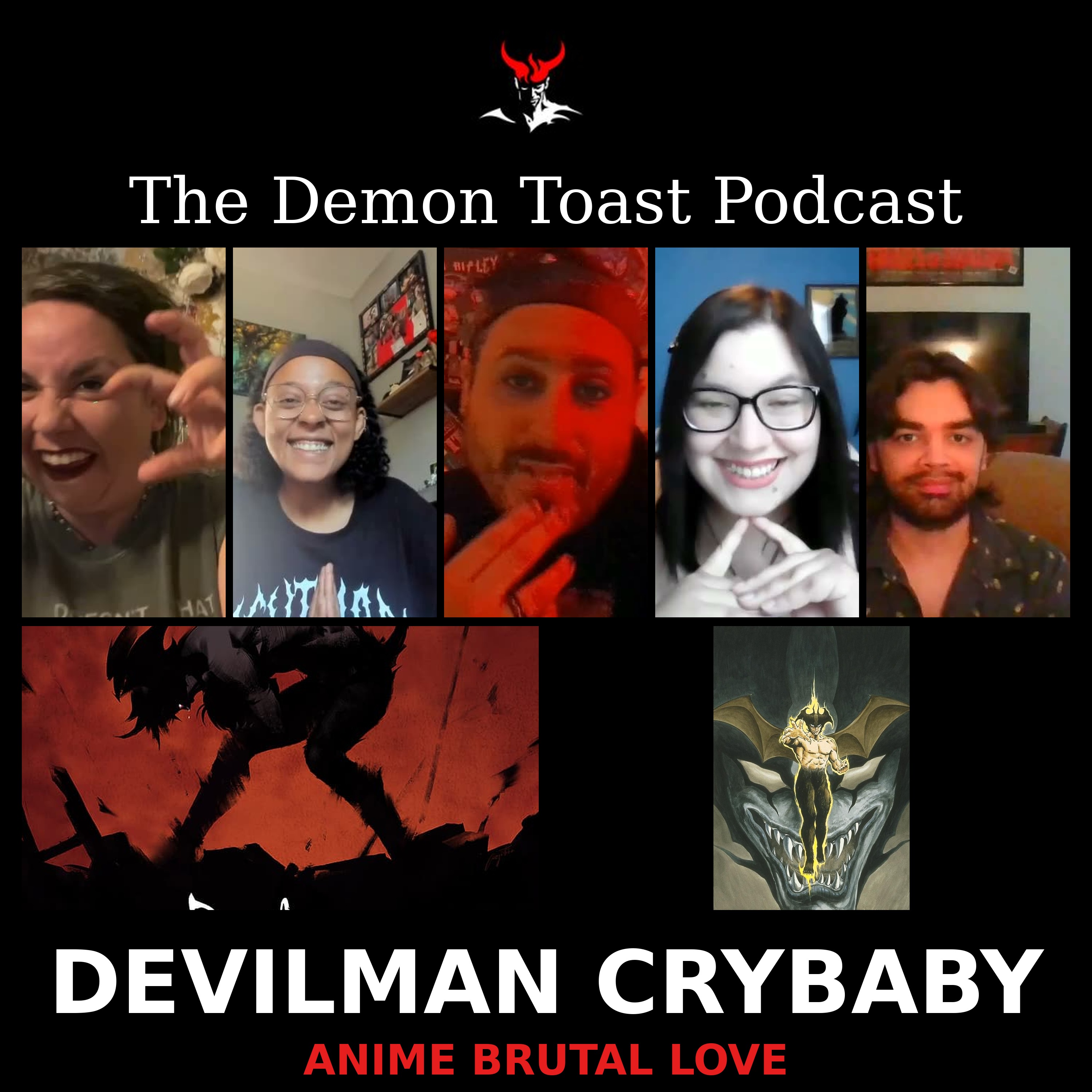
[00:00:34] Speaker A: Well, you know I can't prove a negative. That's not how this works. But anyway, yeah, we're here to talk about one of my favorite things in the whole wide world. It was almost my first tattoo, but depression and things led to me getting an Evangelion tattoo. It just seemed more important at the time, so. Screaming Eva unit. As opposed to my favorite anime character. Go Nagai's Devil Man. We're here to talk about Devilman Crybaby, the Anime from. Ooh, 2018. 2018. I'm King Loki, your host. I'm the editor of Death Wish Poetry magazine and the.
The very competent captain of this awesome ship. With me are my co hosts, Adrian the Queen of the Damned. Erica Jordan, poet awesome person. My assistant editor, Jack the Spider Eater. That's a lie. Jack is very cool. We love Jack.
Marissa, my co editor over on the Goblin Crypt Horror Culture magazine. And ALF is around as well, so, you know, we have a packed house today. And you know just a little bit about Devilman. I mean, you might know what Devilman is, but a lot of people don't go. Nagai is a mangaka. He is very prolific. He created Cutie Honey in 1973, which is the progenitor of a lot of things, like
[00:02:01] Speaker C: Sailor Moon.
[00:02:03] Speaker A: Like Sailor Moon, Magical girl stuff. Robot girl animes.
Let's see. He created Mazinger Z, which is the first.
Pretty sure, the first manga anime featuring a giant robot that's being piloted by someone.
[00:02:16] Speaker C: Yes. He
[00:02:17] Speaker A: got the idea
[00:02:18] Speaker C: 100%. That's it.
Yeah.
[00:02:21] Speaker A: He was stuck in traffic and he was like, what if I could just, like, drive my car into a giant robot, you know, and leave the highway? Which is pretty cool. Mazinger Z was 73 as well, interestingly enough. But, you know, Demon. Demon Lord Dante, also known as Mal Dante, was a manga he wrote in 71 that's its own franchise.
It was inspired by a Gustav Dur Book of Paradise Lost. And he was very, very, very inspired by the. The final shot of Satan encased in the river of ice.
It is a. You know, I'm going to flash it up here in case you guys are. Are watching on YouTube. He wanted to write a manga based around that particular horrifying image of the three headed Satan frozen in ice.
Well, his, his publisher was like, hey, can you, can you do like the same thing but like for kids or something? So that led to Devilman in 72 which quickly took on themes, you know, moving on from its Shonen roots, it quickly moved on to themes of anti war, humanity, sexuality, love, vice, empathy, violence and the darkness and limits of human nature.
Which is not what they were going for.
[00:03:37] Speaker B: That sounds like a kid series if I've ever heard one.
[00:03:40] Speaker A: I mean you could say the same thing about the fairly odd parents. You're correct.
There's a classic Devilman anime from 72. It's 39 episodes. It sucks. I like it. I think it's cute, but it's very stupid.
It's definitely worth watching if you've seen Crybaby because they do the same things but in a kid friendly way. There were, there were a couple of ovas which we watched for this. They need their own episode. You know, there were, there was a movie in 04. Dev man fans were lighting memorial candles because it was the death of the franchise at the time because it was so bad. I like it.
I like, I love terrible things.
But yeah, Devilman was basically, you know, aside from the, the odd manga here and there, dead until 2018 when.
Oh God, I didn't write down the. The artist's name. What's his name? What's the animator's name? Jack. Do you remember?
[00:04:30] Speaker B: I don't know.
[00:04:32] Speaker A: Done by Masaki Yuasa who has done a lot of weird cult classic anime movies. Like there's one called Kaiba. Not that Kaiba. It's a different Kaiba.
And an episode of Adventure Time. It's really incredible. And his unique style gives Devilman Crybaby a really punky, almost graffiti esque like quality to its animation where bodies contort and stretch and change shape fluidly. It's really, it's unlike anything else I've ever seen. With that being said, everyone here has seen it.
Has everyone here watched the OVAs, the birth of Devilman and the. The Siren thing?
[00:05:14] Speaker B: Yes, I have.
[00:05:15] Speaker D: Most of
[00:05:16] Speaker A: that's okay.
[00:05:17] Speaker D: I didn't finish all of it.
[00:05:19] Speaker A: Yeah. So obviously there's. But
[00:05:21] Speaker D: I also think I had already watched some of it like years ago. Well, so I think my dad liked the 70s version of it and
[00:05:31] Speaker C: it actually makes sense because I kind of also remember that Marissa. I think he was literally watching that. Like.
Yeah, because I, I think that was my first
[00:05:42] Speaker D: Robotech. And like a bunch of the old, old, old anime.
[00:05:46] Speaker A: Well, there you go, you know, and it is one of those, those classic animes, unfortunately.
So it has this like, it has this like weird like aura to it where people go, oh yeah, Devilman. But like Devilman is the forerunner to something called Sten, which is a, a type of manga and anime that is scaled towards older people and it features sexual themes, horrific violence, and I mean, have a look at some agona guy's art. It's shocking. You know, if you're, if you're watching us on YouTube, I'm flashing it on the screen.
Like the people look like the red out of Astro Boy, but the monsters and demons are incredible, incredibly detailed and horrific. Like things like berserk, things like Attack on Titan. They owe everything to Devilman. And it's funny that it's associated with, with, with like kitty animes from the 70s. That's, that's very funny.
[00:06:39] Speaker B: Do you think there's some, you know, Junji Ito has some, some deference to pay to, to, you know, go, you know, go in a guy
[00:06:46] Speaker A: undoubted, undoubtedly, undoubtedly like his.
Part of, part of the joy of his, his things, of his art are the, the grotesques and monsters and shocking images in his stories. Also. There is a more playful nature to him. But like, yeah, for sure. I mean it's like talking about Lovecraft, it's like, well, everyone is inspired by this to some degree, right?
[00:07:08] Speaker B: Kind of like convergent evolution where you just can't help but like eventually become that even if you're not directly inspired by it.
[00:07:15] Speaker A: Yeah, for sure. And that brings us to Devilman Crybaby, which is a very interesting show. It's only 10 episodes long. It's not perfect. It's missing things that it really should have and it does things that take up time. But it is probably the purest adaptation that this property has gotten ever.
It's the, It's. It's only the second thing to actually address the ending, the, the true ending of the manga, which is kind of crazy for something so old.
[00:07:51] Speaker C: It's beautiful.
[00:07:53] Speaker A: It is beautiful. The first episode. So I've broken this into a few quadrants. Empathy and human nature. Right. The first episode opens up with our two characters, Ryo and Akira. Akira is a crybaby and Ryo is a cold hearted blonde son of a bitch. And he's going on his edgelord rant about how love doesn't exist, but therefore there is no sadness.
And he doesn't feel love, he doesn't feel emotions. Because, well, you know.
And we see the earth being destroyed, reborn or something. We see white hands grasping through the darkness, which we'll find out later is actually the hands of Satan as the world is reborn around him. There's a cat, it's dying. He tells Akira, we're going to kill this cat because it's dying anyway. We're going to put it out of its misery. And he's like, no, we're not just going to kill it.
And he says, you're crying too, Rio. And Rio replies, as if he's talking over the scene. I didn't know what you meant. There's this. There's a. There's a motif of running.
Like, they all run track. What do we think about that?
[00:09:04] Speaker C: It's a testament of endurance.
It's kind of a metaphor in a lot of ways, especially with the girls and the way that works out.
[00:09:15] Speaker A: Our main character, Akira, he lives with Miki, and she's the sweet, kind girl. She's also the fastest on the team, the running team.
[00:09:23] Speaker B: She's the witch of track and field, they
[00:09:25] Speaker A: call her. They mentioned
[00:09:26] Speaker B: that, like, about 50 times.
[00:09:27] Speaker A: They do say it a lot. She has a rival who goes by Nico, but Miko is also a Miki. And Mikko has an issue where she has big breasts and can't run as fast.
[00:09:41] Speaker B: I don't know if that's ever said as being the specific reason, but I guess we can't infer that.
[00:09:45] Speaker A: I. That's what I got from it.
[00:09:48] Speaker D: Yeah. I mean, I feel like when they talk about her, like when the other students are talking about her, that's literally a statement that's made.
[00:09:54] Speaker A: Yeah,
[00:09:55] Speaker C: it is.
[00:09:56] Speaker D: Like, she's not as fast, but at least we get to watch her big boobies bounce.
[00:10:00] Speaker B: And I thought they were talking about. Wasn't that the boy?
[00:10:02] Speaker C: No, they make it a whole thing.
[00:10:04] Speaker A: Our characters are teenagers, but it's not like a Naruto kind of thing. They. They're a little more realistic, you know, so they're gross.
[00:10:12] Speaker D: I mean, I think it's also the nature of the anime.
[00:10:15] Speaker A: It's nature of the anime? Yeah, it is. It is going for grunge and edge.
And speaking of edge, I mean, you know, we have these characters who are rappers, and they are actually like real Japanese rappers, and they're really good. And they sing about how they got no hope, they got no money, they're by the dock, there's no dreams, there's no ships coming in. Their motifs are very fun. Their rhythm is awesome.
[00:10:41] Speaker E: They are. Some of My favorite characters, I love them so much. The continuity with them is great.
I love that we get some like, actual character development with them. Even though they're supposed to be like, side characters, they have purpose and meaning and we can feel their actual, like, human emotions. And that makes me so happy.
[00:11:03] Speaker A: Yeah. Yeah. Because
[00:11:04] Speaker E: they're not just little street thugs. They're just kids who feel, like you were saying, kind of hopeless and disenfranchised.
[00:11:11] Speaker A: They
[00:11:11] Speaker E: want.
[00:11:12] Speaker C: They found the words for it. They're freaking artists. And I mean, that's part of some of the demise of at least one of them. But it's amazing.
And the way that the character development happens and the music, it was my favorite part.
[00:11:30] Speaker D: I think the thing I thought was interesting is the way that they had them start rapping in the beginning of many of the episodes and the topics of their rap. It almost kind of. Because this borrows from a lot of different mythologies. And it almost gave me like the Greek, like the Fates kind of like dipping your toes into what's about to come in the episode. And that was really fun.
[00:11:55] Speaker A: Yeah, they're like a Greek chorus. It's very clever. It's very effective. And you're right. So, like in the manga, like, we do have these punk characters who pick on Akira, you know, which is a staple of type of anime. But they, you know, they have like a little story where they. They get into a scuffle with like, I don't know, a spider demon or something here. They're put to. They're put to much greater use. They, they. They headline every episode and they do things. They interact with the characters. There's this wonderful moment where one of the punks, Kunkun. Kukun. I think it's Kunkun. He.
He talks to Miko and she thinks he's just trying to talk to her, to talk to Miki, and he just breaks out into song.
[00:12:38] Speaker E: That genuine moment of connection over the flowers, of all things.
[00:12:43] Speaker A: It
[00:12:43] Speaker C: was the flowers that was the other thing. Erica. You knew it was the flowers.
I can't
[00:12:50] Speaker E: get
[00:12:50] Speaker C: into it yet.
[00:12:50] Speaker E: It damn near made me cry.
[00:12:52] Speaker C: I cried.
Those were the two episodes that made me cry the most.
[00:12:59] Speaker A: There's a lot of tears to be shed. You know, one of them is probably for Akira, running afoul of these. These young punks, right? And it turns into a whole thing. And then his buddy Rio just shows up and starts shooting at them with a machine gun and laughing and acting like a total weirdo.
[00:13:15] Speaker C: I'm going to say this once and it's the only time I'm gonna say this, but Rio, oh my God, I hate him so much.
Manipulative.
[00:13:24] Speaker E: He's even
[00:13:24] Speaker C: worse than
[00:13:25] Speaker E: the
[00:13:25] Speaker C: obas.
[00:13:28] Speaker A: Yeah, he's Rio. He's a classic character. The homoeroticism between Ryo and Akira is the stuff of legends. Some people suspect that Go Nagai has a closet to come out of. I I. It is not the position of the Demon Toast podcast that Go Nagai is gay or in the closet, but I have my suspicions.
[00:13:50] Speaker E: Let that man write his fruity manga.
[00:13:53] Speaker A: I agree. I don't know anyone who's as prolific, like Mazinger Z Getter, Robo, Devilman, Grandizer too. That's him.
Like Cutie Hani. Like this guy is prolific as fuck. But anyway, yeah, so Rio takes him to a Black Sabbath.
Why? I'm not sure, but he, he's basically telling him, like, there's this horrible thing going on and you're part of it now for reasons.
And they go to a seedy nightclub that looks like it's in like, like an old abandoned. He's telling him like, demons love, they love fornication, they love sex, they love drugs, they love violence. And he starts attacking, hacking people. And like, I love the way the nudity and sex is depicted. It's almost dreamlike. It's like a nightmare. The way people's like, bodies move, their, the way their breath, the women's breasts bounce.
[00:14:48] Speaker C: It had a total David Lynch Mulholland Drive vibe.
Like it's this nightclub. The colors that are used, the imagery, the weird flashes of violence, but then the beauty and then the horror. Right. It was totally a David lynch moment.
It was magic.
[00:15:10] Speaker A: Well, I don't know that David lynch ever has a woman's breasts elongate and grow mouths with teeth and start attacking people.
[00:15:16] Speaker D: No.
What I noticed was consistently throughout the entire 10 episodes, nipples are a focus.
[00:15:27] Speaker A: Yeah.
[00:15:28] Speaker D: Like in almost every single sexual suggestively suggestion. Like, or even just when, when the women that are demons transform, like, it always focuses in on the nipples.
[00:15:43] Speaker A: Well, I mean, you know,
[00:15:44] Speaker E: it gave me
[00:15:45] Speaker D: all about the nipples
[00:15:46] Speaker E: as buttholes are just cute.
[00:15:49] Speaker D: Yeah, basically. But it is interesting because I don't think I've ever seen anything that quite focused on one like erotic image in such a consistent way.
[00:16:01] Speaker A: Well, so here's the thing. I think that like this being on Netflix allowed it to be a little more free. Usually animes like this will show lots of butts. Right? But you can't show male nudity. You can't show, you know, a Penis. You can't show a vagina. Right.
You don't usually get to see breasts. And I think that's what the animator was really into. And he was like, yeah, look, check it out. It's sirens. It's sirens. Tits. Isn't that great, Silen? You know,
[00:16:29] Speaker C: it was, it was the
[00:16:32] Speaker A: siren.
[00:16:33] Speaker C: It was the altered carbon effect.
They did. Altered carbon. That was the Netflix original. And they did some very risque, very particular content with it. But it was also like one of my favorite things ever made because it was like, beautiful. But that's like Netflix was like, okay, we're just not going to play the censorship then for a
[00:16:58] Speaker A: little bit about that. Actually, let's talk about Cylene right now.
The Japanese language doesn't lend itself to. Wait a minute. They usually can't say els, but they call her Cylene. Huh, that's weird.
[00:17:10] Speaker D: Anyway, well,
[00:17:11] Speaker C: they also called her the. Yep, that's what I was gonna say. Maria, you know?
[00:17:15] Speaker D: Yes. They called her Sirene. And her depiction is something that's kind of in between a harpy.
[00:17:23] Speaker A: Yeah,
[00:17:24] Speaker D: And a siren. And a traditional Greek siren.
Specifically a Greek siren.
[00:17:30] Speaker A: Okay.
Well,
[00:17:31] Speaker E: her character design was one of the most interesting to me, both in the ova and the like 2018 adaptation. I kind of like the ova imagery more.
[00:17:42] Speaker A: Yeah. So the ova is a lot closer to go. Nagai's art. That thing where she's. Where she's standing over the house with her. With her wings covering her face, that's when
[00:17:51] Speaker E: I thought that was so cool.
[00:17:53] Speaker A: Very cool. That's when you first see her
[00:17:55] Speaker C: artist. I'm going to tell you, it literally, like, made my heart jump.
[00:17:59] Speaker A: Well, let's talk about it. So basically, like in the old ova, in the manga, it's just a brutal, savage fight. Ryo. So we skipped. So basically he becomes Devilman. He gets possessed by a demon called Amon, who is a really powerful, high level demon. But because Akira is so pure of heart, he's able to keep his mind. But his, his testosterone is through the roof. He's a big, swaggering, bad motherfucker who really needs to get laid. So Ryo gives him a bunch of money and he's like, here, go to the red light district and get laid. Like, don't bother me. You know,
[00:18:36] Speaker B: this is how historically, people, in particular, men, have dealt with trauma.
They dealing with booze, they dealing with women, they dealing with drugs, vices.
[00:18:46] Speaker A: True.
[00:18:46] Speaker C: Women do the same thing, though.
[00:18:48] Speaker B: Yeah, I know. In general, though, it's. It's mostly women.
[00:18:51] Speaker E: Numbing.
[00:18:52] Speaker B: I mean. I mean, like, men usually seek after women for,
[00:18:56] Speaker A: well, you know.
[00:18:57] Speaker B: Release.
[00:18:57] Speaker A: Yeah, well, yeah, this. This is true. So when we see. So we see Silene in the shadows throughout the episodes leading up to their big confrontation where she. Aon was her lover and she's playing with herself. She can't wait to see him again. And she's bursting at the seams to get him back. And she's like, and if he won't be turned, I'll tear him to shreds.
[00:19:22] Speaker B: She'll eat his man,
[00:19:24] Speaker A: she says. I will swallow. I will eat his penis, she says.
And like, the thing is, is that like this.
This savage, high tuned sexuality is. You would think that we see it all the time, but we don't. And it's really cool. This is in Crybaby, and her design is all blue and white. Her lips are bright red and her hair flies up. And when she's excited, it's so cool. And like, you don't get any of that in the manga. You don't get any of that in the ova.
Like in Crybaby. She's allowed to be sexual and explosive.
[00:20:02] Speaker C: Her colors, you were saying, the blue and the red, like those are complementary colors that are supposed to pop and grab your attention.
[00:20:12] Speaker A: Who wants to talk about their meeting in the red light district?
Who wants to describe it? Should I just.
[00:20:19] Speaker B: Well, first Leo wants to.
He's given this money to go and have sex to soothe his. His worries, his traumas. He happens upon. I'm not quite sure how she planned it, but she happened upon, you know, her. Her. I don't even know what you would call it. Her. Her. Her brothel. Her. Her little area, you know, I don't know how she got that, but whatever. She. They. They are about to have sex. She wants him to become Aon somehow, you know, she wants. She wants Aon coming back. But then, you know,
[00:20:44] Speaker A: well, she knows that if he gets aroused, he's going to. And. And she starts tearing into him, he's going to more.
[00:20:49] Speaker B: It's like bloodlust. It's like it.
[00:20:50] Speaker A: Once the
[00:20:50] Speaker B: crimes are activated, the demon comes out or whatever
[00:20:52] Speaker A: and it
[00:20:53] Speaker B: wants to wake up. Amon. Basically,
[00:20:54] Speaker A: yeah. They hurdle into the air. She wraps her legs around him and like he's still going at her, but she's attacking him, trying to draw a mon out of the music swells. It's really, really kinetic the way it happens.
[00:21:05] Speaker B: He admits that, you know, having sex would have been awesome, but I'm really itching to kill a demon. More. So this is back to perfect. Thank you.
[00:21:12] Speaker A: Yeah. And it's like you.
A lot of this is, like, hinted at in the manga. It's hinted at in the.
The ova.
But I think that these characters are larger than life. They're demons. They're ridiculous.
I want to see them be explosive and manic and crazy.
[00:21:35] Speaker B: Animalistic,
[00:21:35] Speaker A: animalistic, Feral. Yeah, exactly.
Another thing that I love about this episode is that Cyllene has a. Has a sidekick named Kame or Kaim.
And he's like a weird little lightning dinosaur who follows her around. He's a
[00:21:51] Speaker C: kite, Mara.
It's a K reference.
[00:21:54] Speaker D: Yes.
[00:21:56] Speaker A: Okay.
[00:21:56] Speaker C: Thank you, Erica.
Yeah.
[00:21:59] Speaker A: Okay. Yeah. So he's a kite mare. Cool. Yeah. And his thing is that he loves Silene. He loves her. He knows that he's not good enough for her, that she's interested. They're battling, though. Devilman is too much for her to handle. And Caim basically says, take my body.
I've always loved you. And this is. This is. I'm going to give of myself to you. And for a minute there, he gets really overwhelmed, but there just isn't enough life in the two of them. And they die. And it's just like in the manga. He wakes up all beaten up and looks at Silene standing terrible and beautiful in the morning sun.
[00:22:36] Speaker D: I think there's something to be said about the moment because, like, technically he's like, use my body. And she's like, no, because that'll kill you. And he's like, I don't care. And then his head, like, pops off. Like, not really giving her much of a. An option at that point, because it's like, at this point, I've killed myself. Just. Just do it.
And I think there's a lot to be said about the way that they played off that emotional moment because they gave it its credit.
And it kind of takes you out of the fight. It's only for like 30 seconds, but they take you out of that fight and give you that moment.
[00:23:14] Speaker A: Yeah. So you know sex and death. Right. Like, I think that they are contrasted in that particular episode more so than anything else.
Sex is very much a. Well, I have love and violence specifically because Chaim does have love for Silene.
I don't know that Silene has any love for Iman. I think she just wants him.
But she has needs and she will fight for those needs. God damn it.
[00:23:43] Speaker B: On the the subject of sexuality in anime I've seen, I'm not. I wouldn't call myself a huge anime fan, but I've seen quite a few anime, and something that I quite dislike about anime in general is how it treats sex and sexuality.
Most notably, the thing most is the comedic pervert character who I always loathe seeing.
So even though Devilman can be considered exploitative in the sense that has a copious amount of sex and nudity, I would still say it handles the subject matter of sex and sexuality with a lot more grace and dignity than any other anime that has some disgusting pervert stealing panties. You know, they have the bathhouse epistle, the nosebleeds everywhere, which doesn't make any kind of fucking sense. When was the last time you got a razzle nosebleed?
[00:24:30] Speaker C: What is it, the Seven Deadly Sins or something like that? With Jack? He wanted to watch it.
Yeah. Oh, my God. I had to have a huge conversation with him about consent, and he kept looking at me, and I was like, okay, I get why you wanted to watch this, because it's a D and D adventure. It's cute. But oh, my God, this is not okay. And he was like, no, Mom. He's like, that's why I haven't watched it until I'm with you. Because I was like, no. Consent. Consent is the thing. We don't do that. These animes are horrible.
Devilman Crybaby actually does, honestly, even with, like, the ravenous wanting of something. Right. It treats it with, like, this beauty and respect.
And also, it's not
[00:25:20] Speaker B: treated as a joke as in most animes.
[00:25:23] Speaker C: Yeah, it's beautiful. Like, it handles
[00:25:26] Speaker E: the emotional significance a lot of the time, and then, like, the subsequent fallout if it's necessary in some regard.
Sometimes we get sweet moments that are just sweet for the sake of being sweet. But we do also get a lot of intensity. But we see why it's there and how it impacts those characters, and I think that's an important distinction.
[00:25:50] Speaker A: Yeah. The crux of the show is, is Akira's relationships with everyone else. It's Akira and Miki. Miki is like a sister, but he does love her. He has feelings for her when she. When she's taking. When she's getting pursued by that creepy photographer who wants to exploit her.
He wants to protect her.
He loves her, and he doesn't really know what to do with his feelings of lust for her.
Akira and Ryo, that is. That is another very important relationship where he trusts Rio. Rio is his childhood friend. He loves him, and he just trusts him naively. Right. And like, all of the relationships in the show are like that.
The most important theme of this show, I have several written down, but the most important one is empathy.
And that is why the lust and all that stuff is filtered that way. You know what I mean?
[00:26:43] Speaker D: I mean, I think it's also humanity as a whole, like just the concept of being human. And I think that's. I think that's one of the things that I found most interesting about how many of the sexuals, like even when we go to the Sabbath party, which I thought was a cool representation of something that actually was based like in reality, there were in medieval times and in Victorian times. And then of course, pop culture brought it back because then we had the Satanists and the anti religious that were like, woohoo. This is such a fun concept.
But one of the things that were almost always like central was sexual freedom.
And I think that's one of the things that they managed to still give you. Even though, like there are all these horrific scenes that follow.
You aren't seeing something that like manipulative or that's nobody's like being controlled or taken advantage of necessarily in these scenes. Everyone is 100% in their own sexual freedom, in their own.
[00:27:51] Speaker B: They're doing
[00:27:51] Speaker D: sense of like
[00:27:53] Speaker B: they're doing a lot of drugs. I don't think it's possible that maybe breach of consent somewhere, but for, for the purposes of that idea, sure.
[00:28:01] Speaker D: Well, but what I mean is like, like, I know you're saying the drugs, but even within that, like the faces that we see when we get glimpses of faces, everyone is enjoying themselves.
Whereas sometimes in some fictitious examples of a party like this, that is not the case.
[00:28:26] Speaker A: Yeah,
[00:28:26] Speaker D: so that's more of what I'm talking about is the way that it's represented.
Are you referring
[00:28:31] Speaker B: to, Are you talking about like how in general, if you have something like that, like usually an orgy scene. I'm thinking of something like Eyes Wide Shut, where an Eyes Wide Shut is very clear that the purpose of the party is for men in particular to enjoy themselves. And women are seen as like the facilitators of that thing. Whereas you feel like this.
[00:28:49] Speaker A: Yeah, you have that girl who like comes over to Akira and she's like, you're cute, you want to touch my breasts. And he's like, what is
[00:28:56] Speaker B: that your girl voice?
[00:28:57] Speaker A: I'm an anime virgin. Whoa,
[00:29:01] Speaker D: that is an excellent girl voice. What are you talking about, Jack? But
[00:29:04] Speaker B: yeah,
[00:29:05] Speaker D: you have that. I think there's another scene where you actually see a woman, like, grab a guy and like push him down and climb on top and like, you get those Moments which I feel like you don't get a lot of representation in similar media portraying stuff like this.
[00:29:21] Speaker A: Yes.
[00:29:22] Speaker D: Which is nice to see.
[00:29:23] Speaker B: I. I don't.
On that subject, I don't think I'm saying anything particularly controversial when I say that Japan in general is quite a sexually degenerate country, if we're being perfectly honest. It's also quite a sexually puritanical country. And that might sound contradictory to the layman, but it's really not.
[00:29:43] Speaker A: Yeah, America just
[00:29:44] Speaker B: has a
[00:29:45] Speaker D: lesson about the United States.
[00:29:46] Speaker A: Sounds like a. That sounds like a. Like a, Like a problematic statement, Jack. The same.
[00:29:50] Speaker E: I feel like purity, culture and degeneracy do low key go hand in hand.
[00:29:56] Speaker A: Yeah.
[00:29:56] Speaker B: Japan. Japan has vending machines where you can buy women's panties. I don't know what else to call that.
[00:30:02] Speaker A: Yeah, that's pretty bad.
[00:30:03] Speaker B: They. They. Their age of consent laws are horrible. My point. My point in saying that was like, I think having it. Having Netflix involvement and having away from, like, the puritanical censors did give them. Give them a lot of leeway. And I will. I. I do think that the reason that we see that. That perverted character archetype in anime so much that Adrian was just, you know, complaining about is because it is such a. A rigid culture. It's such a puritanical culture, it's such a conservative culture. It doesn't allow for expressive, you know, sexual.
I don't even call it expressiveness, I guess.
[00:30:36] Speaker A: Yeah, I don't know. It's. It. It's the kind of thing where it's always a boy looking down a girl's shirt. Like, I was just playing Persona. And, you know, every. Every. Every time they get a chance, one of the boys looks down Anne's shirt and it's like,
[00:30:48] Speaker B: there's always a beach episode. It's always a bathhouse episode.
[00:30:51] Speaker A: Yeah, yeah. Every Sonic game they go to. They go to the bath house and they. They try to peek at the girls and it's like, oh, my God, like, 15 was like, a long time ago for me, man. Like, you know, like, I just.
[00:31:02] Speaker B: I have. We have an Internet where I can see an unlimited amount of naked women. I don't know why we have to have it in my anime
[00:31:09] Speaker A: on that note. Humanity. So this Devilman is something that was written in the 70s and go. Nagai was an artist, and there was something very horrible going on at the time, something we were doing that we continue to do. The Vietnam, The Vietnam War. One of our many, many, many, many, many, many, many unjustifiable weird colonial incursions and the loss of life. The atrocities wrought by American forces are undeniable and really the stuff of nightmares. And that is what informs Devilman's sensibility, as things go from your typical shonen anime with an edgy hero fighting monsters to something a lot darker, as Ryo outs one of their classmates as a demon in front of everyone with a magic holographic, like, screens. Very, very weird, very strange. And like, Akira isn't willing to go along with this plan because he knows that that schoolmate is still human and he feels for him. And this leads to mass hysteria because anyone could be a demon, right?
And we have lynchings. We have people being hunted in the streets by the military. We have civil unrest on a huge scale which leads to, you know, more chaos.
[00:32:27] Speaker B: As an American, it's. It's easy to think of something like the Red scare or the McCarthy trials in an instance like that. I personally thought of something like the AIDS epidemic. Cow. It was like a real paranoia, like, who has aids, who doesn't.
[00:32:38] Speaker A: Yeah, there was an attempt, there was an attempt to spin Monkeypox as the new aids. For a minute there, it's like, oh, it's only the gay people getting monkey pox.
You know, it didn't go
[00:32:47] Speaker B: anywhere.
[00:32:48] Speaker A: Well, you got to be in the bubble, I guess. But I, I, I, I go into that bubble a lot, so.
[00:32:55] Speaker D: Because
[00:32:55] Speaker A: I'm curious, I want to see what's going on. But yeah,
[00:32:58] Speaker D: it's happened periodically with pretty much any demographic that they could possibly make, from the African Americans to the Asians and the Arabs. And like,
[00:33:13] Speaker A: yeah,
[00:33:14] Speaker D: it is an unfortunate cultural thing, but I think humanity just does again, part of the human condition.
[00:33:21] Speaker A: Yeah, but, like, you know, the. Absolutely.
The thing is, is that, like, what I really like about these episodes, the last few episodes, is because it's only 10 episodes, it's pretty economical. Like, as society falls apart, we see people reacting to it in different ways. Some people are preaching. Some people are running in front of tanks to get run over.
Other people are just not leaving their houses. People are committing suicide.
They're jumping off buildings. It's really raw stuff.
[00:33:48] Speaker B: People just immediately like, oh, there's no roll the thing. I'm just gonna start causing chaos and destroying shit for no reason.
[00:33:54] Speaker A: Yeah, yeah. I mean, I think, like, every time anything happens, I'm. During the, the Black Lives Matter protest, people were taking the opportunity to just go loot stores, you know.
[00:34:05] Speaker B: Yeah,
[00:34:06] Speaker A: it was really fucked up because there was civil unrest. Exactly. You know, people do this stuff.
[00:34:12] Speaker B: There's one other thing I'd like to say about. Has anyone here seen the anime Parasite?
[00:34:16] Speaker A: Well, I haven't watched it. Aid's seen it.
[00:34:19] Speaker B: Adrian's seen it.
I'm calling that instant. The premise of Parasite, if you don't know, is that alien spores descend from the sky. It basically how it works is the Paris. The spore gets inside your brain. Essentially everything from the neck up becomes part of the parasite, which can shape change and turn into tentacles and weapons, all kinds of stuff. The protagonist has a parasite that's lodged in his arm so it can't take over him. They have planned adventures fighting other parasites. It's very nice. It's very well made. Has very similar themes to Devilman. But the point is, at some point, the governments of the world become aware of the parasites, but they find and ordinary. The parasites are not detectable. They look the same as anyone else. They act the same as anyone else. There's one guy who knows he can tell difference just by looking at someone. And that person is a serial killer. He's a degenerate, horrible, psychotic murderer. And the show makes it very clear that the re. The reason that he can see them and the reason he's a serial killer are quite the same. Are actually kind of the same thing. It takes someone who's like, doesn't see humans as human beings to spot them, you know.
[00:35:21] Speaker A: Right.
[00:35:21] Speaker B: And of course that also plays on, you know, who. Who could be infected, who's not who, you know, who can entrust.
The parasites try to take over the government. At one point they're. They're quite similar, but they are very, very different in a lot of ways.
The parasites are a lot more. Not evil, but just amoral.
[00:35:40] Speaker A: Yeah.
Okay.
Okay. Well, that's interesting.
[00:35:44] Speaker B: I recommend that anime for anyone who wants something that's double man esque, but not quite
[00:35:48] Speaker A: okay. Okay. Yeah, for sure.
I wonder how they. How they handle the. So they don't do the whole downfall of civilization, do they?
[00:35:57] Speaker B: No, it actually ends with the parasites just kind of learning to. At first the parasites need to eat other humans to survive, but eventually they learn we can just eat regular food. It's fine.
[00:36:05] Speaker A: Okay. Kind of like a Transformer and they
[00:36:07] Speaker B: can't reproduce so there's no threat.
[00:36:08] Speaker A: Kind of like a Transformers ending where they learn to coexist. That's. That's a. That's cool. That's cool.
[00:36:13] Speaker B: Yeah. The parasite is also very interested in sex. And he turns. At one point, he turns his hand to a penis because he wants to see him copulate with someone very bizarre.
[00:36:24] Speaker A: Yeah, that is interesting. Yeah. I mean there's lots of ways to take this, but I mean like
[00:36:28] Speaker B: something else I also want to talk about real quick is that usually in a story like this, you would imagine that Amon is sort of there. You know, like Amon is like something like a person siesta, like a voice in a sadias to suppress. But Amon. Amon's just gone now in ova, it's that it makes it. And I watch the ova and the ova makes it sound like Amon is like literally gone. Like his mind is in hell right now and just can't come back.
[00:36:50] Speaker A: Akira just says that. I just think he's being a bad mother.
[00:36:53] Speaker B: Yeah, he just said that. But like the point is that Amon is just a non entity in this show. And I think that's kind of interesting.
I'm not sure why I like
[00:37:00] Speaker D: it. Complaints
[00:37:01] Speaker A: it. So it's interesting because like in the old 70s anime and only in the old 70s anime, Akira is dead and Amon has taken over his body and is filling in for his life.
Which is. I mean for. That's
[00:37:16] Speaker B: almost fun
[00:37:17] Speaker A: show that's incredibly dark.
[00:37:21] Speaker B: So they're like. If you just like
[00:37:22] Speaker E: a little bit like the summer Hikaru died, 10 out of 10 would recommend. Great show.
[00:37:28] Speaker A: What is it?
[00:37:29] Speaker E: The summer Hikaru died.
[00:37:32] Speaker A: Okay. Interesting,
[00:37:33] Speaker B: interesting.
[00:37:34] Speaker D: A boy goes up
[00:37:34] Speaker E: to the mountains and dies and gets taken over by a forest spirit. Forest deity and same sort of deal. He's like actively living life as that boy for a little while.
[00:37:47] Speaker D: I watched some of that with my anime club
[00:37:52] Speaker E: the first episode or two. I will say it can kind of drag.
It gives off like slice of life vibes. And if that's not necessarily your type of anime, you gotta kind of push through it. But then there's like immediate twists and it's like, oh, oh, this is spooky and a little homoerotic. I'm here for it.
[00:38:17] Speaker D: I love that. Maybe I'll have to give that a shot.
[00:38:20] Speaker E: It's so good. Ask Adrian. She's seen it.
[00:38:24] Speaker B: You dislike the idea that Amon as an entity is not. Not present, he's just effectively dead in the story.
[00:38:29] Speaker D: Well, I feel like of all of the.
So there are so many demons or entities that could have been picked.
And we went with Amon, who has quite possibly one of the most extensive folkloric and mythological backgrounds. Because not only is he part of the Ars Goetia.
[00:38:56] Speaker A: Right.
[00:38:56] Speaker D: And a Marquis of Hell. I Think he's the seventh spirit of the Ars Goetia. And he's like, supposed to control 40 legions.
[00:39:06] Speaker A: Yeah.
[00:39:06] Speaker D: But we also see him actually in Egyptian mythology. The same exact entity with the same exact traits ends up being a God for Egyptian mythology. And at one point, the Egyptian mythology actually combines him with Ra, the sun God, and he becomes Emon Ra and is like the supreme, like the king of the gods.
So this is a being that has, like, so much rich folklore and so much rich mythology that I think when we first get introduced and he specifically is like, amon, possess him now. I was like, oh, fuck yeah. Like, we picked a good character with all of this wonderful
[00:39:56] Speaker A: magic. Ain't that kind of movie, kid?
[00:39:58] Speaker D: Nope.
[00:39:59] Speaker B: I think Aimon,
[00:40:00] Speaker D: he doesn't even shapeshift into any of the creatures that Amon shape shifts into. Instead he's like a bat thing.
[00:40:08] Speaker A: He's a demon. He's a demon.
[00:40:12] Speaker D: Right. But there's. So there could have been so many. Could
[00:40:15] Speaker A: have been an owl with the snake body.
[00:40:16] Speaker D: You could have done the wolf serpent version of him.
You could have done the owl man version of him.
Or there's also a crow
[00:40:26] Speaker A: name Go Nagai in the 70s. Didn't have access to the Ars Goetia or the dictionary Infernal or any of that.
[00:40:33] Speaker D: Fair enough.
[00:40:34] Speaker A: He knew the name Amon.
You will get it.
[00:40:38] Speaker B: I must.
[00:40:38] Speaker A: And you will like it.
[00:40:39] Speaker B: I believe.
I believe I do. I do kind of prefer, like, Amon not being there, because I feel like this, this. I mean, we're already, like, juggling a lot of things already. I feel like adding the. The Amon Split like a Dr. Jekyll kind of thing would have, like, made it a little too confusing. But I also think it also speaks like, you know, Akira's purity. Like, his heart is so strong and pure. Aemon can't even, like, hope to re. Emerge as a, you know, as anything more than, like, an influence on him.
[00:41:05] Speaker A: That's pretty much. That's pretty much what it is. It's like Akira is the director's Siegfried, you know, he's pure of heart, he's kind, and he cares about people. There's a scene where he comes upon a bunch of people being lynched and he slams down as Devilman, and they all think it's a demon come to slaughter them.
[00:41:25] Speaker B: I think it's one of the best things, if we're being honest,
[00:41:27] Speaker A: one of the best scenes in the whole show. He's like, stop it. You know, and he. He lets the people down and he turns and he's like, if you're gonna hurt them, you should hurt me.
And they don't. They're like horrified by him. And he puts his hands out for a hug and
[00:41:42] Speaker B: take turns hugging him, which is kind of weird, but I like it.
[00:41:44] Speaker A: Take turns hugging him and it's a moment of affection.
[00:41:47] Speaker B: The people who are once throwing stones at the, you know, the shambled people they were torturing, like, generally like untie them. They. They apologize. I think that's quite a, A touching moment.
[00:41:58] Speaker A: It is until, you know, until old Xenon and his, his thugs show up and they start, you know, killing everyone. And.
[00:42:04] Speaker B: But, but by the way, I, I don't even think I have to say it's very clear that that demon is obviously inspired by the illustrations of, or at least the descriptions of Dante, Al's depiction of Satan.
[00:42:13] Speaker A: He's got
[00:42:14] Speaker B: the yellow face,
[00:42:15] Speaker A: he's got the three heads.
Yeah, yeah, yeah. He
[00:42:18] Speaker B: doesn't have Judas and Cassius in his jaws, but whatever. We'll forgive that.
[00:42:21] Speaker A: Yes. He doesn't have the three traitors in his mouth,
[00:42:23] Speaker B: by the way, on that sideline. Really. No. I do think it's like a little ridiculous. Like Judas makes sense to me, but like, but like Cassius and Brutus, like, come on. I'm sure Caesar was an important guy, but like, he would. He wasn't that important in the universe. Come on.
[00:42:38] Speaker A: You know, that was the death of the Roman Republic, which was pretty bad. So I don't know.
[00:42:43] Speaker B: Well, for Dante being in it. Yeah, for Dante it was. I'm just saying, like in retelling all of human history, I think that's kind of ridiculous.
[00:42:50] Speaker A: I hate what's more important than Rome.
[00:42:53] Speaker B: I mean, I get that's poetry, I guess.
[00:42:55] Speaker D: They are one of the biggest empires.
[00:42:58] Speaker A: So, Marissa, what do you think about the. This anime property's depiction of demons as not creatures from hell, but we're drifting spirits with no home.
[00:43:12] Speaker D: So I think it went beyond that and I kind of touched on it earlier when I said something about how if you pay attention, this anime draws on folklore globally because we get. We talked about Cyrene already and her harpy slash siren, like clearly from Greek mythology.
You have Psycho Jenny.
[00:43:36] Speaker A: I love her.
[00:43:37] Speaker D: Who clearly has both almost like a Baba Yaga esque vibe, but she also has a little bit of like that folkloric western like old hag witch kind of a vibe to her in like all of her powers, her art design, when she transforms and she's that little fur ball with eyes.
[00:43:58] Speaker A: I love it.
It's cute.
[00:44:00] Speaker D: It's very Baba Yaga meets with Western bog hag. Like.
[00:44:06] Speaker A: So, weird question.
[00:44:07] Speaker D: So we do
[00:44:07] Speaker B: a tribble.
[00:44:08] Speaker D: Yeah,
[00:44:08] Speaker A: weird question. Do you think that Kuribo is supposed to look like Psycho Jenny? Because that's how Psycho Jenny looks in the manga.
[00:44:16] Speaker D: I mean, I guess it kind of looks a little bit like.
[00:44:18] Speaker A: So that's very interesting that you compare that you. You see the Baba Yaga, the bag hag, and all these other, like, disparate influences. Because when I
[00:44:27] Speaker D: had Kaiju, which are Japanese,
[00:44:29] Speaker A: of course,
[00:44:31] Speaker D: but I think the Kaiju was one of the few that were like, clearly, distinctly and only Japanese creature.
[00:44:39] Speaker A: Well, so me, okay, so me and my fiance, we were talking about how Shigeru Mizuki and how he popularized the usage of yokai in anime with his no Kitaro, which is one of the greatest things ever. If you haven't watched it, go fucking watch it.
There are no real yokai in Devilman. Right? They're mostly based on demons or no mythological creatures, which is very.
They loved Go. Nagai loves, loves Dante.
And
[00:45:06] Speaker D: if
[00:45:07] Speaker A: you remember, in the Divine Comedy, there's all kinds of classical mythological. By classical, I mean Greek, Greek and Roman creatures. Medusas and harpies and all that.
[00:45:17] Speaker B: Gods, too.
[00:45:17] Speaker A: Gods, yeah, they're all down there. They're all King Minos. They're all hanging out.
[00:45:21] Speaker B: Sometimes. Sometimes Dante will talk about fictitious characters that the poet Virgil wrote about, which is weird because Virgil's there.
[00:45:29] Speaker A: Right.
[00:45:30] Speaker B: So it's kind of confusing.
[00:45:31] Speaker A: Well, you know, Virgil was a real person and he wrote a poem. And Dante is also a real person who wrote a poem. Right? Yeah.
[00:45:37] Speaker D: Right.
[00:45:37] Speaker B: Yeah. It's just true.
[00:45:38] Speaker D: See, to me, it almost made me think of, I don't know how familiar you guys are with the Greek daemon.
[00:45:45] Speaker B: I'm fairly familiar.
[00:45:47] Speaker D: So that's what it made me think of. Because the Greek daemons were not necessarily our modern understanding of a demon.
That didn't come till much, much later. They were just creatures and entities that had certain abilities and like, were represented in this one categorization as daemon. But there were realistically, nature spirits, creature spirits, like magical beings that existed and were part of early Greek mythology.
So it. It felt more like that's the type of creature we were getting versus the more modernized, like, pop culture demons that we realistically got from Christian mythology.
[00:46:34] Speaker A: Right.
[00:46:35] Speaker D: Years and years down the road.
[00:46:36] Speaker A: And as you point out, a lot of those demons are repurposed deities. Like if you look at the dictionary in Farnal Shiva. Or is it Kelly? Kelly, is there As a demon. And it's like.
[00:46:47] Speaker D: Right,
[00:46:47] Speaker A: okay, cool.
I didn't realize that Amon was. That was an adaptation of the.
The Egyptian God and might go back further. I didn't real. I didn't make the connection. So.
[00:47:00] Speaker D: Yeah, so Amon has really, really, like, deep, deep roots and is even connected to Ball at one point as like, being not necessarily the same entity, but connected entities. Well,
[00:47:14] Speaker A: baal. So BAAL is Semitic for lord.
So, you know, baal, Amon or whatever. It could have been, like an epithet at a certain point. You know, baal, of course, was a deity, you know, arrival for Yahweh. But we're not going there.
[00:47:32] Speaker D: Right. But it is really cool to see. Like, you had sent me something the other day that was like a couple pages of mythology, and I was able to look and see, like, ooh, that's also inspired by this mythology and that's also in this mythology. So it's cool to see how, like, the same stories are sometimes twisted and adapted, like, through different.
Not just like, cultures, but historical. And a lot of this is originally word of mouth mythology too, right?
[00:48:02] Speaker A: Yeah.
[00:48:03] Speaker D: It wasn't necessarily all written down.
[00:48:07] Speaker A: Erica, does it annoy you when mythological beings are used as window dressing for anime monsters and characters?
[00:48:16] Speaker E: I feel like it could be an interesting segue into learning more about these cultures and their monsters, their creatures, their deities. If it's done right.
Sometimes it does feel kind of costumey.
[00:48:30] Speaker A: Yes.
[00:48:31] Speaker B: If you ever feel like they're not being fair, I want everyone to keep in mind that Japan is a country that made Beyblade. And in Beyblade, Moses parts the Red Sea.
[00:48:40] Speaker A: Yes.
[00:48:40] Speaker B: With a Beyblade. So I feel like they're at least. At the very least, they're very egalitarian in how they. They appropriate people's cultures.
[00:48:47] Speaker E: I feel like that falls more into the camp category.
[00:48:50] Speaker A: Yeah. Beyblade is not taking itself seriously. Like, there's this one. Yeah,
[00:48:54] Speaker B: I know, but, like, I'm pretty sure I'm not. What I'm saying is, like, I feel. I feel like a lot of people would be offended at the insinuation that Moses to split the Red Sea with a Beyblade.
[00:49:02] Speaker A: I don't think anyone takes that seriously enough, though. Like, something like.
[00:49:05] Speaker B: No, I'm just saying, like, what I. Okay, we're fine.
[00:49:08] Speaker A: Like, it's Beyblade. Like, I don't know. I
[00:49:11] Speaker B: know. Well, that's my
[00:49:11] Speaker E: point, though. It's usually a funny nerd.
[00:49:13] Speaker B: It's a kid show that this is the Bible.
[00:49:15] Speaker A: I don't know. Yeah, well, I don't know that devilman is that low brow, but everything kind of boils down to. So look, here's the thing. Akira is still doing his thing. He's trying his best to marshal other devil men who are like, who like him, have resisted their demons and are now demons with human hearts. He's doing his best, but, you know, there's this explosion of animosity towards Miki, whom he lives with.
And because she's saying that the demons might not be all bad, like, people need to calm the down and be nice to each other and they're like, oh, we should go after her, she's a demon. And he doesn't get there in time. There's. There's a lot of horrible, horrible, horrible things that happen, but
[00:50:04] Speaker B: he almost gets there. There's a. It's very drawn out chasing.
[00:50:07] Speaker A: He does almost get there. There's a lot of really nasty things that happen. But
[00:50:12] Speaker B: the rapper characters, you know, help, or the griefer characters, and we can call them either one. They. They actually, you know, protect her for a little bit.
[00:50:19] Speaker A: Yeah, yeah. We didn't get into all the characters. There's a lot that happens, but like, the point is
[00:50:23] Speaker B: Yoda Mickey protects her, she confesses her love for her. I. I like to see it as more like a platonic kind of thing, but if you want to read romance into that, I think you can.
[00:50:30] Speaker A: So I don't know about romance.
[00:50:33] Speaker B: Yeah,
[00:50:33] Speaker A: there's a lot of emphasis put on Miki and in particular her severed head because she gets lynched and torn apart and the people dance in the streets with her body parts.
To me, it's the death of the human ideal. Right. As typified by the atrocities in Vietnam, but expanded outward because the actual manga, the actual manga, it goes into Custer's Last Stand, where Custer had just massacred a bunch of helpless Native Americans. It goes into Joan of arc and 100 years,
[00:51:08] Speaker B: also burned alive for some good reasons.
[00:51:11] Speaker A: Yeah, Like a lot of a huge loss of life for really no reason.
And you know, there's other historical things. Like Hitler is shown to be inspired by demons, which is very stupid, but still, like, Go Nagai is highlighting that this, this atrocity, this monster that lives inside us doesn't need a demon to do it because in real life we did it on our own.
So
[00:51:35] Speaker B: we always managed to like, kill the people who like, tell us all to like, get along, live together and love, you know, love each other. It's always. But we don't. We can't just get around to killing, like, the assholes, like the Hitlers always seem to, like, just. Just hang. Hang on in there, you know?
[00:51:47] Speaker A: So do you think that Miki is the true Christ figure and not Akira?
[00:51:52] Speaker B: I would say so, because I don't think. I mean, Akira I don't think is particularly Christlike, other than just being a really good person.
[00:51:58] Speaker A: Well, he is up until he sees Miki torn to shreds and he says, like, where is.
[00:52:06] Speaker D: I don't know that I would call her the Jesus character so much as, like, his moral tether.
And especially because of how they play that scene out, because we don't actually see her head until we've seen the heads of everyone else. Yeah. That they killed.
And then it kind of like zooms in on her head.
Specifically.
[00:52:31] Speaker A: He declares them to be real demons
[00:52:33] Speaker D: himself.
[00:52:34] Speaker A: Yeah. During the end credits, we see him and Miki on the motorcycle, which is how the 70s anime ends, believe it or not.
[00:52:42] Speaker D: Yeah.
[00:52:42] Speaker C: Yeah.
[00:52:43] Speaker B: Something else I like to talk about. It's like. It is very interesting that I don't know if Akira is actually. He might be, and I just missed it, but Mickey's family is a Christian, and to people in the West, I might not sound like, like anything special, but in Japan, Christians are minority.
[00:52:57] Speaker A: Yeah.
[00:52:58] Speaker B: And it's always interesting seeing Christianity from the lens of the minority Christian because we're so used to them being the majority.
[00:53:07] Speaker A: Yeah, that is definitely true. They highlight the.
The Christian virtues of forgiveness and sacrifice a lot. And I think ultimately what it comes down to is it's only as strong as the community that believes in it, and they don't.
The father goes looking for his wife and son who have run away, and it turns out that the son, the little tiny child, has become a demon and is eating the mother because it can't. He can't control himself.
And then the military
[00:53:41] Speaker B: shows
[00:53:42] Speaker A: up and just guns him down because they're up. Yeah.
[00:53:44] Speaker B: Yeah. I always thought that was interesting because that kind of goes against how the double man process is, like, supposed to work. But I can guess. I can just assume that maybe he's like some kind of halfway in between possessed and devilman, where he can kind of control it, but not quite. But he's still kind of there. But also not.
[00:54:00] Speaker C: Yeah.
[00:54:00] Speaker B: Something else I want to talk about that I think is kind of a plot hole is that. And maybe you guys have a reason for this, but what's the name of the.
The character who becomes the demon that reveals everything to the world? You know, the.
The other devil man. We see the Second Devil Man, I should say.
[00:54:13] Speaker A: I've got it here. Kodama.
[00:54:15] Speaker B: Kodama. It's made clear that the reason Devil Men become Devil Men.
[00:54:19] Speaker A: It's Koda. Sorry,
[00:54:20] Speaker B: K. It's. It's because they have good hearts. They have pure hearts. But Koda, close to the end of the show, totally turns traitor and wants to become.
Joins the demon side. I'm always wondering, like, how does that work? Because I thought devilman, by their very nature, had to be pure of heart, so how could he be not fully possessed but still have wickedness to that extent?
[00:54:39] Speaker A: I don't know.
[00:54:41] Speaker B: So I'm guessing that. I am willing to say that's just a plot hole, but if anyone has any explanations, I'd like to hear them.
[00:54:46] Speaker A: It's not from the manga, so
[00:54:48] Speaker E: I'd be willing to argue that it's a sense of, like, growth on top of that, like, you might not necessarily be the purest of heart. Because we see issues with Mickey and Miko. There's, like, overwhelming overt jealousy that she has to work through before they're okay. And I think that also kind of ties into, like, the issue with the little kid demon. I agree it might be, like, some weird transitional phase, but I also think that's supposed to signify, like, there's a very fine line between being a devil and a devil man. And it's more so dependent on your emotional reactions and how willing you are to, like, figure out how to cope and work through things or let your emotions run you.
[00:55:37] Speaker B: Yeah.
[00:55:37] Speaker A: And. And we do
[00:55:38] Speaker D: almost exactly what I was gonna say.
[00:55:40] Speaker A: We do see that fall from grace when Akira, driven to. To wrath, he faces Rio, who reveals himself as Satan himself.
Beautiful, androgynous, with breasts and seven wings.
I would
[00:55:56] Speaker B: say more hemaphroditic than androgynous, but
[00:56:00] Speaker D: I took it as the alchemical Ribus.
[00:56:03] Speaker B: Yeah,
[00:56:04] Speaker D: that's what it made me.
[00:56:04] Speaker B: I think. I thought. I. I thought androgynous means, like, you don't have any indications of either sex, but Ryu clearly has both male and female qualities.
[00:56:12] Speaker A: Yeah, he does.
He does. He does.
Akira says, my favorite line of the show, I would like to cry for you, but my tears have all dried up. He's wearing Mickey's earring. And this is it.
[00:56:25] Speaker B: Do you know what. What that reminds me of? It's that scene from All Star Superman where the sun God asks for mercy, and Superman just says, I don't think I have any left. I
[00:56:36] Speaker A: don't have any left. And he. He throws the single punch of that entire Story the to break him. Yeah, it's really cool.
All Star Superman. Shout out. Great show. I'm great, great comic book. Grant Morrison, we love you. I
[00:56:47] Speaker B: do love how when other devil men show up, they're just. They're just all good guys. They're all good guys. Cuz like, of course they have to be good guys because that's what they. That's why they're devilman, because they were pure of heart. So they're all just like, yeah, let's fight for humanity. I like that part.
[00:57:00] Speaker A: Well, they see Satan in the air and they see what's going on. And I think that like, there's this understanding of where things are because at this point the nukes have fallen and there's been. There's been like a lot of intervention too, because there's mysterious white light that appears. And the thing that.
[00:57:18] Speaker B: The
[00:57:19] Speaker A: thing I find weird about this is in the manga. In the manga, Rio replaced. Sorry, Satan replaced Rio. He took his place when Rio died of a car accident.
And he actually started liking Akira.
And that's why he goes through all the rigmarole to make him become Amon, because he wants him to survive the apocalypse.
In this show, it's more so that Ryo never existed. He was always Satan. And Psycho Jenny quieted his. She sealed away his memory so that they could put things into place for him to take over. God doesn't seem to know everything.
He's incredibly cruel too. Like, all of this is just a.
[00:58:04] Speaker B: I'm sorry, right now you're talking about strictly the manga or just the anime?
[00:58:08] Speaker A: I'm talking about the anime specifically.
[00:58:10] Speaker B: Okay, Well, I kind of disagree because I feel like we don't really see God's mechanisms for doing things or his motivation. So I think it can be implied that he's like kind of letting this happen.
[00:58:20] Speaker A: Yeah, but like he lets. He let Satan find the earth and.
[00:58:25] Speaker B: Yeah.
[00:58:26] Speaker A: Make the demons his friends. And they do that for a long time.
[00:58:30] Speaker B: Well, that's something else. I also like.
[00:58:31] Speaker D: I would like to have seen like more better clarified with God a long time ago.
[00:58:36] Speaker B: Yeah.
[00:58:36] Speaker A: Does he say that? I don't know. I've seen this a lot, but I.
[00:58:38] Speaker D: Yeah, I'm pretty sure you don't. He doesn't say it till the end when he's doing his like monologue with Akira, but I'm pretty sure he has. He says something to that effect about having made a deal with God already.
[00:58:52] Speaker A: Well, perhaps. Right.
[00:58:53] Speaker D: And once the battle with humanity is done, I will have to battle with God again.
[00:58:58] Speaker A: He Might say that. Maybe that's in the dub. Did you watch it dubbed?
[00:59:02] Speaker D: I watched whatever version is on Netflix.
[00:59:05] Speaker A: It's dubbed and subbed.
[00:59:06] Speaker B: I watch it dubbed.
[00:59:06] Speaker A: You gotta pick.
[00:59:07] Speaker D: Okay. I think I watched dubbed.
[00:59:09] Speaker A: So I don't. I don't think he made it to with God. Because Akira and Rio have their epic battle. They throw each other around.
Like Akira has his arm torn off. A devil man merges with his arm and he punches him with a huge fucking fist. They shatter the moon. Like it's epic. It's truly epic.
And as they're laying there, like Ryo says. What does he say? He says the seas are red. Everything is gone. There's nothing left. There's just debris in the air that it looks like distant stars, it's been thrown so far out.
And he mumbles something about the rabbit is probably dead. You're crying too.
I didn't know what you meant. Echoing the beginning.
And then Ryo is talking to him and he's like, right now I'm feeling something.
What is it?
And he's like, why am I the only one talking? And you see the famous shot of Akira torn in half
[01:00:06] Speaker B: in Darth Maul.
[01:00:08] Speaker A: What'd you say? He's been Darth mauled. He's been Darth mauled.
Yeah. And then what happens is there's a single drop.
Boop.
And the world gets remade. It all gets reset. And the moon that was split in half, now there are two moons.
And like, that is how every. Well, most of them don't get to this ending. Right. But the manga ends like that. And it's heavily implied that Devilman lady is the same continuity. It's just the world's been reset. Violence, Jack. Same thing. It's heavily implied that the characters are Rio and Akira be playing this out because God is torturing Satan forever because he is so pissed off that he dared rebel against him. So I don't.
[01:00:53] Speaker B: It could be just
[01:00:54] Speaker A: any kind of deal or understanding between these two. Like I think God is all powerful in this and he's a cold hearted bastard.
[01:01:01] Speaker B: It could be me just reading like a little too deep into it. But I. I particularly love the line where Ryu just kind of, kind of sadly says, like, I guess he just hates me or something. It's like it really does give the. The.
The feeling of Satan being a sort of abandoned child or like a misused child or a child who doesn't feel like he's been giving. Given the affection he wants.
[01:01:21] Speaker A: Yeah.
[01:01:22] Speaker B: That's why I think he. He says at the beginning, there is no love, so there's no sadness. I don't think that he. I don't think he literally believes that. I just think he's trying to cope.
[01:01:30] Speaker A: Well, I think, I think he believes it up until he kills Akira.
[01:01:35] Speaker B: Yeah,
[01:01:35] Speaker A: because this, I think the reason this whole show is predicated on the importance of empathy. Without that, the
[01:01:41] Speaker B: reason he believes that at all though is because he. He loved God and God with him and he wants, he doesn't want to feel sad. He's not in the presence of God.
[01:01:48] Speaker A: Well, we don't know that he loved God. I mean, you're, you're. You're implying.
[01:01:52] Speaker B: I mean, if we go, everyone, if we're going based on
[01:01:54] Speaker D: like,
[01:01:55] Speaker B: you know, you know, Abrahamic lore and stuff, I'm going to assume that.
[01:02:00] Speaker A: Okay. I think that at the end of the day though, what the show is presupposing is that everyone has a limit. And that limit is usually a person.
And if that person is taken from you, that's it. You know, for Akira it's Miki.
For Koda it's that Junichi guy where he. He keeps whispering his name throughout the show.
And for Rio, it's Akira.
[01:02:27] Speaker B: I. I do want to.
I think this is against the manga. I'm pretty sure that is the case the manga that after Miko dies, you know, Akira completely loses faith in all humanity. I'm quite certain that is the case in the manga. But in the anime there is that one moment where he says, you know, you're the real demons die. All you morals. But other than that, I only. I. It didn't seem to me that he lost all faith in humanity because he still seems to be fighting for mankind.
[01:02:50] Speaker A: He's not though. It's just rage. He just wants to make Rio suffer for what he's done to him.
Like, it's not even a righteous anger, it's just anger. It's all consuming. It's destructive. You know, he's not super.
[01:03:03] Speaker B: I think that's a little up to interpretation, but I can see both being clearly true, accurate.
[01:03:08] Speaker A: There's no chance of, of saving humanity like in the manga. Actually, there's a 10 year skip and the world is gone.
[01:03:14] Speaker B: Yeah.
[01:03:15] Speaker A: You know,
[01:03:17] Speaker B: but I think even avenging humanity can be a noble cause in and of itself.
Something else that I think was in the manga that was left out. I think I should have been included as it's not as well explained in the anime. But Satan's motivation is that God was going to kill the demons and the Reason Satan fell at all was because he said, no, let's spare the demons. The demons have value. And he got completely Molly whopped and, you know, rebellion. And then at the end, at the end of this whole episode, you know, this whole arc, he kind of realizes, oh, man, I'm doing to humanity what God wanted to do to demons. And I'm kind of like,
[01:03:51] Speaker A: well, you're reading a lot into that. I mean, you know, it is a reading and I do appreciate it, but I don't know, I don't. I don't buy it, to be honest with you. I think Satan is very selfish and he's as cold as he thinks God is, you know?
And
[01:04:06] Speaker B: like, he probably liked the demons because they don't. He. He thought they didn't have love. And he was like, oh, I wish I didn't have love. I want to be like them.
[01:04:12] Speaker A: Maybe. I don't know. Erica, what do you think?
[01:04:15] Speaker E: I'm enjoying this back and forth because I'm kind of on Dan's side. I think Satan's just total selfish and.
[01:04:23] Speaker B: Yeah, he is.
[01:04:23] Speaker E: He was serving his own self interest, so then got a little too caught up and realized too late that he didn't believe the things he thought he did. So holy.
[01:04:32] Speaker B: I mean, he clearly doesn't care about demons that much because he's quite willing to let Amon kill them or like Kira kill them. And even he killed Amon, if we're being honest.
[01:04:41] Speaker A: Well, the thing is, is God doesn't care about any of that. He's just really mad at Satan and he's gonna make himself.
[01:04:46] Speaker B: I'm saying that Satan himself doesn't care about
[01:04:48] Speaker A: human.
Right? He is not human. Part of being human is having empathy. But you have people who lose their empathy and do horrific things to each other for petty reasons or severe reasons, you know,
[01:05:03] Speaker B: But I mean, like, Satan himself, like, clearly does not care about the demons very much.
[01:05:06] Speaker A: He doesn't care about anything.
He just wants to. He would. He just wants to hurt God, like, and God is like, I have the high grounds. I'm just going to watch you do all this and then you're. I'm going to give you something you actually care about and you're going to realize it way too late. And then we're going to reset and we're going to do it again because you suck. And I have no empathy. The demons,
[01:05:26] Speaker B: the demons.
The demons clearly care about Satan though, which I think is interesting. I wish they kind of flipped that out more. Like, why the demons? All
[01:05:34] Speaker A: so that's the key thing, right? Like, like, like there's this idea that the demons are scary and they're monstrous. But like Silene, she has a sex drive, she has friends.
Kaim, he's noble, he's cool, he loves. Right
[01:05:49] Speaker B: from the very, right from the very beginning, like when, when, when Akira is possessed, what's the first thing that happens? The demons are like, hey everyone, Amon's here. Like
[01:05:56] Speaker A: they're all happy to see
[01:05:57] Speaker B: him. Like they're all friends. Like,
[01:05:59] Speaker A: yeah, yeah. He goes on,
[01:06:01] Speaker B: like have, you know, human feelings and stuff. They're just not best at it.
[01:06:05] Speaker A: And the real demons are the humans we metal along the way.
[01:06:07] Speaker D: Well, I, I was just gonna say, I mean 2005 effect, again, like obviously it's not super fleshed out, but like if you know the lore of the Ars goetia, like there is a hierarchy built into that system. And like
[01:06:22] Speaker A: yes,
[01:06:23] Speaker D: whether you call him Satan or Lucifer, he is like, like and adored by these beings because of what he represents, like freedom and free will and these things that are the opposite of what we get from God, who believes in complete obedience and submission under all circumstances. So like, I don't necessarily know that. I feel like it has to be fleshed out because anyone who's even vaguely familiar with Christian mythology knows, you know, God, obedience and righteousness and giving yourself over to the deity versus Satan who is, you know, free will and anarchy and sexuality and
[01:07:17] Speaker B: also
[01:07:17] Speaker D: all
[01:07:18] Speaker B: these
[01:07:18] Speaker D: things that these beings appreciate,
[01:07:22] Speaker B: but also, you know, brutality and violence and depravity and vices.
[01:07:25] Speaker A: So say some people,
[01:07:26] Speaker D: right?
[01:07:27] Speaker A: You know, I mean, God's pretty brutal and if you read the Bible, I mean, you know, all the, all the, all the child massacring, all this sex slavery. And
[01:07:37] Speaker B: I guess my point is being if I had to pick between either of them,
[01:07:40] Speaker D: I don't think I made fun of a bald guy and he killed all the children.
[01:07:43] Speaker A: I mean like that's pretty bad. But I'm thinking about Moses like slaughtering the Moabites and like killing the day old babies and stuff. Like
[01:07:51] Speaker B: my point is I don't think there's any good guys here.
[01:07:54] Speaker A: Well, I mean. Again, again, again, again, again. This is why I don't, I don't know how to feel about the metatextual analysis. Because what we're given is a Satan who barely knows who he is. He's raised by those aboriginal looking people,
[01:08:09] Speaker B: I think they're South American,
[01:08:11] Speaker A: okay, Pretty sure the people living in the wilderness, he's raised by them and he doesn't know who or what he truly is, but he's worshiped as a God by them and he can't help the way he is. He doesn't have emotions, he doesn't have feelings, but he has pride and he has power.
And like, you know, he does what he knows. He. He. He comes to understand that these demons are his family.
And you know, I
[01:08:42] Speaker B: mean, Psycho Jenny is basically his mom.
[01:08:44] Speaker A: Psycho Jenny is she. She took him away. Exactly. She raised him. And like, like, like. I'm just saying, like, like you're talking like Satan is here for brutality and violence. And it's not so much. It's an act of resistance, if anything. Right. It's not necessarily malicious. It's something that has to be done, though, because demons and humans, as. As he sees it, they're not going to be able to coexist.
[01:09:08] Speaker B: Well, no, but even putting that aside, even putting aside a universe for humanity never existed. The demons would still be like.
Life among the demons would be still pretty hard. Like they're constantly killing each other. They're developing each other, ripping each other apart.
[01:09:19] Speaker A: They
[01:09:19] Speaker B: enjoy. They enjoy violence in and of itself, like it would. Earth would not be a paradise if humans did not come here or emerge here, I should say.
[01:09:27] Speaker A: Yeah, I suppose so. I will say that his motivations are nebulous at best.
[01:09:33] Speaker B: Yeah. Which can kind of be seen as a good thing because it lets your imagination wander. I'm a big proponent of.
[01:09:38] Speaker A: Yeah.
[01:09:38] Speaker B: You know, there's this thing in writing called, you know, don't tell show. But I'm a big fan of don't tell, don't show, and let let the reader kind of like, infer some things. I'm glad the show gives us that freedom. But on the other side of that spectrum, I would like to see more stuff. I would like to see more of this universe, if anything.
[01:09:56] Speaker A: Yeah. It is a hard pill to swallow because like, this is 10 episodes. It feels very constrained. The manga, the classic manga, is also fairly short and ends on pretty much the same note.
[01:10:10] Speaker B: I will say that on one point where I think the constraints really improve, it is near the end when the world falls apart, because I feel like it's a lot more. Seeing a gradual fall of the world is very interesting, but I feel like things happening, things degrading really, really quickly I also think is quite effective. So I think in that regard, I think the pacing really works, but I can totally understand someone saying it's rushed.
[01:10:29] Speaker A: Yeah, it feels rushed.
There's like weird stuff where like, I think a devilman lady or violence, Jack. One of those, like, they go to hell and Akira is down there.
[01:10:40] Speaker B: Really
[01:10:41] Speaker A: still? Yeah. Like, as Devilman. It's very weird stuff. Like, I don't. Because
[01:10:45] Speaker B: I was just about to say something else I think was interesting. Like, there's really no indication of any kind of afterlife here. Like, we don't know if Hell's actually a place if we're just going off the anime.
[01:10:54] Speaker A: Right. Well, it's funny. It's funny. And Demon Lord Dante, which again, is its own thing, its own mythology, its own lore. The demons are frozen in ice. Like, they're literally still alive.
They, I don't even think they come from hell. I don't. I haven't actually read old Demon Lord Dante.
[01:11:12] Speaker B: That's another improvement, I think, from, from the manga is like this idea that the demons are thawing out, I think makes a little less sense than them just being immaterial and like, possessing people.
[01:11:22] Speaker A: Yeah. Again, Demon Lord Dante was his original idea, and it's a lot more edgy and aggressive than Devilman. It's definitely worth a look, you know, but we don't really have the time.
[01:11:32] Speaker B: The demons themselves aren't really demons. They're almost kind of. They're more science fictiony. In a weird way, they reminded the silur from Doctor who, where they're a race of people who inhabited the Earth. And then a disaster came, they went into hiding, humans came. It's like, what the. Is this? All this?
[01:11:47] Speaker A: Yeah, I, I, I really like that you were able to point to Parasite and be like, this is similar because they are more like aliens than anything else. Right.
[01:11:55] Speaker B: I mean, I was about to say,
[01:11:56] Speaker D: like,
[01:11:56] Speaker B: I think about Parasite and Devilman have in common. I think they're both kind of inspired by John Carpenter's the Thing in terms of the physiomic, the physiology of these, these demons and how they transmogrify their hosts.
[01:12:07] Speaker A: Well, Devilman predates the thing by a fair bit. I mean.
[01:12:09] Speaker B: Does it?
[01:12:10] Speaker A: Yeah, it's from the 70s.
[01:12:11] Speaker B: Interesting.
[01:12:13] Speaker A: I
[01:12:13] Speaker B: was, you know, I was intending to look that up beforehand, but I just didn't get around to it.
[01:12:17] Speaker A: It's okay. Yeah, that's okay. I mean, that's, that is an interesting. I think that is a convergent evolution kind of thing. But
[01:12:23] Speaker B: yeah, yeah, definitely. Because I don't think, I don't think necessarily thought. I mean, honestly, though, hang on. The story. Who goes there does predict. That was written in, like, the 40s, so maybe we never know.
[01:12:34] Speaker A: You might have read it.
[01:12:36] Speaker B: Might have read it.
[01:12:39] Speaker A: Okay. Any other Discussion points we want to bring up.
[01:12:44] Speaker D: I think we covered all of my notes.
[01:12:47] Speaker A: Okay. Is there anything you wanted to. Anything you wanted to say?
[01:12:51] Speaker B: Erica, you've been awfully quiet. I'd love to hear your thoughts.
[01:12:54] Speaker E: I do appreciate some of the stylistic differences between the ova and the anime and some of the things that they decided to flush out and kind of admit, like, the whole dinosaur head thing, cool, fine, dandy, neat little thing, didn't make a ton of sense in retrospect, honestly. So I'm glad they left that out of the 2018 rendition. I will say I'm very glad that we got to see some more, like, relationship building between individual characters and especially between the demons. Because. Because I think that whole scene with Seline, both in the ova and the remake, is impactful. It's necessary, but the ova is definitely lacking because we're just kind of thrown into this whole endeavor with Seline from, like, start to finish. She just kind of shows up out of nowhere and is like, I'm going to ambush this man versus us. Getting to see her. Her and her little posse come together, like, several times beforehand and kind of plot. And we get to see him, like, yearning for her. Right. So when it does get to that point where he's willing to sacrifice himself, it's that much more meaningful. And we do get that full scale of like, oh, they do have the capacity for emotion outside of what we had initially assumed.
There are some points in the ova that feel hollow, and that's one of them. To me. It doesn't translate as I'm doing this as a testament to my love for you.
[01:14:29] Speaker A: Right.
[01:14:29] Speaker E: It very much feels like, oh, we're losing this. So, like, let's do the thing.
[01:14:34] Speaker B: Yeah, there's not much sacrifice in it.
[01:14:36] Speaker A: Yeah. He just shows up and he's like, take my body. And she's
[01:14:39] Speaker E: like, okay, but if I'm dominant, you're gonna die.
[01:14:45] Speaker A: Yeah, that's how it is in the manga. And it's just. It's. It's a thing.
Something I find interesting is so Jellmir, the liquid demon who takes over Miki. That is actually so in the manga and in the ova, it's actually working for Silene. It's part of, like, her weird plan to draw Devilman out
[01:15:05] Speaker B: there. We're like, minor, overarching villains.
[01:15:08] Speaker A: Well, it's because. It's because it lures you in and, you know, it's like, look, look, look. It's a fun shonen anime. Boom. And then it. You over you know, it's great. But like, my point of bringing that in is.
Bringing that up is Gelmir is it borrows its name from Hiver Jellmir, which is the primordial well of Niflheim.
Oh, you know, not a demon, not a giant, but a fun reference. You know, it is aquatic also in the 70s show. It's very funny because they do Gelmir. Like you see Mickey in the tub and it's like, oh no, there's a demon in the tub and she runs away.
[01:15:46] Speaker B: The demon is the tub.
[01:15:48] Speaker A: Well, no, it's like, it's the. It's her bath water. And she's like.
[01:15:51] Speaker B: Yeah,
[01:15:52] Speaker A: it's very kind
[01:15:53] Speaker B: of like Jack Fast.
[01:15:53] Speaker A: It's hilarious. It's watching that episode, if nothing else, because it's so stupid.
Yeah. So I would agree. You know, the, the ova came out in the late 80s, which is when lots of money was being poured into anime.
[01:16:09] Speaker B: Yes. It looks very nice.
[01:16:11] Speaker A: That's like when Dragon Ball Z came out.
Super God Master Force, you know, which is a Transformers show that took on elements of Gundam shows. It looks gorgeous. What else? Oh yeah, Mobile Suit Gundam was around that time. I mean,
[01:16:27] Speaker D: it
[01:16:28] Speaker A: was like. I don't know if we call it the golden age of anime or what, but it, it has that look. But yeah, you're right, Erika. It is very fixated on spectacle. And it's, it's adapting the manga in a very faithful way that I think really, really, really, really does a disservice to the material. Because Go Nagai was writing under constraints at the time. There were things he simply couldn't do. And if you're gonna adapt it and draw out, tease out the things that were implied, you want something aggressive and punkish like fucking Devilman Crybaby. In my humble opinion.
I love this
[01:17:02] Speaker B: show.
[01:17:02] Speaker A: Yeah,
[01:17:03] Speaker B: I think the, the washed out colors kind of like to make, give it a, you know, a greater sense of style. It's not the typical, like anime art style, which I kind of don't like in a lot of ways. I don't like the way women are drawn in that style. I feel like they're always made to look. Their eyes are just a little too big. They almost look a little too prepubescent even when they're not.
[01:17:21] Speaker A: Yeah,
[01:17:21] Speaker B: I really appreciate how they give a lot more respect to anatomy and, and facial proportions and in this art style.
[01:17:30] Speaker D: I think some of it can also be cultural too. Like, I have not personally been to Japan, but I have several friends who have gone to Japan and they've talked about what, like, the experience was with like, presentation and how people look like from what I was told from people that went a lot of women, even into their older years, intentionally try to still look younger and dress a certain way. And they do tend to have smaller frames more often than not.
[01:18:11] Speaker B: Well, I mean, more. I mean, more like. Well, I don't know. I'm not sure that's entirely the case. Or at least it's like, not always been the case. Because I can watch animes from like the 70s, the 80s, the 90s, and the women were a lot more normally proportioned then. It's kind of like. It's kind of like looking at a dog, a dog breed that's really inbred now and looking at Hun's Path and like seeing. Oh my God, that's so healthy looking.
[01:18:31] Speaker A: Well, Miki is.
[01:18:33] Speaker D: Look at our own cultures.
[01:18:34] Speaker A: I mean, Miki is a lot thicker in the, in the manga. Just saying, you know, like, you see her naked a lot, so.
[01:18:40] Speaker B: Yeah, that's true.
[01:18:41] Speaker A: Yeah,
[01:18:41] Speaker D: Right.
[01:18:42] Speaker A: So, I
[01:18:42] Speaker B: mean, that was.
[01:18:43] Speaker D: The manga had a more.
Even our own cultures of what is beautiful and what is sexy and attractive have changed repeatedly. Like, we had Marilyn Monroe, who was at one point the most, you know, desirable woman in America, and then at another point you had Twiggy, who was considered one of the more desirable women in America. And if you put them side by side, they are polar opposites.
[01:19:13] Speaker A: This is true. This is true. This is true.
[01:19:16] Speaker B: I'm not, I'm not just saying in terms of attractiveness. I'm just saying, like, in general, like, I don't like the, the anime art style as much.
[01:19:25] Speaker D: Okay,
[01:19:25] Speaker A: okay, fair enough.
[01:19:26] Speaker B: The standard one. I mean,
[01:19:28] Speaker A: fair enough, fair enough, fair enough. I will say again, as much as I say that Miki was like, incredibly sexy and like, you know, bottom heavy in the manga, the people do look like they're right out of Astro Boy, which is. Yeah,
[01:19:41] Speaker B: it looks
[01:19:41] Speaker A: like
[01:19:41] Speaker B: they're drawn like by Tessica or
[01:19:43] Speaker D: something.
[01:19:44] Speaker A: It's the style and it's, It's. It's really cute. But it's funny when you see them next to like the demons and they're like these incredibly.
[01:19:50] Speaker B: Yeah,
[01:19:51] Speaker A: I
[01:19:51] Speaker B: love
[01:19:51] Speaker A: that. Nightmare beasts.
[01:19:53] Speaker B: My favorite demon in the manga, by the way, is that one demon who is like just a regular woman but has like, monster breasts.
[01:20:00] Speaker A: What are you talking.
[01:20:01] Speaker B: She's always drawn with like, the funniest expression. I don't know how to explain it, but like, it's just hilarious to me.
[01:20:06] Speaker A: Are you talking about Miko like the. The anime, The. The manga Miko?
[01:20:11] Speaker B: No, I think it's. It's like a background demon. You just only see her, like, once or twice.
[01:20:14] Speaker A: But
[01:20:14] Speaker B: she has. She has face. She has malice on her boobs.
[01:20:17] Speaker A: Yeah. Because the manga Miko is like a normal girl, but her demonic. Her devilman thing manifests as breasts that are holes and like a third hole down here, like where her belly button is. And she shoots, like, acid out of them. And she came.
[01:20:34] Speaker B: There's one demon with, like, an eyeball in her navel. I like that. I like that one too.
[01:20:37] Speaker A: That's cool. I. I love weird demons.
[01:20:40] Speaker B: We're talking about you. You raised a question of, like, what. What is the significance of running in the show?
[01:20:44] Speaker A: I. I mean, I kind of.
[01:20:47] Speaker B: I kind of in the Fly kind of came up with an explanation that we don't really think about it that much, but our human beings are quite slow creatures in terms of everything else. Like, we're kind of laughably slow, but we actually also aren't because if we count long distances, we're actually remarkable, you know, runners. One of our advantages is the fact that we can literally just like, walk animals that we've hunted to death, you know. So I think although we can't compete, like, over a short distance, I think in the long run we do better. I think there's some kind of symbolism that, like, in the moment we may fail, but in the long run, humanity tends to outsmart their. Their natural predators. And in fact, one of my favorite lines from. From Rio in the Ova is actually about how, you know, don't even try running or fighting, only weapons and vehicles is how humanity could show its strength. And I really. I don't know, I like that a lot. That. That idea
[01:21:39] Speaker A: that
[01:21:40] Speaker B: we don't need to compete physically, necessarily.
[01:21:43] Speaker A: Right.
Yeah. There's a lot of, like, hand wringing about weapons and how, like,
[01:21:48] Speaker B: tools.
[01:21:50] Speaker A: Tools. Yeah. I
[01:21:51] Speaker B: like how he uses a lot more weapons. He has, like, a sniper. He has a shotgun. I mean, he uses guns and stuff in anime, but not as much.
[01:21:59] Speaker A: Yeah. Yeah. That is interesting because, like, a lot of times people say, like, oh, we're losing our soul with technology, but that's part of being human, you know?
[01:22:06] Speaker B: Yeah. You know, finding easier way to do.
[01:22:08] Speaker A: Yeah, yeah, yeah. I mean, I don't know about capitalism and like, this. This. This hell we live in where, you know, we. We sit in front of our TV when we're not working because we're so burnt out. But, you know, making tools was not the problem.
But that's a. That's
[01:22:27] Speaker B: a
[01:22:27] Speaker A: greater discussion for another day.
Yeah. Yeah.
So I
[01:22:32] Speaker B: think it's interesting. I think it also speaks to, like, some kind of humanity. Even though we can't compete in any capacity, we still do it. We still do it to push ourselves. We do it just because it's there, I guess. You know, we. We run. Even though we can't compete with fast animals, we swim. Even though we're laughable compared to any. Basically any aquatic life.
We do things for the sake of themselves, whereas demons really just do things for survival.
[01:22:55] Speaker A: So do we prefer. Which Devilman do we prefer? Do we prefer the classic Devilman that looks like Salamence, or do we, like. You know,
[01:23:02] Speaker B: I'm sorry to cut you off, but we need to talk about how Devilman exists in the universe of the anime.
[01:23:07] Speaker A: Yeah, that's pretty.
[01:23:08] Speaker B: As a franchise,
[01:23:08] Speaker A: that's pretty weird. Yeah. Yeah.
[01:23:11] Speaker B: Do you think. Does anyone have anything to say about that? Like, I think that's interesting.
[01:23:15] Speaker A: I think that Crybaby is supposed to be a sequel to the manga because God keeps resetting the world.
[01:23:21] Speaker B: No, but, like, I mean, like, it's interesting for a sequel to a sequel to have.
[01:23:25] Speaker A: Yeah.
[01:23:25] Speaker B: Reference stuff. It's like the Human Centipede kind of where, like, the second movie. In the second movie, the first movie is like a fictional movie,
[01:23:32] Speaker A: and
[01:23:32] Speaker B: the third movie, the Revance, the first and second movies.
[01:23:34] Speaker A: Right.
[01:23:35] Speaker B: That's not something that's done often. I always like seeing it, but it just never really.
I mean, you're saying, like, it's like a universe thing, but, like, it's. Maybe I'm just overthinking it, but, like, I would like to see them done with that.
[01:23:44] Speaker A: Yeah. Yeah. I don't really know what to make of that. I just kind of shrugged because I. I have no idea. Like. Like,
[01:23:50] Speaker B: my mind. My mind kind of came to. Like, what if Ryu was inspired by the show as a kid and wanted to make, like, reenact the events kind of.
[01:23:58] Speaker A: I don't know.
[01:23:59] Speaker B: That didn't make any sense, though.
[01:24:00] Speaker A: I thought maybe it was in the cultural consciousness, like in a Jungian sense, but I. I don't know.
[01:24:04] Speaker B: Yeah. And that's what. That's what all that. Like, the reason Akira looks the way he does is not because that's what Amon looks like, but that's what his childhood hero, Devilman looks like.
[01:24:13] Speaker A: Yeah, I. I don't know. I don't know.
I don't know. He looks like Salamence, so, you know.
Yeah.
[01:24:20] Speaker B: You see his Room is, like, decked out with Devilman. It's
[01:24:23] Speaker A: pretty.
[01:24:23] Speaker B: He's a real demoman fan.
[01:24:25] Speaker A: Yeah. Yeah. Do you think he's a fan of Salamence, too?
[01:24:29] Speaker B: I don't know. Maybe.
[01:24:30] Speaker A: It's
[01:24:31] Speaker B: possible.
[01:24:31] Speaker A: It's possible.
[01:24:32] Speaker B: Entirely possible.
[01:24:33] Speaker A: Anything's possible. That's true. That's true.
Yeah. I think it's funny that Salomons has the Mazinger Z Devilman look. It's very, very. He's blue. He's got the wings and all.
Anyway, that's Devilman Crybaby. We're all big fans. I think it's great. Cry
[01:24:51] Speaker B: Baby Devil Man. I mean, that's one of the great. That's also something great. Like, that's one of the greatest titles. I think there is Double Mag Crybabies. Like, that's a great title.
[01:24:59] Speaker A: It's shocking. Yeah. It's like, what is. Why is it called? Definitely. I actually. Funny story. I put the show on to piss off my fiance and. Because I thought it was gonna be stupid. And it turned out to be, like, one of my favorite things ever. So, you know.
[01:25:10] Speaker B: Yeah, it's like one of my probably, like, top three anime, but, like, one of my favorite stories in general.
[01:25:15] Speaker A: Yeah. It's hard to beat Evangelion, but, like, it is my favorite, for sure. You know, it might be
[01:25:20] Speaker B: better
[01:25:20] Speaker A: than Evangelion, but it is my favorite, personally.
Would Erica, Marissa, would you guys recommend this anime?
[01:25:30] Speaker E: Absolutely. I really enjoyed it. The ova, the dialogue is trash, and it makes it great. So definitely watch it, if only for the giggles.
[01:25:39] Speaker A: Dante,
[01:25:40] Speaker E: the 2018 rework is phenomenal.
[01:25:42] Speaker A: It's great. Yeah, yeah. It was the anime of, like, the year when it came out. Like, everyone was talking about it. I had one friend that was really mad about it.
Yeah, he was.
[01:25:52] Speaker D: I already recommended it to at least one person, so.
[01:25:55] Speaker A: Yeah. Yeah, yeah.
[01:25:57] Speaker B: It has the benefit of, like, taking a story that has been around for a while and being able to, like, rewrite it with, like, hindsight in mind.
[01:26:03] Speaker A: Yeah, that's the fun of adaptations. That's the fun of all these new versions. Like, what are you gonna do different? Like, that's what makes Batman live Forever. Because
[01:26:12] Speaker B: how would you improve upon it?
[01:26:13] Speaker A: How would you improve upon it? How would you change it? Because each version is different, but does something new and bring something to the lore and mythology of the character. It's why a lot of mythologies are still kicking after centuries, millennia. In some cases. It's why Superman, Batman, Spider man, they just live forever. And every time they make a movie They've done something a little different if they're smart, you know, occasionally returning to basics. Devilman. It doesn't get reworked that often. And Crybaby. Crybaby was a hell of a fucking change for that. And
[01:26:47] Speaker B: anime
[01:26:48] Speaker A: landscape, I don't know, like, what it led to. Right? Like, I don't. I'm not that plugged into anime to know if it had any kind of impact. But
[01:26:54] Speaker B: yeah,
[01:26:55] Speaker A: it's a very rich, very beautiful, very, very trying and challenging show that everyone should watch.
[01:27:03] Speaker B: I think I was gonna say, like, the plot itself is actually quite simple, which I really appreciate. I think a plot does not need to be complex to be really good or creative. I think simplicity now. And when I mean simple, I just mean in the sense of like, the plot points in general are like kind of in a broad sense of very simple. But
[01:27:19] Speaker A: yeah,
[01:27:19] Speaker B: you can, you know, it's not bad. It's very interesting.
[01:27:22] Speaker A: Yeah, it builds up to this big thing and then, like, it pulls the rug out from under you and then
[01:27:27] Speaker B: you can do a lot with a basic story.
[01:27:28] Speaker A: Yeah, I agree. I agree. I think that simplicity can be very refreshing and sometimes it's the best way to do things.
[01:27:35] Speaker B: I mean, I think simplicity is a good way to, like, increase your creativity because people think that if you have no limitations at all, you'll be the most creative. But, like, it's really not the case.
[01:27:43] Speaker A: I don't. I don't believe
[01:27:44] Speaker B: usually the limitations make you more creative.
[01:27:46] Speaker A: So that's Devilman. Thanks for listening. I'm King Loki. I edit Death Wish Poetry magazine and host this podcast. Check us out. Check out my books. Demonlandbooks.com Marissa.
[01:27:58] Speaker D: I run the Horror Art Film Society pages and co run them with Adrian, who is not here at this point, but she's a super great artist. You guys should go check out her watercolor paints and all that fun stuff. I also write myself. I have a substack. I have photography services that I offer over on my Instagram as well as links to my substack if you want to check out my stuff.
And I think that summarizes everything.
[01:28:27] Speaker A: Links are below.
Erica.
[01:28:31] Speaker E: I write occasionally. You can find my poetry on Instagram at Eros Fatalis. I also post pictures of my cats every once in a while. You can find them also on Instagram at Double Stuffed Oreos because their name.
[01:28:49] Speaker D: They're so cute.
My favorite follow of the year.
[01:28:53] Speaker A: Have you. Have you stopped using Monstrom Exemplum?
[01:28:57] Speaker E: Oh, no, that is the correct one. I dropped my main tag on accident. Yeah, Monstrum Exemplum, not Eros Fatalis. Because that account is private and I probably won't accept it.
[01:29:07] Speaker A: There you go. There you go. Because that's the one I'm always linking. All right. And Jack,
[01:29:12] Speaker B: I'm a writer. I'm a short story writer. My mostly I do science fiction and fantasy mostly. I have an Instagram. I'm sure Dan will link it in the description. I also have a substack and a wattpad. It's called Jack L. Menagerie. I haven't posted anything there yet, but I will very soon, I promise. I also have a YouTube channel with the musician Josie Days. We do a lot of stuff. We also see movie content. We're moving away from that because copyright keeps us over. We're going to branch out and do other more exciting stuff. If you love Josie and I, or just love Josie, then just go check out the channel links below again. Also, I'm sure I am also a volunteer editor for Seven Story Publishing and they also publish a lot of really good short stories. I, I edit them. I, I give my approval on them. Really strong stuff. I recommend checking it out. There's always new stuff coming on there.
[01:29:56] Speaker A: Yes, there you have it.
So yeah, watch Devilman Crybaby. Write poetry, make art, and as always, love your demons. Ave Saitanas.