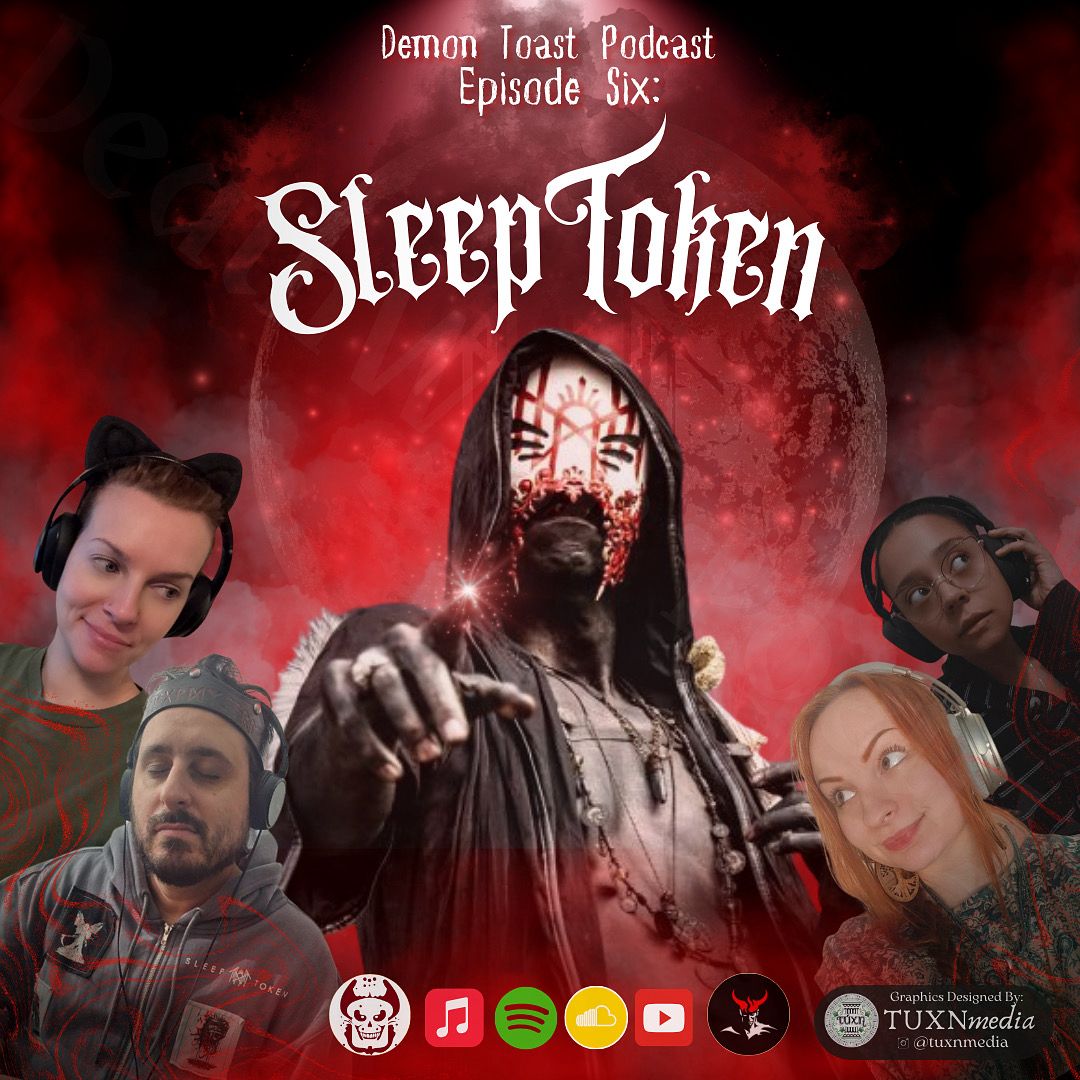
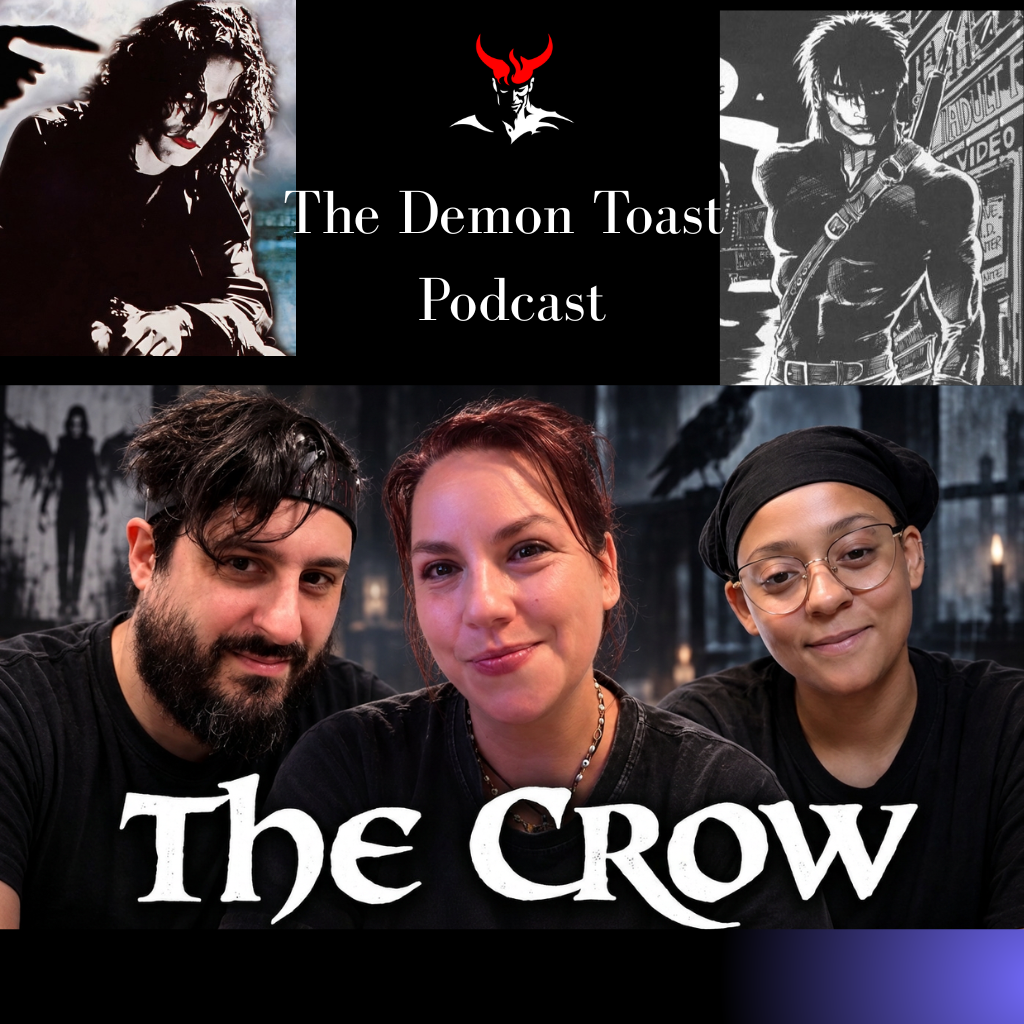
[00:00:00] Speaker A: Hey, everyone. Welcome back to Demon Toast. This is the podcast of Death Wish Poetry magazine.
We cover gothic and horrific literature and art, and. Well, I'm your host, King Loki. I'm the editor of Death Wish, and I host this cool show. My two co hosts are here. We have Erica Poet.
Awesome lady. And Adrian Artist all around.
Like, I mean, she's a big deal. She does a lot of cool things in New Mexico and Texas.
[00:00:33] Speaker B: Yeah, I'm not that cool, guys. You guys know me by now. I'm really not that cool.
[00:00:39] Speaker A: Well, you're cool enough to talk about our subject today, which is the Crow.
Classic goth icon.
You know, very important independent comic book, very influential movie. It is kind of a franchise. There are several comic books that are unrelated to the original one. There are four movies, three of which, I mean, none of them are really related. There's a TV series, so lot going on. We're not here to talk about all that, though. We're here to talk about the original movie. And me and Adrian will probably talk about the comic book a fair bit. It's kind of a big deal, right?
[00:01:17] Speaker B: It's a very big deal. And James Obar is brilliant.
[00:01:19] Speaker A: Yeah, James Obar. We're going to talk about him because, you know, I talk a lot about the healing power of art, and, well, his experience is a little different in that regard, but we'll get there. First of all, Erica, you're a little younger, and you just saw this movie for the first time.
Tell me about that.
[00:01:37] Speaker C: I did.
It was a very interesting experience. I had heard some really great things about it, both from y' all on the podcast team and then some friends outside of the podcast.
So I'd been meaning to watch it for a while, but I couldn't really convince myself to not for lack of interest. I'm just kind of lazy.
But I loved it. I can see why. It has the reputation that it does. And it is a very powerful film, I think.
[00:02:08] Speaker A: Yeah, it certainly is.
Before we get to my impressions, Adrian, I mean, you're, like, two years older than me. I mean, you know, tell me about your.
[00:02:20] Speaker B: I was in seventh grade when it came out.
It was a big deal. My friend rented it from the movie store. My mother told me I wasn't allowed to seen it. Like, I wasn't allowed to watch it.
And I was usually a pretty good girl. Like, I didn't do bad things, but Ren put it on anyway, and I couldn't say no to the Crow. Like, I couldn't, like, be like, Nope, nope. So I sat There and watched it. And then I had to tell my mom that I lied and watched the Crow later that night. But it was fine. She wasn't mad at me because I loved it so much. It is a gothic beauty of a film.
[00:02:58] Speaker A: Yeah, yeah, yeah, definitely.
Yeah. I mean, there's nothing worse than watching the Crow. So, you know, I don't know how good you were really, but, yeah, growing up. So I was really into the Punisher when I was like, 12 or something. I had a Punisher shirt and all. You know, I would watch this episode of the Spider man cartoon.
I mean, you know, it's funny. This is before YouTube existed, so I think I would just quote it all the time, actually, where the Punisher and Spider man team up and it's this whole thing. But, like, my mother was like, yeah, he's into the. He's into the Punisher. You know, it's this stupid movie where people. Where he paints his face and kills everyone. And I'm like, I don't think the Punisher paints his face. And she's like, shut the up. You don't know. And I'm like, oh, okay, I. I don't. You're right. And years later, you know, when I'm wearing a. You know, when I'm out of that house and I'm wearing a. Know a leather trench coat every day in combat boots, I watch this movie called the Crow, and I'm like, right there, that's me.
I will say that the Crow has a reputation. It's like, it was so. It's like the Hunger, which was also influential in the goth scene.
Like, it's like the movie. Oh, he saw the Crow and it became his whole identity, you know? Like, I think. I think in Johnny the Homicidal Maniac, like, there are some digs at it, but, like, yeah, I mean, it is a. So there's a lot of things about this movie, right? Like, I was arguing with someone about Marilyn Manson recently. They were saying, oh, his newest album, one Assassination Under God Chapter two is his.
His first goth album in years. And I'm like, everything the. You talking about, everything he makes is gothic. And the thing is, is like, goth refers to a very specific era of music, right?
This, like, 80s, like, monotone, almost monotone, dreary sound.
Kind of influenced by post punk, right? But like, you know, Bauhaus, Joy Division, the Cure, music like that, that, you know. Like, I think a lot of people, when they think of goth, they think of, like, screaming metal and, like, Cradle of Filth. Those things are Gothic now.
Like, the title, I think, has expanded a fair bit, and the Crow is a great example of that because, like, you. Um, let's look at the soundtrack, which is a. One of my favorite albums.
You know, there's the Cure, of course. There's, you know, stuff like Medicine, right, Which are goth bands, but then there's also, like, Nine Inch Nails, which is, like, industrial, right.
[00:05:31] Speaker B: And it is now also considered a goth band as well. Like, Trent Reznor is King Daddy. Like. Yes.
[00:05:38] Speaker A: Yeah, yeah. If you go to a. If you go to a Nine Inch Nails, like, show, you're going to see a lot of girls and, like, ripped, like, fishnet stockings and smeared red makeup, Right. I mean, Adrian's one of them, right?
[00:05:50] Speaker B: I'm totally 101 of them. I actually went to a gothic dance night in Las Vegas, New Mexico, and sure enough, they were playing me some Nine Inch Nails. It was fantastic.
Yeah, it was one of the best nights.
[00:06:05] Speaker A: Yeah. So, like, you know, I mean, not everything on here is goth, of course. Like, it is a movie. So, like, there's a part where, like, the car. Like, a bunch of thugs in a car driving, and you hear Stone Temple Pilots. I'm not gonna sit here and say that that's part of the subculture, but it is a snapshot of the era. Like, the Crow is very much a 90s movie, right down to the little skateboarding girl, the Stone Temple Pilots. You know what I mean? And the awesome special effects. I mean, movies like this age wonderfully. By the way, I've watched this movie so many times. This is the first time I noticed that the city you see in the opening is a miniature. Did any of you pick up on that? I mean, it looks pretty damn good. You know, as someone who's watched a lot of Godzilla movies, I know a miniature city when I see one.
The director of this is Alex Proyas.
He's Australian. I thought he was French for the longest time, but no, I feel like
[00:07:03] Speaker B: that's fair, though, because a lot of his, like, aesthetics and, like, at least the two films of his that I really like are that dark, dreary, rainy, French, like, kind of surreal take on things. So, I mean, that's fair, Dan. It's fair.
Yeah.
[00:07:18] Speaker A: Yeah. Of course. You're talking about Dark City. Another interesting movie. Maybe we'll cover it here someday. I mean, you know, do I. I. There's a lot to say about it. I think it's kind of a derivative movie. But, I mean, you know, it did the Matrix, like, in. In a goth Away, you know, years before. Like a year or two before the Matrix.
[00:07:37] Speaker B: So.
Yeah, it was a couple years before the matrix, wasn't it?
[00:07:41] Speaker A: Like 98.
[00:07:43] Speaker B: Okay.
[00:07:45] Speaker A: So I did want to say that the crow in this movie is actually a raven because crows are pretty small and they have trained ravens that are very beautiful. His name. His real. His name was magic.
And he was a very good boy.
They gave him treats.
[00:08:02] Speaker B: This.
[00:08:02] Speaker A: So the crow. Right. Broadly, we're speaking about the movie first and foremost. It's a story of Eric Draven and his girlfriend Shelley. They are attacked by a group of thugs in their home. Their little apartment is destroyed, ravaged. His girlfriend is raped. He's. He's shot and thrown out a window.
And then a year later, old Eric Draven is brought back from the dead by a magic crowd who is his spirit guide. It's his link to the world of the dead and the world of the living. And it has brought him back so that he can settle the score for the horrors that were wrought to him and his fiance.
Now, I'd like to mention that Brandon Lee, who was the star of this movie, died in real life making the movie.
Luckily, they shot most of them. They shot all of the movie before the execution scene, which, ironically, is the first. First scene, there was something wedged in the prop gun, so when they fired the blank, it killed him.
[00:09:08] Speaker B: Never get over it.
[00:09:10] Speaker A: It's really sad. It's really sad. He's incredible in this movie.
It's. It really is like a. Like a incred. Like a once in a lifetime kind of role. It's like the Goblin King or something, the way he plays this character.
They considered not finishing the movie, but it felt. It only felt right with the movie mostly done and this being his last movie to finish it. So they burned the footage of him dying, reshot the scene with a. Another actor, like a body double, and called it a day. So kind of a morbid bit of trivia about this movie.
But, yeah, he goes on a path of revenge. I really love, by the way, the. The resurrection scene.
It's really cool. Like, the crow is pecking at his gravestone to wake him up. It reminds me a bit of the scene in Spawn where he's brought from the dead. But the Spawn movie is terrible, so it's, of course, a common. It's a comedy scene.
[00:10:04] Speaker B: Well, it reminds me of Edgar Allan Poe's the Raven knocking on my chamber door, you know, but it's a tombstone. It's waking him up.
[00:10:12] Speaker A: That's a good point.
[00:10:13] Speaker C: I Had a very similar thought seeing that scene. I do also love that we get to see the. The crowd, like, often and frequently throughout the film.
[00:10:24] Speaker A: Yeah, yeah. It is a haunting presence that follows him wherever he goes. I love when it's on his shoulder as he's walking.
The comic book, it's usually his cat, Gabriel. Gabriel, which he adopts, but the crow makes more sense because he's the crow and the crow is. Is his tether. Right.
It's also cool how the crowd can share its vision with him.
Which brings us to the point about I eyes, which are a recurring motif in this movie. Right?
One of our villains. Yeah, one of our villains. So basically, like, the comic book doesn't have this element, but Shelly is, like, I don't know, fighting against, like, eviction or something. There's like, some kind of movement.
And, you know, this guy who profits off people's misery sends his thugs to go kill her. That's basically what's going on. And, like, the guy who lords over all this, Adrian. Is it Top Dollar or T Bird?
[00:11:32] Speaker B: It's Michael Wincott. He is always Michael Wincott. His voice is absolutely magic. He sounds like rough silk every time he talks.
[00:11:42] Speaker A: So, yes, he's very scary in this movie. And his partner in crime, who he claims.
[00:11:50] Speaker B: Sister.
[00:11:52] Speaker A: It is the one and only filing relationship.
Yeah, they have a strange relationship. They. The first time you see them, they have, like, a corpse in bed, and she's like. She says something and. And he goes like, I think we broke her.
[00:12:12] Speaker C: Her siblings, they are particularly intimate.
[00:12:16] Speaker A: They are.
[00:12:17] Speaker B: This is Game of Thrones before Game of Thrones, guys.
[00:12:19] Speaker A: Yeah. I don't know if they're. I don't know if they're siblings. I'm very. I don't. I never thought too hard about it. I just assumed they were weird, strange creatures.
[00:12:26] Speaker B: He makes that whole thing. He does a whole.
[00:12:29] Speaker C: Talk about a weird kink thing.
[00:12:32] Speaker A: Yeah, yeah. I mean, I'm not. I'm not gonna kink. Shame. You know, Michael Wincott and Bai Ling. It's okay. They could do whatever they want. Just stay away from.
[00:12:39] Speaker B: Yes, they can.
I will say I have met Biling, and she is one of the nicest, most amazing people ever. And she talked about snakes with my daughter for 45 minutes, which is a total Biling thing to do. I suppose it was cute.
[00:12:56] Speaker A: Did she.
Did she. Did she tell you you have beautiful eyes and look strangely at you?
[00:13:05] Speaker B: Actually, she told me I needed to stop dressing so conservatively, which is funny because it's me and she's like, you're so much cooler than the way you dress.
[00:13:17] Speaker A: Interesting. Wow.
[00:13:18] Speaker B: I loved her so much.
[00:13:20] Speaker C: Oh, it made me.
[00:13:22] Speaker B: Oh, she was wonderful.
[00:13:25] Speaker A: Wow. Man, that would. That would make you change my whole life, you know?
Yeah. So I. You know, it's interesting. She. She cuts out that woman's eye, and she.
She burns it. And she tells Michael Wincott, there's. There's. There are dark forces coming for you, right?
And of course, it's the Crow doing this, right? It is Mike. It is Michael. It's Eric Draven. And there's this wonderful scene where he goes back to his apartment, and as he touches the things that are still there from a year ago when he was killed, he relives every moment of it. You know, there is a part where one of the thugs is reading Paradise Lost, you know, and a bash the debt. The devil stood and felt how awful goodness is.
He sees his girlfriend being sexually assaulted. He sees himself getting shot. You know, he even falls backwards. But because now he's. He has mystical powers, he's able to catch himself.
And he picks up this. This. This white joy mask that had been on the wall, and he looks at it, and he just is so repulsed by it that he looks at his face in the mirror and he punches it. And that's when the Cure's Burn starts playing. And it's like the person he was before is dead and gone, and he is now remaking himself into this avatar of vengeance and death.
[00:14:51] Speaker B: Can I say something about that Cure song, by the way?
[00:14:54] Speaker A: Go ahead.
[00:14:55] Speaker B: Robert Smith, the lead singer of the Cure, was originally, when they contacted him to give them a song for this movie, he was like, sure, let's just use something that I already have.
And then they let him watch a copy of the movie with no sound.
And he was so inspired that he wrote Burn in three Days and was like, no, we're writing something completely new for this movie. And it was entirely inspired by the movie, for the movie.
And we love you, Robert Smith. You are awesome.
[00:15:25] Speaker A: Yeah. Yeah.
[00:15:26] Speaker C: That's so iconic.
[00:15:28] Speaker A: Absolutely. It's a great song. It's a great song. Yeah. It's funny because I remember when I first, you know, started listening to the Crow soundtrack as just an album, I was kind of like, I wonder what album this song is from? And I remember trying to find it, and I just kept coming up the Crow soundtrack. And that's. Yeah, that's kind of when I realized, oh, this is for the movie, you know?
Yeah, it's a great, powerful scene in the comic book. He dances.
You don't see him go through this phase where he's, like, reliving everything. He doesn't have that magic where when he touches things, he sees them.
He knows what happened. And you see him in. In his. His apartment, and he's, like, doing these elaborate movements, you know, J. O Barr.
We'll get deeper into that. But he was working through some heavy trauma when he wrote, so the movie's a lot more focused and it has a much more positive tone and message, in my opinion.
[00:16:31] Speaker B: It has a lot of hope in it.
[00:16:33] Speaker A: Huh?
Right down to, you know, his relationship with Sarah, the little girl, right?
She's like Eric and Shelly's friend before they die, and then they bump into each other.
He saves her from getting hit by a car while he's the crow.
And she's like. She says something like, it always sucks around here. And he goes, it can't rain all the time.
[00:16:59] Speaker B: All the time.
[00:17:01] Speaker A: Yep. It's the line, right?
[00:17:02] Speaker B: It is. I get that.
[00:17:03] Speaker A: Goosebumps.
It's a great scene. And she connects that, of course, to, you know, a song that he wrote with his band, which is the Hangman's joke, by the way. I knew a girl, I almost dated her, but I knew this girl who had it can't rain all the Time tattooed on her with a crow. You know, it was, like, on her arm or something.
Very cool.
I have to assume that that is a pretty common tattoo also. If you have that tattoo, leave a comment.
[00:17:29] Speaker B: You know, let's see how many of you guys have tattoos like that, because that's actually epic.
We need more girls like that in our lives.
[00:17:37] Speaker A: Yeah, I mentioned that, like, the special effects, like, there's a scene where he's doing parkour, where he's running across rooftops and jumping and feeling the power of night. He fall. He lets himself fall into, like, a mound of trash. And I should probably point out that this is one of two gritty revenge movies with a theme of resurrection set in Detroit.
There's the crow and, of course, robocop.
Kind of interesting, right?
[00:18:08] Speaker C: I've never seen robocop, but I've seen plenty of memes about robocop. So the fact that those two have such similar plots but seem to have such different vibes takes me clean out.
[00:18:22] Speaker A: Yeah, they're very similar. Erica, what are you doing with your life? Go watch RoboCop.
[00:18:27] Speaker B: You're killing me, Kate.
[00:18:28] Speaker C: RoboCop under a rock. Okay. I didn't see Die Hard until, like, two or three years ago.
[00:18:35] Speaker B: That's awesome.
Oh, My gosh, I'm so old.
[00:18:41] Speaker C: I'm just uncultured.
[00:18:44] Speaker A: It's okay. It's okay. You'll watch RoboCop and you'll be cultured. You know, we will. We will anoint you in the healing waters of robocop and all will be right with the world.
That's it. So just like robocop, the thugs, the criminals in this movie are pretty wacky, right, Adrian? Like, they're very wacky and over the top, they, like, eat bullets.
They. They burn their tongues with cigarettes.
[00:19:10] Speaker C: They were very interesting characters, I thought.
Like, very eccentric. But I think that also did well to kind of underscore, like, the level of depravity that seems to exist within the city, because they are just genuinely unhinged for the sake of being fucking unhinged.
[00:19:29] Speaker B: Yeah, it's like a Batman comic book kind of.
[00:19:31] Speaker A: They have no hope. They have no future. This is it, right them.
[00:19:35] Speaker C: Because some aspects of it are relatively easy to identify with, like that sense of helplessness or hopelessness sometimes when you're existing in this place that you can't seem to, like, really get a leg up in or get out of.
But I think the way they went about working through that was definitely not the greatest.
[00:19:59] Speaker A: Well, they had hobbies. I mean, Tintin liked throwing knives, right? You know, that other one liked setting fires, maybe.
[00:20:06] Speaker C: Let's not throw them at people.
[00:20:08] Speaker A: It's not very nice, is it?
Yeah. Don't you just hate when, like, you kill some guy and then a year later he comes back on a mission of revenge and you throw knives at him and, like, he dodges them and then catches one and stabs you with it. And it says, victims aren't we all? Don't you just hate when that happens?
[00:20:25] Speaker B: It's very unfortunate. I mean, what a world.
[00:20:29] Speaker A: What a world.
[00:20:30] Speaker C: You shoot him and he laughs in your face.
[00:20:33] Speaker A: You know, he manically. He quotes Edgar Allan Poe, you know, like, what the.
It's funny. In the comic book, he quotes a lot more than Mr. Poe. He quotes Emily Dickinson. He quotes Joy Division, he quotes Bauhaus. He quotes the Book of Revelation. I mean, he quotes everything. He's a very well read crow, you know,
[00:20:52] Speaker C: very scholarly.
[00:20:53] Speaker A: I think my favorite scene in the movie, and it's probably because my mother was a drug addict, but it's where he goes in, right? And he's there to kill Funboy. Yeah, Fun boy's gotta go. That's actually the scene where they.
[00:21:06] Speaker C: Fun.
He's.
[00:21:07] Speaker A: Well, you know, it's fun for him. I Guess. But that's actually the scene where they play Nine Inch Nails. Dead Souls. Great scene.
And he goes in there and Sarah's mom is there, right? And he kills Fun Boy. Well, he. He attacks Fun Boy, throws him in the. In the. In the shower. And she's sitting there, right? And she's. She's swinging her little switchblade.
[00:21:30] Speaker C: He.
[00:21:31] Speaker A: He grabs her arm and he forces her to look at herself in the mirror. And he says. Says this line, he says, mother is the name for God on the lips of all children.
Morphine is bad. And he uses his power to suck the drugs out of her veins.
He says, your daughter is on the street.
She needs you. Go to her.
And then he goes and kills Fun Boy.
But the scene's really cool because in the comic book he does the same thing, but there's no follow up. Like, that little girl. I think her name is Sherry. There's. She doesn't. She doesn't come back. Like, he goes and says goodbye to her before he dies.
Spoilers.
But, you know, in. In the movie, of course, they're friends. They know each other. So there's this, like, really great scene later on where Darla, the, you know, the mother, is trying to cook breakfast for her and be a mom. And there's tension, right? She's like, what kind of eggs do you like? And she's like, you don't care. You're never here. And she's like, ah, this mother sucks. And then, you know, Sarah goes, I like them over easy. And it's like this little hint, it's a tiny bit, that things might work out, right?
[00:22:47] Speaker C: That was a really nice scene. I will say. It did also just rub me the wrong way a teensy tiny bit that she was willing to throw in the towel. That fucking fast lady. You are a drug addict that lets your kid run wild on the streets while you can get some in the back of the bar. Do you expect her to just be okay with all of that overnight because you made some fucking pancakes? Be so for real.
Yeah, but I was really happy that she did not just lose her shit on her mom and be like, are you fucking serious?
She didn't have to make the effort. It wasn't her responsibility.
But I'm glad she did because there is hope.
[00:23:27] Speaker A: I feel like it was a realistic, like. Yeah, I mean, you know, what you said is valid, but I feel like it was realistic because recovery, even when there's a magic crow guy who sucks the drugs out of your veins, recovery is a journey of a thousand Steps, at least. Right? I mean, you know, I think that's
[00:23:45] Speaker C: something I would like to see expanded on a little bit more. But I also understand that this is like an hour and a half movie, so you can't have a whole recovery arc in that time frame.
And this isn't the sort of thing that would probably translate super great to a series. I feel like they would butcher it.
[00:24:05] Speaker B: Not. Not in the 90s. Not a series made in the 90s. Because they did try to turn this into a series in the 90s called Crow. Stairway to Heaven with Mark Dacoscos, who's great show is terrible.
[00:24:16] Speaker C: It's terrible.
[00:24:17] Speaker B: It's boring. It's awful.
[00:24:18] Speaker A: Is it better than Night Man?
[00:24:20] Speaker C: He's important.
Yeah.
[00:24:24] Speaker B: I don't know.
[00:24:25] Speaker A: Oh, God. Okay.
Night man. He plays a saxophone by day and wears a cheesy mask by night. It's real good. All right. Yeah. So that's arguably my favorite scene.
Let me think.
So basically, like, he's. He's on a. He's on a tear, killing these guys. He really only wants to kill four guys. But of course, you know, the.
The head of this weird outfit and Bai Ling. Michael Wincott and Bai Ling, they understand that he's supernatural and they want his power. So the last guy is held in their fortress at the top of some building, right? And that leads to a really great scene where Eric Draven, who in the movie is a.
He's a rocker, right? So he goes up to the rooftop and he starts shredding on his guitar, playing this beautiful melodic guitar riff because he's saying goodbye.
[00:25:26] Speaker B: That is my favorite part. That is my favorite part of the whole movie.
[00:25:29] Speaker A: It's good. It's a beautiful scene, you know, because, like, here's the thing. And it's. It's in the spirit of the comic book, because the comic book has a lot of interludes where it's just pictures of the crow, like, brooding or sneering. And there's, like, you know, the lyrics to a Joy Division song or a Bow House song or a Cure song.
One of my favorite things that the Crow, it's. It's after he kills Funboy, after he makes Funboy overdose on morphine, he writes in his blood, I know why Jesus wept.
You know, a line that was stolen or reappropriated by Slipknot. On my favorite Slipknot album, the Gray Chapter, he opens up one of the songs with I know why Judas Wept. So there you go. If you wondered where that was from, it was not from the Bibble. It was from the Crow.
Good old the Bibble. The Greatest Story.
Better even than the Crow, apparently.
Let's see. He tells a really hilarious joke, by the way, when he goes to kill Funboy, he says, you know, because he screams, jesus Christ. He shoots him in the hand, which makes Eric Draven, as he looks through the hole in his hand, makes him think of the stigmata. And he's like, jesus Christ walks into a bar. He walks into an innocent.
And the innkeeper three nails and says, can you put me up for the night?
[00:26:49] Speaker B: You know, I got a good giggle out of me.
[00:26:52] Speaker A: Yeah, it's better than anything that the Crypt Keeper ever says, you know?
Yeah, you know, it's true, Adrian.
[00:27:00] Speaker B: You mean if we're talking poetic wise. Yeah, but I don't.
[00:27:05] Speaker C: I love my Adrian said fantastic side eye.
[00:27:10] Speaker B: That was the Crypt Keeper's sacred, man.
We.
[00:27:14] Speaker A: We love the Crypt Keeper here.
Speaking of scary people, you know the star of Ghostbusters, Ernie Hudson's in this movie. I don't know why we haven't talked about him.
[00:27:23] Speaker B: That's what I was waiting for you to get to.
[00:27:25] Speaker A: I was like, don't do Ernie like that, Adrian. Tell me about Ernie Hudson in this movie.
[00:27:31] Speaker B: Well, back in the early 90s, Ernie Hudson gets to play this really awesome cop who had to, you know, he has to deal with, you know, Eric's death and shell. What happened to Shelley. And he sits there with Shelley while she's dying, wanting to catch these bad guys. And of course, it's all corrupt because it all takes place on this night called Devil's Night, where is like the night before Halloween where they all burn the houses down and like, all sorts of stuff to like. Yeah, it's like a whole conspiracy thing, which is Michael Gwyncott's in charge of all of it. But Ernie Hudson is so funny and so jaded as this cop, but he's also friends with the little girl, Sarah.
So the Crow kind of like watches over Ernie Hudson and watches over Sarah. But my point is, in the 90s, a lot of black men did not get to live at the end of films, especially films like the Crow.
But he does. He actually gets to be a good guy and he gets to do the right things and he gets to live. It was kind of a big deal.
[00:28:39] Speaker C: Cop and Sarah were definitely my favorite characters, I think, because he reminded me a little bit of my dad. But also for all the reasons you gave, especially in older media and like gothic or horror media especially, there's a lot of underrepresentation in people of color. And if they are represented, it's usually negatively or they die first.
And we still do kind of see that out of the gangsters, the black one dies first.
But it was really, really nice to see that we got such a prolific character out of him and that he was recurrent throughout the movie. It wasn't just like we saw him in passing and he was non verbal for the three seconds he was on screen. He was genuinely helpful.
And I think both his presence and Sarah's helped to underline that message of, like, love transcending and like, grief transforming. Right.
Because it exemplifies that there's more than just romantic love that fits into that. Like, you can just be deeply enamored with someone for any reason and be driven to do something for the good of them in the relationship that you've built.
[00:30:03] Speaker A: Yeah, yeah. They. Speaking of which, they have this wonderful scene.
I love this scene where Ernie Hudson, he's in his house and he's. He's in his underwear, but he's still wearing his hat.
And it's like he took that. It's like he took his shirt off and then he put his hat back on, like, and he's like drinking a beer and smoking a cigarette. And Eric shows up in his crow makeup and he's like, whoa, don't do that, man. And he's like, he says something charming and Ernie Hudson's like, smoking a cigarette and he's like, those are bad for you. And Eric takes it and he starts smoking it.
You know, they have like this wonderful little moment, this like, little Frodo and Sam moment. And yeah, like, the character's name, Albert, it's taken from the comic book. But that, that's a nothing character.
I will say that in the comic book, like, all the black people are thugs and bad people. They all talking ebonics.
So, you know, I will agree he is a great character.
Conversely, there is a very scary, very efficient.
I. I think of him as like an assassin, but he's really like T Bird's muscle.
And he's the other, like, major black character in this movie. And he's very like Kurt. He doesn't speak very much, but when he does something, he does something. When he puts on those black glasses, those, those round glasses, he means business.
But getting back to Ernie Hudson, it's a great role for him.
It's funny, there's this huge shootout. It's when he kills the last guy and he murders, like, all of T Bird's people. And he's Running from the cops, and there's, like, a helicopter. And the whole scene kind of reminds me of that chase scene in Batman, Mask of the Phantasm.
It's this elaborate animated scene where, like, Batman's running and the cops are everywhere, and there's, like, a helicopter.
And, like, I'm pretty sure the same exact thing happens where.
So in this movie, Ernie Hudson pulls up in a car, and he's like, get in. He's just there. And I'm pretty sure in the Batman movie, like, Alfred pulls up in a car, and he's like, master Bruce, get in the car. You know, but it's a great scene. Speaking of which, actually, there is a really cool chase scene where the crowd he captures, he's in the backseat of one of the thug's cars that he wants to kill. He's, like, the one that sets the explosives.
[00:32:26] Speaker B: That is the guy that plays Jerry on Twin Peaks, like the original series. I'm just saying it's a big deal. Okay. Anyway, I'm done.
[00:32:34] Speaker A: Yeah.
Here's a screen gap.
Here's a shot of him.
If you're watching this on YouTube, there it is. Yeah. Yeah. But, like, they're being chased by the cops while the crow takes him to the. I guess the harbor where he wants to kill him.
And it's this epic chase scene. But what I love about that scene is that, like, parts of it are the car. They cut to the speedometer, which keeps going up to 120 miles per hour, and then they cut to, like, these wide shots of two miniature cars driving.
Like, it's elaborate and crazy and really unlike anything else. Like, when people say that, like, you know, the chase scene in, I don't know, the Avengers is a bad car chase scene.
It's because there's no panache to it. You know, Like, a good chase scene can be as effective as anything else. And this scene, this movie, it doesn't do anything in a. Like, if I had to describe this movie in one word, it would be style.
Like, this might be one of the most stylistic movies of its era.
[00:33:37] Speaker C: You know, I thought it was so beautiful. Just visually, they did make a lot of very important, I think, choices with the way they chose to set scenes up, the lighting, everything. It was so intentional, and it makes everything so much more meaningful, I think.
Yeah.
[00:33:58] Speaker A: Yeah, definitely. Also, I did want to point out, much like, the Hunger, which had Bauhaus in it, this movie had medicine and Adrian, Is it My life with a thrill kill.
[00:34:11] Speaker B: My life with a thrill kill cult.
[00:34:13] Speaker A: Yeah, it has Two bands, which of course, adds to the atmosphere that we're talking about and I think is pretty neat. If you haven't listened to this soundtrack, by the way, just go listen to it like it's on Pandora and stuff as the Crow soundtrack.
[00:34:27] Speaker B: You know, what are you doing with your life if you haven't heard the Crow soundtrack?
[00:34:32] Speaker A: So the movie is very different from the comic book. You know, at the end, like, there's this wonderful scene near the end where he has killed everyone that he needs to kill. And he sees a bunch of little kids in costume run by. They're gonna go trick or treating, right?
And Eric has this moment of joy where he smiles, right? And, you know, of course, there's like a, you know, a bit of a denouement where they. They, you know, the bad guys capture his little friend, his little child friend. They capture Sarah, and he has to go save her. And Ernie Hudson saves the day, whatever, right?
But the point is, is that, like, the movie is very hopeful. At the end, when he returns to his grave to, you know, his mission done, Shelley comes and crosses him over, and she's wearing this lovely white gown and takes him by the hand and walks away with him. The comic book, it's nasty, it's horrible, it's edgy.
And at the end, after he's killed everyone, after he's massacred so many people, he returns to the grave and just injects himself with all the drugs that, you know, he's taken from these people, and he dies again.
It's brutal, it's morbid, it's full of, like, horrific quotes from different things.
Let me see here. Let me read a bit of dialogue for you.
This is the first thing he says in the comic book. Let's go back to page one, shall we? So the bad guy shoots him, right? No, he stabs him.
[00:36:01] Speaker C: Him.
[00:36:01] Speaker A: And he says, man, you must be dusted not to fuel that. And the crow replies, pain. I know pain at the molecular level. It pulls at my atoms. Sings to me in an Alphabet of fear. I am the boiling man come to break the bones of your sins. Meat Puppet hands him the knife. Try again.
Yeah, that's how he talks.
He cuts people's fingers off with.
You know, occasionally he has these, like, weird little interludes where he's thinking back to Shelley and him or riding the train to the world of the dead.
And it's rendered in, like, this realistic style. I'll flash it on here in case you're watching on YouTube. Of course, there's also, like, this Recurring, like, motif of, like, a skeleton cowboy who, I guess is the conductor of the train. I don't really know. He was supposed to be in the movie, but the effect was a little expensive. I think he was stop motion. So he didn't make it in.
But the comic was J obar's way of coping with the death of his girlfriend. She was killed by a drunk driver in 78.
And he wallowed in that for many years. And then he heard a story about a couple that was mugged and killed for $20, and it brought up a lot of pain for him.
And he wrote the Crow. It took him a long time to finish it. You know, it was. It started being published by one press, it started getting published by another.
There were some, like, prequels he wrote that were very short. They were in bigger magazines. And the version we have now kind of came together in 2011. But the thing about J. O' Barr that bothers me is that he says the comic book brought him no relief. It brought him no salvation.
He feels like he was just wallowing in his pain.
And, you know, as a poet, as, you know, the editor of Death Wish Poetry magazine, like, I have a strong belief that art can heal us. Art can change us. You know, sharing our grief, transmuting our pain and other feelings into paintings or poetry is transformative in and of itself. It's spiritual.
So I don't know, what do you guys make of the fact that, you know, this guy wrote this comic book that was so influential, it was such a pure expression of his pain and he didn't feel like it was enough. You know,
[00:38:47] Speaker C: the comic isn't something that I'm particularly familiar with. I didn't have the time to read it in between watching the movie and recording today, but I'm definitely going to look into it.
I will say that I agree wholeheartedly. By and large, I think that art is a transformative experience and can help guide you through a lot of difficulties in life. Yeah, but if you're not coming at it with the right intentions, a lot of the time, I think, is where things can get sort of lost.
And if your goal isn't to work through that or to, like, share those experiences and that grief so that it.
So that someone else who has experienced it has the opportunity to relate or so that you can get that off of your chest, it does have the ability to transmute into something heavier instead of.
[00:39:47] Speaker B: I feel like by the time it was done. I have spoken to so many people who have read it who did, like, who have gone through traumatic experiences and were able to find something that did heal them in some way by being able to relate to these characters that he created, that even though maybe he was trying to help himself, he ended up helping others for sure.
[00:40:17] Speaker C: Almost feels like it was a necessary thing to come into existence because he might not have felt relief in it initially, but hopefully seeing that other people have found some of their own in his work has made him feel better after the fact.
[00:40:38] Speaker A: I would hope so. I would definitely hope so because like, you know, I've seen a lot of myself in this character. The crow isn't Deadpool. He's not like, he's not the Punisher, right? He's not this self assured.
Well, yeah, he's just a man, but like, you know, he's gifted with mystical power, but he takes no joy in it. Like he, he cuts himself, he feels pain and sadness. He quotes his, his morbid poetry like, you know, a teenage kid in his, in his Doc Martens. Right? But he's in pain and he's suffering and yeah, I, I would definitely agree that like, you know, Mr. Obar might not have felt relief in it. You know, a lot of people like us have though. And the thing is, is that like, I'll agree with both of you, intention matters.
But at the end of the day, you know, I think that mental health is a complex thing, you know, very.
It's a complex thing and it's very easy for us when we're alone and don't have proper community to wallow and fall back into cycles of depression, sorrow that just perpetuate themselves and compound and drag you deeper and deeper no matter what you do.
You know, it can be an addiction, you know, in a sense, right? I mean, like pain is protean. It takes different forms and can be pernicious. You know, like trauma just has these patterns that repeat over and over again like. Like some kind of chaos theory model, right?
So, yeah, I mean, you can make, you can make art, but you know, you should probably talk to a therapist too.
[00:42:31] Speaker C: I had a therapist tell me one time that when you are accustomed with disorder in your life, you have a tendency to seek it out when you are in situations that feel too comfortable for too long, because that comfort translates into unrest because you don't know how to be still or how to live in that piece. So maybe this was a similar sort of situation. He could have gone into it with the intention of working through things, but putting that to paper might have triggered like a negative thought loop that just Kind of spiraled from there.
[00:43:10] Speaker A: Yeah, fair enough. Yeah, I mean, I definitely. Like, it's not a magic spell. You know, you're depressed. You know, you're abused by your parents, you're in a bad situation, you paint a picture, you write a poem.
It's done. I'm better now. Right. Like, nothing works like that.
Everything's a process.
[00:43:31] Speaker C: I think the complexity of his emotions translates really well into all of the iterations of the crow. It sounds like, in some way or another. And there's value to be found in it, regardless.
[00:43:42] Speaker A: Speaking of which. Yeah. There's many iterations of the crow. The second movie. Me and Adrian were just talking about it. It's basically the first movie again, but on a shoestring budget. It's. It's terrible. There are elements that Adrian reminded me of that I don't remember. Where Sarah gets shot and all this stuff.
[00:44:00] Speaker C: Yeah.
[00:44:00] Speaker B: Like, Sarah's all grown up.
[00:44:02] Speaker C: Watch that.
[00:44:03] Speaker B: No, don't, don't. You don't want to see it. I was like, I guess this is okay. Until they shoot Sarah and he ends up like. It's Vincent Perez as the crow this time. And, you know, he's not Eric Draven, the crow. He's a different crow, but he and Sarah end up sleeping together even though he's avenging his dead wife. It is so gross. It is terrible.
[00:44:26] Speaker C: It's a terrible.
[00:44:29] Speaker A: Yeah.
[00:44:29] Speaker C: It just makes no sense.
[00:44:31] Speaker A: Is the third one the one without Edward Furlong?
[00:44:35] Speaker B: Is that the one with Eric Furlong or Eric Mabius?
[00:44:38] Speaker A: I don't know.
[00:44:39] Speaker B: Why do I know this?
[00:44:40] Speaker A: It's called Wicked Prayer. Right?
[00:44:43] Speaker B: I don't know.
[00:44:44] Speaker A: It's awful.
[00:44:45] Speaker B: Well, so does the Eric Mabius one. They're all terrible. And I love Eric Mabius, but. Ew. No.
[00:44:51] Speaker A: Yeah, the last one opens up with this, like, reference to the Good, the Bad and the Ugly. It's very weird. It's a. I always. I like that movie because it puts me to sleep, and that's a great thing, you know, like, sometimes I can't sleep.
[00:45:01] Speaker C: So I put on that movie since I was, like, 10 or 12. And. Yeah, it was one of those movies that my mom would put the DVD in every night. Fall asleep, too. That and Passion.
[00:45:13] Speaker A: Well, the Passion of the Christ is a. Sleep is a snoozer, too. Yeah, yeah, yeah.
[00:45:18] Speaker C: No, my mother's also extremely religious, so it was either I got to bore myself to death or I got to listen to the gospel.
Oh, well, okay, Mom. Do what you do.
[00:45:30] Speaker A: Yeah, we have fun here, right, you guys that Jesus guy, you gotta love him.
What a scam. What a scamp.
Where am I going with this? Oh, yeah, yeah, yeah. So like, Adrian mentioned the TV show. There are lots of sequels to the comic book. They none of them pick up the same character. Each comic book is a different crow. None of them are written by J O Barr. Maybe one or two, I have no idea.
I bought like one once. It was kind of like. I don't. It's okay, whatever.
[00:46:02] Speaker B: It's one that was this girl crow and it was so good. I wish they would like, make us a girl crow movie if we're gonna do it. Like, don't make Eric Draven do one of the other stories. Make it, make it cool. No, it will never happen.
[00:46:16] Speaker A: Yeah, I remember back when I was in college.
[00:46:18] Speaker C: Get a prequel with all of this stuff that happened leading up to them being murdered.
[00:46:27] Speaker A: X Men Origins, the Crone, her perspective
[00:46:30] Speaker C: specifically, since they were after her ass for her ACT activism.
[00:46:35] Speaker B: Okay, I like it.
[00:46:37] Speaker A: Yeah. Back when I was in college, they were talking about remaking the Crow and I was like, yeah, I've been hearing about this for like 10 years. It's never gonna happen. And if it does happen, I'm gonna be really mad. And my friend was like, but Dan, they cast Hiddleston. It's you, It's Loki. And I'm like, I don't care. You don't remake the Crow. And thankfully they never did remake the Crow, you know, with Phil Skarsgard, that never.
[00:47:00] Speaker B: That never happened.
[00:47:02] Speaker A: The Crow movie and the. The live action Akira movie set in New York. These are two movies that will never be made, thankfully. Holly. It's incredible. Hollywood can't get their together now. There is a movie that came in 2024 called the Crow. It's unrelated. I think it has something to do with the Raven with Don Cusack. I'm not sure. I haven't seen it. I'm sure it's great. I'm sure it's a great film.
[00:47:24] Speaker B: I mean, it's probably at least as good as the Raven was, right?
[00:47:28] Speaker A: Oh, yeah. You know, the classic John Cusack as Edgar Allan Poe, you know.
[00:47:33] Speaker B: Oh, yeah.
[00:47:33] Speaker A: Good stuff. Yeah. Thanks, Hollywood. You're doing it. Doing a bang up job.
Oh, my Digimon is crying.
I'm shooting a podcast, you fucking shitheel. Oh my God. Let's wrap up, let's wrap up. We've been going for a minute. Any last, Any last words?
[00:47:53] Speaker B: Still one of the most iconic movies ever made.
The 90s were a heck of a time yeah.
[00:48:00] Speaker A: So that's the crow. Go watch it. Go read the comic book, play the game. Live the legend. Buy the T shirt.
Sadly, it's based off the second one, I believe. The third one, I don't know.
[00:48:10] Speaker C: Oh, now I'm disappointed because it's not based off the good one.
[00:48:15] Speaker A: Nah, nothing. Nothing good is based off the good one.
[00:48:19] Speaker B: The series was. But it was terrible.
[00:48:21] Speaker A: Oh, yeah. I still haven't watched the Stairway to Heaven, you know, so, yeah, do. But like, yeah, watch the crow and read the comic book and all, you know, all Kayfabing aside, I am King Loki. That's Old Norse for Daniel Sokoloff. Hire me at nightcap writing services nightcaprite.com hire Adrian to do your book cover. Hire me or Marissa to do your editing, your proofreading, whatever. Read my
[email protected] and check out Death Wish poetry magazine. Erica, your pluggies.
[00:48:55] Speaker C: You can find me on Instagram at monstrumexemplum. I post poetry at least once a week. You can also find me at. On Substack at the same handle. I will be posting there a lot more frequently as well, including literary essays, so stay tuned.
[00:49:11] Speaker A: Very cool. Very cool. Adrian. Pluggies
[00:49:16] Speaker B: even know what to say. I think you did a good job with me earlier. I'm fine.
[00:49:20] Speaker A: Well, yeah, hire her to do your book cover. She's. She's really cool. I follow her on Instagram at.
It's down below.
[00:49:26] Speaker B: Shalott. Lily. Yeah.
[00:49:27] Speaker A: Shout out. Lily. Yeah. Write poetry, make art, love your demons. You know, buy Transformers and read the Crow. Ave Satanas.
[00:49:44] Speaker B: Sa.