[00:00:00] Speaker A: All right, Big Foot.
[00:00:03] Speaker B: Big Foot.
[00:00:05] Speaker A: If you watch Mountain Monsters, you know this creature? I know him from the Weekly World News where he would post his classifieds all the time talking about his foot size for some reason.
[00:00:16] Speaker B: I know him because he's my boyfriend.
[00:00:19] Speaker A: True.
[00:00:19] Speaker C: I know him because he's my ex husband.
[00:00:30] Speaker A: I mean, the Weekly World News was a tabloid. Was it in the 80s, though? I don't know.
Oh, that was. That's the Weekly World News. Yeah. We need to do an episode on the Weekly World News. Like, I need to buy like a stack of them and mail them to you guys, and.
[00:00:49] Speaker B: That would make me insanely happy.
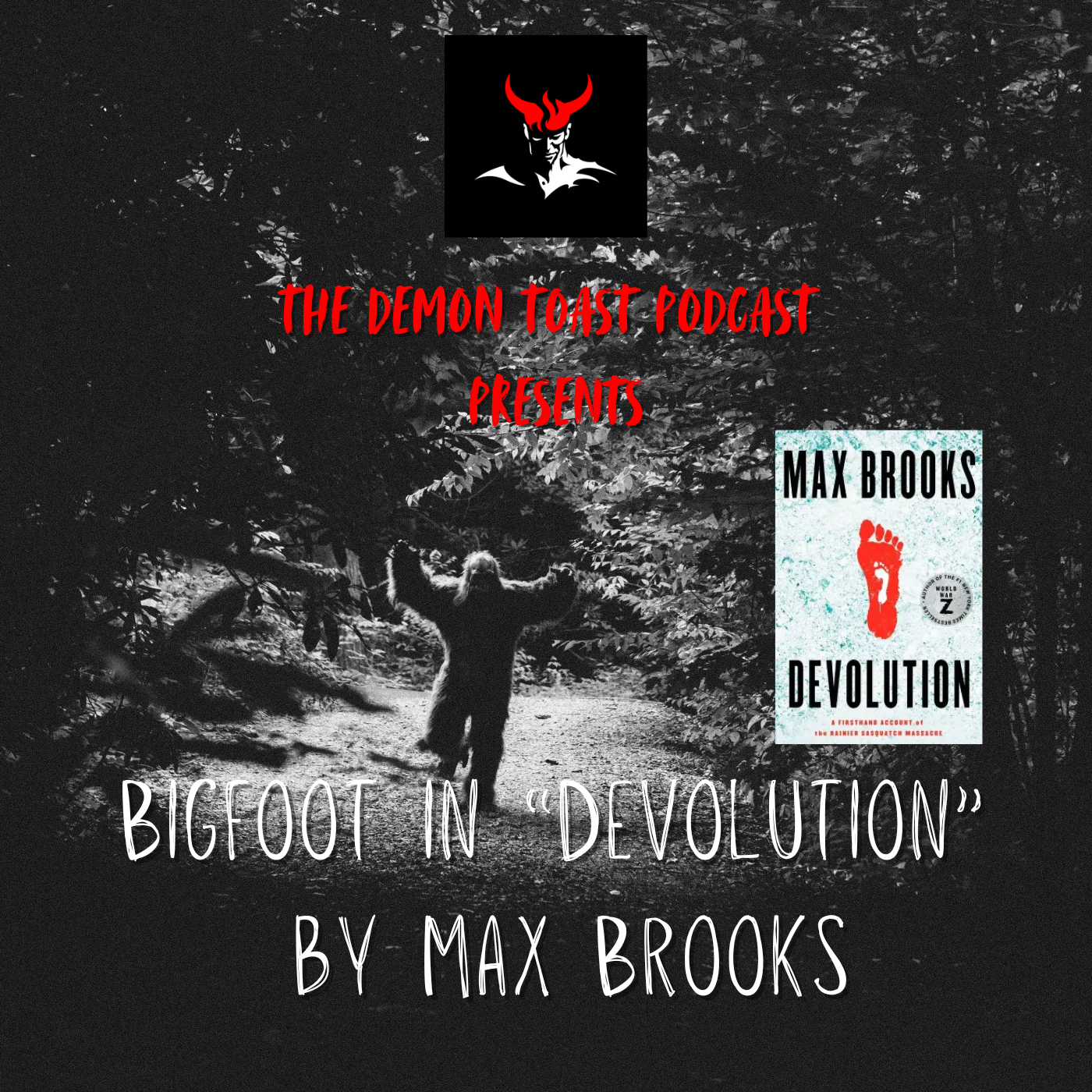
[00:00:52] Speaker A: Yeah, we should do that. We should do that. I used to read it every week. That being said, we are here to talk about Max Brooks's de evolution. You know, the latter half of it, of course. We did cover most of it and how it maps to the Bigfoot mythos. We might get a little mean to old Bigfoot on this episode because there are reasons to be mean to Bigfoot.
[00:01:12] Speaker B: Part of my researching was researching my favorite Bigfoot story. And in my research, I found out it was all bullshit. And I'll mention that later, but we will get there.
[00:01:23] Speaker A: We will get there.
[00:01:24] Speaker B: Really did break my heart.
[00:01:27] Speaker A: Yeah, it's heartbreaking. I do want to say that Max Brooks's Devolution is a serious novel. It is very horrific. And, you know, its goal, of course, is to highlight the hubris of, you know, the Hollywood passive progressive. I say this to disparage, you know, performative aspects of the left.
So this part of the novel is where after having seen the Bigfoot tribe, you know, and assigning them names and so on, they don't know what to make of it. They're like, holy fuck, this is great. And they can't be calling anyone because a volcano just erupted and all their communications are down. So all these motherfuckers are sitting around listening to it. And I will read from the novel. Now, the more we listen, the more we could make out a single source. A branch against a trunk, a. Not sure if the grunts were meant for us. Something about them, soft, low, chaotic. Like they didn't want their voices to drown out the knocks. That's at least what I think now. I don't have a clue. I didn't have a clue at the time.
That's communication. Vincent surprised me. I would have expected it from Reinhardt. I looked over at him, the gas bag professor, who was amazingly yielding the floor. Vincent stepped out of the circle, head craned toward the Trees. They're trying to talk to us. They're friendly, said Reinhardt, who I think was trying to get a jump at the next possible conclusion. They must be. Communication implies intelligence, which implies an innate desire for peace. Is that true? The booth seemed to believe it, or wanted to, along with Carmen and Effie. But Palomino, the little girl, she kept her eyes locked on Mostar's dubious face. Now, Palomino previously had almost been eaten by a puma.
You know, it's saved by Mostar. So she's like, yo, this Bosnian woman, she knows what the. Is up, you know?
Yeah. So the one idiot starts yelling, hello, hello, we're friends. Into the wilderness. And the Bigfoots, they stop knocking, and then they start knocking really hard.
[00:03:33] Speaker B: I just love the statement communication implies intelligence, because I've heard a lot of people talk and. No, it doesn't.
[00:03:40] Speaker A: Yeah, I live with. I live with people that can. People that can communicate who don't want peace. Like, I live on the Internet.
Nazis. Communicate with us just fine.
[00:03:57] Speaker B: That, like, a lack of communication does not imply non intelligence. I work with adults with developmental disabilities.
I have several who are non verbal, don't know ASL and choose not to use a communication device. They're still intelligent.
[00:04:12] Speaker A: Yes.
[00:04:14] Speaker B: They're still human fucking being.
[00:04:17] Speaker A: Yeah.
So after the knocking, they start throwing rocks, and they start throwing big rocks, and all these idiots go running for their lives because those Bigfoots, they're not friends.
They seem. They seem surprised that it happened, you know?
[00:04:41] Speaker B: God, I love the Bigfoots in this book, Volcano. But, like, I loved the Bigfoots.
[00:04:53] Speaker A: I love them, too. They're really cool, by the way. So I did a little bit of reading when I first read this book, and I found that the knocking on trees is a thing. Tell me. Tell us about that, anyone?
No one knows about Bigfoots banging on trees. Okay.
[00:05:22] Speaker C: I actually.
In all my research, I haven't seen.
I'm an expert in the Native American associations, specifically that father history.
I'm an expert in racism. Feel free to quote that.
[00:05:41] Speaker A: Okay, that's a clip. Yeah.
[00:05:47] Speaker B: That'S the ad right there.
[00:05:49] Speaker C: I'm so glad that my actual real face is associated. And I didn't put on the mask to say that anything. The only things I can pull out of that is a lot of Native American tribes, which I can only speak for.
Well, actually, no, I can't speak for anything.
I am familiar with various Native American tribes communicating with various calls that white people go, and it was, like, frightening. They're communicating with Bird calls.
It's like, well, maybe it's just not a language that you speak. Have you considered this?
[00:06:37] Speaker B: I think the thing about banging on trees also, just like in nature, is many a creature has a communication that says, like, don't come any closer. Stay away from me.
I am gonna fuck you up.
And I'm thinking about. I'm from New Hampshire, so I hear a lot of stories of moose.
And if you hear a moose scraping its antlers on a tree, like, leave.
It's similar to if you're standing near a horse and it's stomping its foot really hard at you, leave. It's, you know, it's like there's this universal sign of, yeah, if I see any kind of great ape and it starts banging on a tree, I'm out.
[00:07:26] Speaker A: I mean, if I see any kind.
[00:07:28] Speaker B: Of great ape, I'm out. But people.
[00:07:30] Speaker A: People think the world exists for their benefit, you know, so there is a bit here about chimpanzees. Not all chimps throw rocks for dominance. In West Africa, primatologists recently observed them hurling stones, trees, no one knows why.
There's a theory that it's some kind of sacred ritual for some yet undiscovered goal. And this is a hypothesis, not a theory.
Personally, I couldn't care less why they do it, just that they do it shows me rocks have multiple functions and we can't be sure what all those functions are. If some chimps use stones in their monkey hunting tactics, and those tactics are being used by some of their larger North American cousins, like Bigfoot, then both the Mount St. Helens attack and the bombardment of Green Loop weren't meant to drive the humans away, but to drive them out into the open.
[00:08:21] Speaker C: That's a fun quote.
[00:08:24] Speaker A: Yes.
[00:08:27] Speaker C: That is a hunting method used by.
Sorry, I'm such a nerd.
That's a hunting method used by ancient humans was.
In order to tackle these big giant prey items like mammoths, you would herd them off of a cliff, which is badass, I think.
[00:08:53] Speaker A: Yeah, I think that's true. I think that we found that there wasn't like any historic. There isn't any, like, evidence of it. I know. Justin was telling me something about that. But, yeah, herding animals into a kill zone is like. Even if it wasn't off of a cliff, it is effective.
So, yeah, it's specifically the cliff thing that, you know, a little iffy on.
[00:09:13] Speaker C: Fair enough. I don't have a source for that.
John Pickerel did not say that.
[00:09:20] Speaker A: What'd you say, Adrian?
Yeah, Graboid's not Bigfoot, Adrian. You're not allowed to talk about gravity.
There's a real. So there's a really, really, really cool part where the Bigfoots get one of them and they see him out there yelling in pain and I'll just, I'll read this, okay? He's hurt. Bobby looked incredulously at Mustar, then to Dan. He needs help. I saw Dan wiggle his arm slightly, pulling at Mustar's grip testing. She wouldn't budge. That's what they want. It took me a second to realize what she meant. Suddenly I wanted to throw up everything I'd eaten. Dan got it. I saw his shoulder sag carbon and Reinhart too. Not the shoulders, but the understanding.
But Bobby, they. What they. You can't hear them? Can't you smell them? Asked Mustar.
Even with the wind at our backs, the stench was overpowering. They're keeping quiet on purpose. They want to draw us out, pull us apart. The way her eyes squinted, flicking from side to side.
[00:10:31] Speaker C: Sniper trick.
[00:10:34] Speaker A: You know. So it goes on for a bit, but eventually the Bigfoots get kind of tired of it and they just come out and grab him and tear him apart.
It's pretty fucked.
[00:10:45] Speaker B: I think it's really important to go back to the fact that Mustar survived like a very brutal war where her family, like, at one point she said a quote that like really stuck with me was that we were so starved, we told the children not to go out at night or they'd be caught and eaten. And that's not the worst reason to not let a child go out at night in a war zone.
And that's the kind of upbringing Mustar has seen.
It reminds me of like, stories my, my grandma told me as a kid of like, if you're at home and you hear a baby saying, don't go outside because it could be a kidnapper playing a recording to get you to come out for it.
Stories from actual wars of people being used as bait. And Mustar has like seen this before and is now seeing it again and it's just very up.
[00:11:41] Speaker C: That's one of the things about the.
[00:11:42] Speaker B: Book that really me up was that I, I've heard these examples, you know.
[00:11:48] Speaker A: And it's, and she, that character is here to plant the seed that these people all think they're hyper evolved because they have the Internet and, and, and drones deliver their groceries and all this stuff.
And what do we do? Like human civilization is killing other humans. I mean, it's happening right now. There's people Laughing at other people, crying for bread in Gaza. You know what I mean?
Like, there's nothing more human than war and murder and cannibalism.
[00:12:16] Speaker B: And that's what it makes me think of is, are these Bigfoots, primitive apes? Because they're acting the way people act.
[00:12:24] Speaker C: Right?
[00:12:24] Speaker A: Exactly.
[00:12:25] Speaker B: We are doing the things that people do, which is the ape, you know?
[00:12:31] Speaker A: Right. Adrian, do you have to go?
Okay.
It's. It's 450.
All right. Is there anything you want to leave us with?
[00:13:01] Speaker B: It was nice to meet you.
[00:13:06] Speaker A: Right. All right, I'll do your plug. Don't worry about it. I'm gonna write a note for myself. Take care. Okay. I'll talk to you later.
All right.
We're a very professional podcast, and we're very good singers here.
[00:13:20] Speaker C: The most professional.
[00:13:22] Speaker A: Yeah. Are you kidding? Look at us.
Yeah. So, all right, where do we want to go next? I don't know.
Apes go crazy, blah, blah, blah.
Yeah. So, yeah, and that's the key thing. Who are the real apes? Right. And, like, that brings me back to the Rousseau's Children book, where, you know, what ends up happening is Mostar starts showing our main character how to make spears. Because she's like, we're not gonna survive this. She start. She sends her on a little quest to start categorizing all the food they have, all the potatoes, all the little bits of meat, everything in the fridges, sauces and spices, solaces and spices. Because she explains to her we're rationing our food because we might not live two more weeks.
When you ration food, you know, when you diet, you eat less because you want to. When you ration your food, you eat less because you fucking have to.
And, yeah, they.
They make spears. How to make a spear from scratch. This is from the book. Choosing the right bamboo staff is critical. It can't be tapered. That'll ruin the balance. When harvesting, the stalk you saw just below the bottom connector, or whatever those rings are called, it takes a while, especially with a skinny bread knife. And there's a special method. If you go down one side, like, with regular wood. With regular wood, and miss just a tiny bit of connecting fiber, the fiber will tear a strip down the whole length. As MyStar warns, that will decrease integrity and increase splinters.
It goes on for some length. And the point is that they make spears. They make actual spears. And these aren't like, man, I don't know. I think that, like, we think of weapons such as the Zulu or the native peoples of North America or Even South America would have used, you know, like the Jack. What's the.
What's the.
Oh, the macawattle. Like, the Mac. Like the Aztec Macawatl. Like, we might think about it, like, oh, it's this low tech, like, fucking primitive caveman shit. They're actually incredibly.
What'd you say?
[00:15:37] Speaker C: I was agreeing with you. Sorry.
[00:15:39] Speaker A: No, you're okay.
In craftsmanship.
And they have to be balanced correctly. The blade has to be sharpened, forged correctly. The metal has to be forged correctly. The spear has to be, you know, the shaft has to be polished and made for throwing or thrusting. There are different kinds.
And that's why Max Brooks goes into such detail about how to make a spear, because all that fucking technology is gone. These people don't even have guns.
They went up here to live in harmony with the trees and birds and fucking squirrels, and boom, the Internet's out. Can't order your.
You can't. Can't order your Hungry man cans. You know what I mean? You can't order your fucking TV dinners.
And guess what? There's. There's hungry things out there that want to eat you. They're Bigfoots here. But it could just as easily be bears or anything real.
And the only way to survive is to fight back. That's kind of what it boils down to. They literally have to devolve from their perspective.
[00:16:52] Speaker C: Only that was referenced in the title of the book.
[00:16:57] Speaker B: I've been really into survivalist horror lately, so I was actually super glad for this recommendation.
I watched Yellowjackets and I just went, wow, I loved this show. I wish it was good.
[00:17:11] Speaker A: Whoa. Shot. Shots fired, man. Whoa.
[00:17:14] Speaker B: It's fine. Yellow jackets is fine. But I actually didn't know all of.
All of the intricacies of building a spear.
You. You know why? Because I. I am not devolved. I live in 2025, and I love my car and my Instacart.
The closest I've come to survivalist horror was I moved to a very rural area and had to learn how to buy enough groceries to last me to the next time I would want to go buy groceries.
But, like, I think it's one of those things where, like, people will be sitting on their couch, you know, covered in popcorn, watching yellow jackets or 28 days later or what have you about, you know, this apocalyptic scenario. And they'll say, I could do that.
And I think it was the creation of the spear that made me go. I could not yet. Like, yes, before I read that book, I was like, I could make a spear I could go outside my yard and make a spear right now. No. No, I couldn't.
[00:18:25] Speaker A: Yeah.
[00:18:25] Speaker B: The answer is no.
[00:18:26] Speaker A: It's very involved.
[00:18:29] Speaker B: If there's one thing Max really knows, it's his history, and it's getting rid of the. I can do that. Of it all.
[00:18:37] Speaker A: Jack, what you want to say?
[00:18:38] Speaker C: I just wanted to bring up an example of. We mentioned Native American weaponry.
I was just recently in Tennessee for a family trip, and I was refamiliarized. I've learned about making arrowheads several times, and they're seen as a relatively primitive weapon because it's a rock. Effectively, it's a piece of flint.
But there is an entire set of tools for making these arrowheads, and it takes years and years of practice and expertise to actually get the shape you want. You're effectively. When you're making an arrowhead, you're chipping glass, and you have to know exactly how much pressure to apply, exactly where to chip it to get the shape that you want.
It's not as easy, or.
I honestly think it's incredibly.
What's the word?
It's incredible craftsmanship to be able to make an arrowhead.
In summary, that shit's hard.
[00:19:45] Speaker A: Yeah.
[00:19:46] Speaker B: I have never looked at an arrowhead and said I could do that.
[00:19:49] Speaker A: But, you know, me and my little brother, we once broke a window and we had to buy a pane of glass that turned out to be too big, and then we had to cut the glass. So we bought a glass cutter, thinking it was easy, and it was not easy. It sucked.
[00:20:04] Speaker B: I'm taking a stained glass class in about a week, and I'm fully expecting to get whooped.
[00:20:12] Speaker C: Get some good gloves.
[00:20:14] Speaker A: It's difficult to do things in summary, but thankfully, we're good at doing podcasts, so there's that at least.
[00:20:20] Speaker C: Yeah, we can do podcasts.
[00:20:23] Speaker A: Yeah, we can do that. I mean, I can do podcasts.
It's advanced technology.
[00:20:29] Speaker B: I'm great at reading horror books and judging the main characters.
[00:20:35] Speaker A: The main character in this book is pretty good. She listens to the one person that knows what's up, and she lives. Well, actually, she doesn't, but she gets pretty.
[00:20:43] Speaker C: Hey, spoiler.
[00:20:45] Speaker B: I really thought I was gonna like her based, like, dislike her based off of the nature of the story. Like, I was like, oh, great. Like a rich girl who wants to get with nature, writing this book as a journal letter to her therapist. This is gonna get old.
But I found myself pleasantly surprised, especially by her, like, self awareness throughout the book.
[00:21:07] Speaker A: Her humility.
[00:21:09] Speaker B: Yeah, like, you know, when mustar was like, we're gonna start rationing food and I'm gonna have you do it because you're a skinny white girl who probably knows the calories of everything within a five mile radius of you.
And she was just like, you're right, I am a skinny white girl who knows the calorie everything within five miles of me. I'll do that. And then when she makes the ration plan and makes it.
[00:21:32] Speaker C: Right.
[00:21:33] Speaker B: Wrong. Moar is like, hey, you know, you gave the biggest people the most food. You should get the most food because you're the thinnest. She was like, yeah, you're, you know, that makes sense. So, like, she, she had a lot of humility. She had a lot of self awareness.
I liked her. I liked her as a main character.
[00:21:55] Speaker A: There's a bit here. It's a. So I, you know, obviously I don't support the state of Israel or its horrific genocide of the Palestinian people, but there is a bit here from, you know, Golda Meir's daughter, right. From her book, I Believe My Life in the IDF by Lieutenant Colonel Hannah Reinhardt Roth.
So. And I think it's really important. It's about the need for armed resistance at times, which is a very uncomfortable topic, especially when we're talking about, you know, what we're supposed to do in the face of political malfeasance and, you know, injustice. Right. I mean, all of us are queer on this podcast.
[00:22:39] Speaker C: Bisexual.
[00:22:40] Speaker A: I mean, we probably are. Everyone's bisexual. But, like, my point, to a certain degree. But my point is, we're all queer people. We all have to grapple with what this administration is doing and what future administrations will do and what previous administrations have done, which gives us, you know, reason to be frightened. Right?
So with that in mind, let's read the words of Goldamere's daughter.
Alex spluttered, but America. I'd won. I knew it. America. I buried him in counterpoints. Vietnam, Watergate, the inward distractions of cultural civil strife. Alex huffed, retreating from my onslaught. If I'd only been magnanimous in victory and refrained from that conclusive nail. America can't help us.
Just two words. One word. Just two letters. One word. Us. The resurgent flames blazed in Father's eyes. Us, Hannah. Aren't we Americans? American Jews, I countered, regrouping before those smug, tranquil faces. Haven't we learned anything from our past?
Hmm, mused Father, pretending to ponder my point. Learning is indeed the key. Learning to understand ourselves. Political economy, Alex added, winning an approving smile from our patriarch. Biology, psychology, without unroof, unearthing the roots of our desire for conflict, Father lectured, we are no better than pre pasture physicians who acknowledge the existence of microbes, yet failed to acknowledge, yet failed to connect their existence to disease.
It goes on some bit, right? But the big part is eye for an eye, my father continued, only leaves the world blind. Oh, wait, hang on. Let me read this actually, because it's important.
Okay, I'm saying, I shot back, that it's suicidal to waste time deconstructing the Versailles Treaty. The morning after Kristallnacht, my father, still sitting, smiled that insufferable victorious curl. Ah, he said, waving his infuriating finger to the sky. And now we come to the final keep in your crumbling fortress. Should we have fought? It was no argument the first time I'd been six, asking about the black and white faces on our mantel. Who were they? Where is Strasbourg? Why did they die? Why didn't they leave with you? Why did they die in the Holocaust? And with the final question, why didn't they fight back? Came the inevitable dismissal. Because it would not have made a difference. An eye for an eye, my father continued, only leaves the world blind. I parried his Gandhi quote with another saying from the Raj. If the Indians all pissed at once, the British would be watched out to sea.
Are you dismissing nonviolence? Alex said Alex, shaking his head. Are you really going to deny the progress made in this country by Dr. King?
Are you going to deny that King's leverage was based on the fear of Malcolm X? An open hand works when the alternative is a fist.
So they go on, you know, you cannot simultaneously prevent and prepare for war. Quote from Einstein, said the man fleeing Dachau's oven. Such a zealot. You claim to defend her tradition. So it goes on for some while, but like, the point remains is that like at a certain point you have to stand your grounds or the Bigfoots will eat you, you know, because that's, that's where this book goes, you know, needless to say, spoilers, I suppose. I mean it's. It's a hell of a read.
It's a hell of a read. But that's ultimately where things go, right? Like our heroes are forced to forget about the Internet, forget about all their high minded ideals and, you know, culture and all the good they think they're bringing to the world. Because in their minds, by doing green loop and they're showing people how to live and we can't, there's a bit where they're like we can't. Not everyone can afford to live in a green loop.
But we're going to be recycling in junk. They'll be able to afford the stuff that is made to market to us.
[00:26:28] Speaker B: That part made me so mad.
[00:26:32] Speaker A: Yeah, it's. It's like capitalism is good because the poor asses can afford the detritus of the rich. You know, trickle down economics is legit.
[00:26:42] Speaker B: I regularly whine about how the rich do not deserve the bullshit rich people stuff they have and how much more I could do with a Prius than they could because I drive my Prius to protests. And I.
That part just like made me think of all of those moments where I've been like, if only I had the really nice thing, I would be changing.
[00:27:10] Speaker A: The world with it.
Listen, you can't just go back to nature and live a simple life. You have to spend millions of dollars on a house with the Internet and a drone. Your own. They all have their own personal drone. It's not like there's a drone.
Yeah, yeah, go ahead.
[00:27:29] Speaker B: It makes you so mad. And honestly, I know that realistically I could not change the world if I had a solar powered house under Mount Rainier.
But like, what if, you know, the.
[00:27:45] Speaker A: Ancient Greeks, they had a saying, give me a lever and a place to stand and I'll move the world.
So I think we can move off reading from the book at this point. It is a very good book. It is very dark. It is very, very, very horrific. It brings to mind some of the cannibal movies of the 70s and 80s.
It brings to mind Dracula and Max Brooks's first novel, of course, World War Z, which was also epistolary.
And you know, look, I mean, it's a monster book. It turns Bigfoot into a flesh eating, thinking, planning monster who gets away with it, which is the best part.
Jack, why is Bigfoot sucky?
Why do we hate Bigfoot even though we love monsters?
[00:28:40] Speaker C: I don't have anything against Bigfoot hunters.
I want to put that out there.
Bigfoot is fun to believe in. It's a fun story.
The reason I have so many problems with it is the same reason I have problems with the commercialization of the Wendigo and skinwalkers. It's that we are.
Bigfoot is something that you can't really separate from Native American culture. Not only is it something that Bigfoot hunters are constantly looking towards Native American cultures to justify, which I will. Quick tangent.
When I was a lad, a small little man, smaller than I am now, we went to a Bigfoot Museum in Georgia.
And this was the moment where I stopped liking Bigfoot because there was this entire wall of Native American names for Bigfoot, an entire wall dedicated to it.
And one of my sources that I have been researching specifically for this video and another one of the reasons why I'm not super big into Bigfoot is a book entirely about all these Native American names for Bigfoot.
And I was going to look it up, but I'm in the middle of a tangent, so I'm not going to give you the title right this second.
But looking up at that wall, I. I'm Cherokee. My heritage is important to me.
And I go, there's a Cherokee name for Bigfoot. The name on that board was.
I believe. Yeah, usatily. I'm pronouncing that wrong.
[00:30:44] Speaker A: That's fine.
[00:30:46] Speaker C: This Cherokee name for Bigfoot directly translate to foot snake.
And his entire thing was he was a snake that had feet.
[00:31:00] Speaker A: So not a. Not a furry man that lived in the wilderness?
[00:31:04] Speaker C: No, a snake with feet.
[00:31:06] Speaker A: Snake with.
[00:31:08] Speaker C: Yes. Large feet. The snake did have large feet. And in his story, he is so ugly because he's a snake with feet that the snakes are like, you're so ugly.
We hate you because you have feet.
So he turns him to a human and marries the daughter of a chief. And that's the story.
That's our Cherokee Bigfoot.
Effectively, it's the ugly duckling.
[00:31:40] Speaker A: I mean, that's a little more exciting than Bigfoot, but it's not Bigfoot.
[00:31:44] Speaker C: And that's kind of the moment where I got.
What's the word when you meet your heroes? Disillusioned.
Thank you.
[00:31:53] Speaker B: The glass breaking moment.
[00:31:55] Speaker C: Yeah.
And ever since then, I haven't been a huge fan of it. And the more that I look into Bigfoot, we take the name Sasquette from the Salish language. Whole bunch of Native American tribes speak that language. The Sasqets are figures in this tribe. And you know what they are? Wild men.
Let's look closer. The Saskat were described as a tribe of more like barbarian natives that wore clothes and spoke.
And sometimes they would kidnap women and children because they didn't have any women and children in their tribes. And you know what? That was problematic. It was.
[00:32:35] Speaker A: Yeah.
[00:32:35] Speaker C: It was another tribe.
[00:32:37] Speaker A: It was another tribe. That's what I was going to interject with. It was just another tribe. It's. It's like all these Irish stories about these. These weird pre cult. Pre human, like, creatures that had heroes and all. It's just older tribes, right?
[00:32:52] Speaker C: Yeah.
And then you go into the Yoket people. And the Yoket people have hairy man. And this is a figure that a lot of Bigfoot hunters have latched on to because it's hairy man.
And this hairy man is a.
Which, by the way, it is worth clarifying that when it comes to the term hairy man in most American cultures, more typically, that is a person with long hair, like on the top of their head.
That's just typically we have a similar. We have a tribe in the Cherokee culture that they are defining features. They have long hair.
Anywho, the hairy man is a tribe of spiritual people that can walk in the physical and spiritual worlds. They have the power to transform and speak and heal.
And they're not Bigfoot.
In fact, they are very specifically not Bigfoot. They are so not Bigfoot that the Yopet people get really pissed off.
They don't want Bigfoot hunters using their iconography. They are specifically. There have been interviews with them.
Mr. Trey, the Explainer on YouTube did actually interview a Yoket representative who was like, yeah, that's not Bigfoot. And we really wish people would stop saying it was. This is our religious figure. And we aren't going to tell you the actual name that we have for them because it's all religious figure.
Not your business, not your circus, not your Bigfoot.
So I'm not super into Bigfoot just for those reasons.
There's also, in my research, I was looking for the original documentations of Bigfoot and I had the article pulled up.
Let me see.
Because I lost it.
Obviously, we've had the Mountain Devil story. I would argue that that is closer to the original.
58 was supposedly the birth of the modern version of the mythical wild man.
That was an article from the Humboldt Times talking about a letter from readers about loggers in Northern California who found mysteriously large footprints. That's where we get the name Bigfoot.
And when I was reading this original article, this article was by Andrew Ginazoli of Humboldt Times.
What stood out to me was that virgin Mr. Genzoli, I could mispronounce any word when he was writing about it. One of the things that he mentioned was the native tribe in the area, which a century beforehand, 1860, the loggers in this area attacked them during a festival, massacred them, and then called the US army, who took this tribe, which I'm getting the actual name of the tribe, because that is important. Important to me.
The Hoopa took them, put them on the Hoopa Indian reservation, and then in this location, there's all these stories like, oh, there's some mythical creature that's messing with our stuff.
Just really interesting to me that all these stories about Bigfoot attacks seem to have such close connections to.
What is the word? Friction with local native populations.
[00:37:00] Speaker B: It somewhat makes me think of.
Not to say this is the same situation, but the cannibals in the Appalachian Mountains.
There are no cannibals in the Appalachian Mountains. What there are is a bunch of people making moonshine who don't want you to go with them. Making moonshine.
[00:37:18] Speaker C: Yeah.
[00:37:19] Speaker A: Yeah. It's a persistent trope in, like, horror movies. You have the wrong turn series. You know, you have all kinds of stuff like that. Yeah.
[00:37:27] Speaker B: I mean, if you're from the area, especially if you're from. If you, like, have, like, an older relative, they'll tell you all these stories about, like.
Like when I was a kid, we had a well.
My papa used to say there was a man who lived in the well well, and his name was Rawhead and Bloody Bones.
And if I was up past my bedtime or looked into the well, Rawhead and Bloody Bones would come eat me. Obviously he was saying that to me because he didn't want me to. With the well, like.
[00:38:00] Speaker C: Yeah.
[00:38:00] Speaker B: There's so many times that when there is something that people don't want other people to find or around with, there becomes a big scary moment monster there.
[00:38:11] Speaker A: Yeah. Yeah.
I think that that is very on point. When we did our Santy Claus episode, we talked. I talked about the wild man hypothesis that, you know, there was a persistent myth across cultures going back at least a thousand years of cultures talking about wild men. And this going all the way back to, of course, the Fair Folk, you know, don't. Don't go into the Cotswolds. You might get stolen by fairies. And at a certain point, yeah, there might well have been, you know, Celtic peoples that the Romans had. The Romans and the Danes hadn't killed off living off the land and hence a lot of these fairy stories. If Adrian was here, she might yell at me again. I don't remember if she did, but I feel like she wouldn't like that. But it doesn't really matter because, like, I think that there is something to that. Right. All these encounters with Native Americans and, you know, people who, as far as we know, are unknowable. Right. And I say we as in colonizers. Jack, you are of native heritage. I am Jewish. I'm like, fourth generation. I wasn't there, but, like, if I was there, right.
I probably would have fallen into the culture Because I would have been living in one of these, in one of these settler towns and running into native peoples or fearing them. Right.
[00:39:34] Speaker C: So I want to clarify.
I wasn't raised in the culture.
Amazing thing when you take out a third of a population, which I'm not going to get into blood quantum and all of that on our episode right now, we're not going to touch it.
But I wasn't raised in the culture either. I just do a lot of research because I have that personal tie to it.
But it only goes as far as blood and the tribal card.
[00:40:06] Speaker B: Yeah, but I, like I said I'm a Bigfoot lover, but like, I can totally see the connection to, you know, problems happening with the indigenous tribes and going, big, scary black monster in the woods.
[00:40:22] Speaker C: Woods.
[00:40:24] Speaker A: Right.
[00:40:25] Speaker B: I'm seeing it now and I'm like, oh, Bigfoot, are you problematic?
And that's.
[00:40:31] Speaker C: I'm so sorry.
[00:40:35] Speaker B: Nothing will ever take away my love for Bigfoot, but, you know, not even racism.
[00:40:41] Speaker A: So, you know, we, you know, there's.
[00:40:43] Speaker B: There, there, there, there is the racist aspect. There is also the aspect of, of like, I mean, yes, there is the racism. And I'm not denying that there, there is definitely, probably a lot of racism. There's also something to be said for like respect for nature and believing that I don't know everything about it.
[00:41:03] Speaker A: Sure.
We're going to have this conversation a lot. We've had it a few times. But you know, me and Adrian had a, she had a moment where she didn't know that Nosferatu was, you know, an early example. Not an early example, but a pretty prominent example of anti Semitism in art. You know, she didn't know that Count Orlok was a Jewish stereotype with his long nose, his rat like features, his ears, his rat teeth.
The fact that he comes to a culture that is not his own and infects it with his Jewishness. I mean, vampiress, you know, he steals their women. Like, and she had a nervous breakdown about this and, and our conversation was basically like, look, that is its legacy, but it's also a monster and it's something else. And it's been taken and repurposed and lives on in a new form. That's art. Art is a conversation. You know, things are.
[00:42:02] Speaker B: I am interested to know more of the indigenous Bigfoot connections because like I said, like being of like an Appalachian family, a lot of Appalachian folklore is admittedly just ripped off indigenous folklore, but it's also something that can be so unique and dear to us.
[00:42:28] Speaker A: Right.
That's where you live?
[00:42:31] Speaker B: Yeah, it's, it's, it's where we lived.
Like, it's, it's. There's things in Appalachian folklore that I have a lot of problems with, particularly the appropriation of the Wendigo.
But also I can understand why the people who were forced to work in coal mines that regularly collapsed would attach to such a creature.
And I think Bigfoot, for me is this example of like this kind of unique cryptid like creature to the United States in that almost every single state has a Bigfoot myth.
Like, if you look into people like the cryptids of every state, almost every single state has their own variation of Bigfoot.
And I think it's something special that there is a big, hairy, scary man in the woods.
Whether it be the, the, the, the hairy man you were describing, or my friend Biljim who's just basically a giant lumberjack and would definitely run at people and bang his chest and scare them away.
I think there's just something so special about the big, hairy, scary man in the woods.
That being said, I have been having to accept some harsh realities about Bigfoot, like finding out he's racist today.
Well, not finding out he's racist, but.
[00:44:02] Speaker C: So Bigfoot himself called in to tell us he's racist.
[00:44:08] Speaker B: Rude.
But like, when I was researching this episode, one of my things that I've loved like this story I fixated on for so long was Portlock, Alaska.
And when you love a story like that, you don't look at its ugly roots. And the fact is, is like the, the story is that there was this town in Alaska that is a ghost town. And that is true.
There, there is an abandoned town in Alaska called Portlock.
And the story was always that people were like going into the woods and turning up mutilated. And some explorers had even seen like people who were like urbexing there. Even saw this big Bigfoot type creature.
And while I was researching it, the more I found there was no evidence of mutilated bodies turning up at any point.
And the town was, for better or worse, abandoned because a rich man bought it out.
[00:45:07] Speaker A: Yeah, that explains a lot.
[00:45:08] Speaker B: Something about building a highway system.
And I was like, oh my God, my favorite Bigfoot.
What?
[00:45:16] Speaker A: Pathetic.
Again, I'll reiterate. Like H.P. lovecraft, horrifically problematic racist piece of garbage, wrote some of the greatest, like horror stories of all time. Changed the world from his mother's. From his aunt's basement. Right.
Also, many of those stories are incredibly problematic. However, his characters and fixtures and settings have been taken by Other people and repurposed, some of them Jews. Go ahead.
[00:45:45] Speaker B: That's like. That's why it's so important that we do our jobs. Like we. The queer people, the Jewish people, in your case, the indigenous people in your case. Like, we have these old problematic stories that we can take now and say, yeah, this Nosferatu was incredibly anti Semitic, but I can turn him into something empowering.
Count Dracula at many times was a very predatory gay man. But when I write Dracula intentionally gay, it creates a new lore, creates a new law.
[00:46:27] Speaker A: Exactly.
[00:46:28] Speaker B: Something I love about the way lore like that is ever shifting.
[00:46:32] Speaker A: It recontextualizes it. I mean, you know, what's stopping me from writing a Dracula story where. Or Nosferatu story, rather, where he's more or less the victim, you know, I mean, that. That's how he's treated in the. In the seventies Werner Herzog movie.
My. My final thought on Bigfoot is just that he's an American icon, you know, and much like another American icon, Hulk Hogan.
He's racist, he's cringy, he's embarrassing, his face is on beers, and he makes me laugh.
He's a real American.
Yeah, sorry. Sorry.
[00:47:15] Speaker B: I say, I have a Hulk Hogan VHS in my room right now, but I've got.
[00:47:19] Speaker A: I've got them too. My. My bubby, she.
[00:47:22] Speaker B: Her.
[00:47:22] Speaker A: Her late husband used to record all the summerslams and stuff that they would pay for, and now I just have one.
[00:47:28] Speaker B: I. I got one for $4 the other day at, like, a VHS seller at a con I was at, and I was like, hulk Hogan's not gonna make any money off of this. And it's gonna be the best gag gift ever.
[00:47:39] Speaker A: Oh, yeah.
[00:47:42] Speaker B: Hulk Hogan. Now I'm like, but the guy who bought that thinks I like Hulk Hogan. So then I had to, like, say while I was buying, buying it, like, oh, this is gonna be a great gag gift.
[00:47:51] Speaker A: You know, he was a great wrestler. He was a terrible, terrible human being. And he was shitty to other wrestlers, too. So him, you know. Yeah, he picked the worst week to die, too.
This is all getting cut, so it's all right. But he picked the worst week to die. I mean, Ozzy Osbourne dies, and we're like, oh, man. And then the Hulkster kicks in, and.
[00:48:10] Speaker B: It'S like, then chuck mangioni, like, 10 minutes later.
[00:48:16] Speaker A: Yeah, it's one of those things. I mean, like, I'm in my 30s, so I've kind of accepted that people I grew up watching on TV are gonna die. You know, like, since Bowie died.
I mean, the world ended in 2016 when Bowie died, and this is all just a weird dream, you know, so.
All right.
Is there anything else to say about Mr. Bigfoot and his.
Well, you know, as the weekly work. As his, you know, classified profile in the Weekly World News said, you know, all that big feet, you know, indicate, you know, anything else to say about Mr. Big Feet?
[00:48:56] Speaker C: I think it's really beautiful what he can be.
Obviously, I'm not personally fond of the culture.
I'm not going to hold that against Bigfoot, and I don't hold that against individual Bigfoot hunters. I just have problems with.
Believe it or not, I have problems with.
Okay, I can lose my word.
I'm gonna repeat it so you can edit it. And it sounds really cool.
That thing where you steal culture from another.
Appropriation.
[00:49:33] Speaker A: Do you want to do that again?
[00:49:34] Speaker C: Yes, I do. Believe it or not, I do have a problem with Native culture appropriation.
But I do think it's beautiful what he can be when you separate that.
Stop getting tattoos of the hairy men, please.
[00:49:51] Speaker B: Thank you.
[00:49:52] Speaker C: They don't want me to do that.
[00:49:55] Speaker B: For, like, taking the time to educate about that during this episode because, like, I figured that, like, the term Sasquatch was probably appropriated, but I had no idea how deep that ran. And I will be doing my research on it before I get a. Before I get a. Bigfoot is real and he tried to eat my ass tattoo.
[00:50:14] Speaker A: Yes. Yeah.
Yeah, that. That is probably a good idea. Shout out to Robert Brockway's fucking podcast, Big Feats and Sean baby, where they. What they do is they watch episodes of Mountain Monsters and they just talk about how amazing. Because Mountain Monsters has a universe. Like, it's not like a normal show.
Like, they have continuity, and there's, like, stuff that happens. Multiple Bigfoot species will show up to team up and take them on.
Like, it's a crazy fucking show. Like, there's an episode where they're.
The Bigfoots have them surrounded. They're in a. And this is also supposed to be a reality show.
They have them surrounded in a barn, and the Bigfoot start pounding on the wall, and then the wall gives out and, like, a rubber gorilla arm grabs the one guy and tries. And it's like, you just got Bigfoot on camera. You broke it. You pushed it too far.
There's a part where they're. They're talking to some hillbilly, and he's like. He says, yeah, it was the dog man. He come around here. And then one of the guys goes I know him.
[00:51:19] Speaker C: I know I know him.
[00:51:21] Speaker A: Steal your truck? Like, did he date your daughter? Like.
Yeah. So, highly recommend Mountain Monsters. Highly recommend. Big feats. Even though, as per JRR Tolkien, it would be Bigfoots, you know, because there's the one hobbit Bilbo calls. Calls the Proud Foot people the proud feet. Yeah. Remember that? And he's like, proud foot. Proud foots, not proud feats. You know, so.
Oh, no, he says proud feet, actually. Wait. Oh, well, whatever.
Bilbo. Bilbo says proud feet, and I trust Bilbo because that's Tolkien's character. So. Whatever. Anyway, that being said, any final thoughts on Bigfoot before we wrap up.
[00:52:08] Speaker C: Loki? If I send you a link, will you send it to Luca? Because I don't exist on the Internet anymore.
[00:52:14] Speaker A: Absolutely.
You can call me Dan, too, if you'd like. Okay, Perfectly excited. I will allow that.
[00:52:20] Speaker C: Dad, can you send a link to Luca?
[00:52:24] Speaker B: Appreciated.
[00:52:25] Speaker A: Of course. Did you send it in the chat here?
[00:52:28] Speaker C: No, I was going to do it afterwards because it's my.
[00:52:31] Speaker A: Are you gonna tell me?
[00:52:32] Speaker C: Yes.
[00:52:34] Speaker A: Okay.
Yeah, yeah. I'll get it to Luca. No problem. Yeah.
[00:52:39] Speaker C: Cool, cool.
Okay.
[00:52:41] Speaker A: Okay.
[00:52:42] Speaker C: It's a great documentary. You're gonna love it. We go into the 157 Native American names for Bigfoot that are wrong.
[00:52:51] Speaker B: I can't wait.
[00:52:53] Speaker C: Thank you.
[00:52:55] Speaker A: Well, in conclusion.
In conclusion, Max Brooks. Devolution is a great book. It's very horrific, it's very interesting, it's very thought provoking.
It will definitely dash any hopes you have of living off the land in a modern, ecologically conscious way, because it's really not doable in the long term and it's really not that considerate. And all you motherfuckers ordering shit from Amazon every week, you're really. You're not. You're not helping anyone by not driving. So, you know, also, Bigfoot is kind of problematic, I think. I still think he's rad, but he's kind of problematic. So do keep that in mind.
But that is our episode on De Evolution and Bigfoot.
So Luca can be found at the Instagram, listed below.
And he is a poet and writer, has a new book called With Endless Love Poems from inspired by 28 Days Later. The COVID is awesome. If you're watching this on YouTube, there it is. It's gorgeous.
What else, what else, what else? Yeah, you can get that book from his Ko Fi or by messaging him on Instagram. So do support him. He, you know, we here at Death Wish Poetry magazine and the Demon Test Podcast are very supportive of our independent writers. I'm an independent writer myself, so do support independent artists and writers.
I am, of course, King Loki. That's old Norse for Daniel Sokoloff. You can find my books and
[email protected]. check out Death Wish Poetry magazine. Also, we are opening up for submissions for the, oh, I guess the fall edition. I can't keep track soon, so, you know, follow us on Instagram. Read our stuff. It's very cool. Luca has two poems in the spring edition. They're wonderful. Well, wonderful is the wrong word. One of them is about a.
You know, just read them. Just read them.
[00:54:59] Speaker B: Just read them. Or maybe don't if you're really upset by snuff films.
[00:55:04] Speaker A: But there are trigger warnings, so, you know.
[00:55:06] Speaker B: Yeah, there are trigger warnings. Read the trigger warnings.
[00:55:12] Speaker A: And Jack is a. You know, he's. He is the daddy of a spider named Jack Jr.
[00:55:18] Speaker C: I am sending me. I customize a furby.
[00:55:24] Speaker A: What'd you say?
[00:55:25] Speaker C: I customized the furby.
[00:55:27] Speaker B: Yeah, you did.
[00:55:29] Speaker C: I did.
Look at my furby.
[00:55:34] Speaker B: Oh, my God, I love them.
[00:55:37] Speaker A: His eyes light up. That's wonderful.
[00:55:39] Speaker C: She's not technically done. She's supposed to have another wing, but she's beautiful.
[00:55:43] Speaker A: Okay, what's her name? Does she talk?
[00:55:46] Speaker C: No, she does not. She is broken.
[00:55:50] Speaker A: Well, you know, I'm glad that you're taxidermying that poor creature.
[00:55:53] Speaker C: You know, me too. It's important.
[00:55:57] Speaker A: Yeah. Jack also likes to send me killer clown dolls, so that's that.
[00:56:00] Speaker C: I do I have something I can name. Draw.
[00:56:05] Speaker A: Do.
[00:56:05] Speaker C: So listen to the indie.
I guess it's a podcast.
Listen to the Scarlet owl Tavern on YouTube. We have well over a 100 episodes. You won't find me until the last season.
[00:56:22] Speaker B: Hell yeah.
[00:56:25] Speaker A: Better than ever.
[00:56:26] Speaker B: It has been wonderful getting to know you in this little hole of time, Jack.
[00:56:31] Speaker C: It's been great to meet you. I hope to see you again one day. I'm on nothing.
I live under a stone in Florida, of all places.
[00:56:42] Speaker A: Yeah, yeah.
Right wing hellhole if ever I heard of one.
[00:56:48] Speaker C: Hey, but my town was one of the first Trump stores. We got that going for us.
[00:56:53] Speaker A: Hey, that's cool. I. I heard he's. He's the president, man.
[00:56:56] Speaker C: Yeah.
[00:57:00] Speaker A: Rip on that note, Write poetry, make art, love your demons. Ave Satanas.