Episode Transcript
[00:00:00] Speaker A: Hey, everybody. Welcome back to Demon Toast, where we talk about alf, and we're all really good singers here.
Yeah, that's how we get it done, right?
Yeah. So I'm King Loki, your post. I'm the editor of Death Wish Poetry magazine. With me are two of my co hosts. We have Adrian and C.A. adrian is our brilliant artist.
Yeah, yeah. C.A. is our mystical healer and wise person.
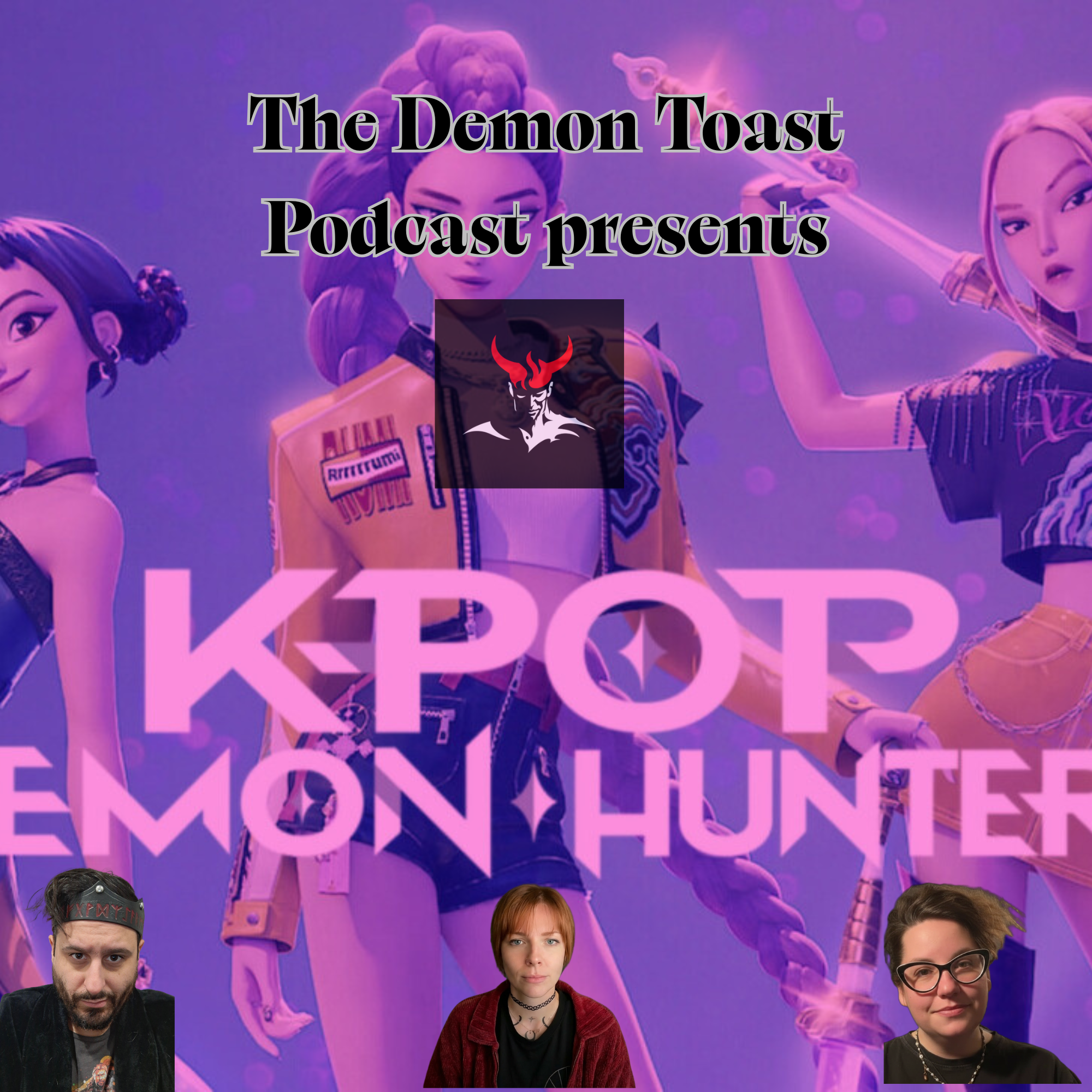
And we're here to talk about K Pop Demon Hunters, the smash hit, surprise sleeper hit on Netflix that somehow Sony Pictures made from the people that brought you Morbius.
[00:00:46] Speaker B: Okay, but if Dustin Dimalkian does not get to. David Dismalkian does not get to play Morbius in the new show, I'm gonna be real upset.
[00:00:53] Speaker A: What new show?
[00:00:55] Speaker B: Doesn't even matter.
[00:00:57] Speaker A: There's. There's no new show. There's. They're not making a Morbius movie. It's not happening. It's. You know, they cast Jared Leto. That never made it. All right, so anyway, K Pop Demon Hunters. This is something I was not planning to watch because I've seen K pop and not quite my thing, but everybody loved this, and you all loved this and were like, let's do an episode of K Pop Demon Hunters. And I said, okay, and here we are.
So, CA you want to tell us about K Pop Demon Hunters, the movie?
[00:01:28] Speaker C: Okay. So, yeah, I mean, K Pop Demon Hunters.
You hear that title and you think to yourself, this is about to be the worst, cheesiest, campiest, dumbest thing I've ever watched. Right. Like, that's. It does not evoke strong, you know, like, encouragement from the title that it's going to be anything, you know, deep or interesting.
Well, depending on. Depending on who you are, whatever. But, like, I'm the same way. Like, I'm. I'm not at the time. I. You know, I. I mostly listen to, you know, heavy music, alternative music. Not a big K pop person. Although when I was a little girl, of course, I had my boy band phase, which is, you know, K Pop adjacent. So, anyways, that's neither here nor there. So the movie. Well, there is a trio, a female K pop group known as Huntrix.
And they are, you know, K pop stars by day, demon hunters by night.
And there are three of them. One of them is, you know, we follow her story a little more closely as the main character, Rumi.
But yeah, the whole. The. The main plot of the film is that there is.
There is this realm of demons that are trying to infiltrate into, you know, Earth. And it is the job of Hunt tricks Well, the job has befell to them over time. You know, they've had predecessors ahead of them each step of the way. There's always a group, a trio of female singers that through the power of their music, they create what is called the Hun moon, which is like a protective barrier around the earth, basically keeping the demons out. So that's the main. That's the main plot. And then of course there's lots of twists and turns and self discoveries and things along the way that happen as the movie goes on. And later on we get introduced to a male K pop group, the Saja Boys, who are demons. And they have decided that was their method of infiltrating into earth, which is to, you know, instead of, you know, like heart, like fighting against this whole K pop hon moon strategy that's been working for many, you know, decades or centuries, we don't really know exactly how long, but they go, well, let's beat them at their own game. Let's become K pop stars ourselves and pull the fans away from them and get them to be fans of us instead and devoted to us instead. And you know, that's how we'll infiltrate. So yes, that's what I'll say for now.
[00:04:17] Speaker A: Yes. And we will get deeper into all of this.
[00:04:19] Speaker C: Yes.
[00:04:20] Speaker A: But I. What I love about all this is how delightfully homegrown this is. Right.
I have written here.
So Korean shamanism, there's a.
A flavor of it called Mugyo, which features singing on mountaintops and mountains are seen as the link between heaven and earth. Of course, the singers are called mudang and often they're women wearing men's clothing, which is fascinating because it's usually the other way around. Right. It's usually men who will wear dresses or elaborate headdresses and so on. And they use song and dance to call down spirits or banish them as the need arises.
Yeah, so. So, so there's a lot of really fun stuff to get into, but I'd like to point out that Saja is Korean for lion. But it's also. It's also a pun.
Jsong Saja are the. I probably said that wrong and that's okay because I'm not Korean and I am very happy to be corrected. But they are the grim reapers. They are the grim reapers. Exactly. They are the emissaries of death. They bring you to the great beyond, as it were.
And it's. It's funny because this, this is an American production, but everyone involved in it is Korean.
There's so many things about this. That are cool. Maggie Kang, she is the. Oh, I believe she's the director. Yes. So her original idea was she wanted to make, like, a superhero movie centered on Korean pop stars fighting demons.
And her original idea was like, I don't want them to be, like, Marvel superheroes who are sexy and very cocksure. I want them to be, like, burping and overweight and very real normal.
[00:06:06] Speaker C: Yep.
[00:06:08] Speaker A: That obviously didn't win out for obvious reasons. You know, other people, like, that would have been cool, but they were kind of like, marketability, that does matter. So.
And that's kind of fascinating because when it comes to Korean pop stars, Japanese pop stars as well, they are very tightly managed, you know.
[00:06:28] Speaker C: Oh, yeah.
[00:06:28] Speaker A: They are in many cases. Yeah. Yeah. Their contracts are. They're not like pop stars in America where they might have a producer they work with. Yeah. Like, the movie didn't go into this, but. Because it had other concerns. But, like, you know, like, one of my favorite stories is there. There's a. A boy band in Japan. They got the main singer to play Ultraman, and Ultraman in Japan is a huge fucking meta series. They were like, this is great. We have the singer playing Ultraman. We're gonna get him on stage shows across Japan. We're gonna sell records of him singing as Ultraman. He'll sing it well. They cast him, and then his. His record company calls up. They're like, no, he's not allowed. He's not allowed to do that.
He can't do any of that. He only sings for us. You know what I mean? They dictate what you can eat, who you can date.
The fact that the movie kind of was put on a leash is kind of interesting in that light, considering it's about pop stars and that's the reality of pop music. Right. In Japan and Korea.
[00:07:25] Speaker C: Well, if you listen to some interviews with Maggie King, one of the things she talks about is how many times the film got rejected by multiple different places that she sent it to and workshopped it to. And everybody said, no, no, no, no, it's never gonna work. It's never gonna work. It's never gonna work. It's never gonna work. And now it finally, you know, it did eventually get picked up, and we are seeing in real time just how many of those people are kicking themselves going, I should have said yes to this film.
[00:07:59] Speaker B: The soundtrack for the film literally just went platinum yesterday.
[00:08:03] Speaker C: Yes. I mean, they are charting higher and they are charting the. This is a. By the way, this is a fictional.
For the movie. Only K pop group, right? These, this is, it's not like they hired out some like actual already established K pop group to come sing for this film. It's quite literally they, they hired three. I mean, there are beautiful singers, of course, but like, it's, it's an invented K pop group for this film and they are charting higher in the United States than any actual K pop artist has. They, they, they beat all the actual K pop artists that have, you know, you know, have good. They, they are doing well here in the U.S. you know, K pop has had a surge of popularity over, you know, maybe the last five, ten years or so. How, however, K pop Demon Hunters, the Hunt tricks this fake group and Sasha Boys are charting higher than actual K pop groups. And that to me is also very illuminating to the, the concept, the success of the film, how connected people feel to this story and to these songs.
[00:09:08] Speaker A: So, yeah, speaking of which, you. You both have daughters, right? I mean, tell me about that. Tell me about their connection to this. I mean, because this is aimed right at their demographic.
[00:09:21] Speaker B: So for me, my daughter, I had her a few weekends ago and she came into the room and I was painting because I was working on a show. And she's like, hey mom, can we paint together? And she brings her little sketch pad and like all of this stuff. And I was like, absolutely. She's like, hey mom, can I show you my favorite movie right now? And I was like, absolutely, let's watch it. And so she puts on Cayman Demon Hunter, K Pop Demon Hunters. And I sat there and we watch this movie.
And I was literally. She's like, mom, you're gonna cry now. And I was like, no, I'm not. Five seconds later, I'm like totally sobbing. And I was like, oh my God, it's amazing. The way that girls connect with this on like an emotional level is honestly, like really inspiring and really beautiful.
I was taking them back and golden started playing on the radio in the car. And just a random station because I have to drive for like eight hours and we're all listening. Morgan's got her little earbuds doing like the 13 year old, like broody, you know, I'm cool.
And I turn on the radio and that song started playing. And I'm sitting there driving, waiting for her to react.
And then she finally takes the earbud out and she's like, mom, is this. And I was like, yes.
And we started like singing together. Even Jack, my son, who's younger than Morgan, he's 10, we all started singing this Amazing song together in the car on what would normally be like kind of an emotional ride. And it was beautiful.
Morgan really likes the little character with the black hair. It's Zoe.
Zoe is Morgan's favorite character because there's this whole line that she says where she feels constantly like she's not enough and stuff like that. And you know, as a 13 year old teenage girl I hear my daughter say that quite frequently. But then you know in the movie it's like super empowering and they're like able to express their emotions and talk about. Of course they're singing it but like you know, and like acknowledging their fears and their emotional states but then like finding power in that instead of hiding it. It was, it's just beautiful.
[00:11:46] Speaker C: Yeah. And I would say so my 12 year old daughter also like deeply, deeply connected with. I have three daughters, my oldest, she's 15. She watched it and liked it and that's enough for me because she usually doesn't even like participate in family activities. So the fact that it like pulled her out of her bedroom, out of the cave is you know, success in and of its own.
[00:12:06] Speaker A: She's, she's too cool.
[00:12:08] Speaker C: Yeah, yeah, yeah. But she, she actually, she did like it and she's very hard to impress and she usually likes to take a critical, you know, stance on things especially if other people really like it because she's very like contrarian like that. But she like, I don't know like that she actually just like sat there and just consumed it and really just chilled and I could, I could tell that she liked it. And then my youngest is seven and she, she loves it for all of the like 7 year old reasons of it. Right. Visually it's incredibly entertaining.
There's funny parts, it's you know, cute and relatable and she loves music. She is such a little musician. So she's dancing, she's singing, she's loving it.
My 12 year old, this is, I think the key demographic is this like younger, like this preteen to younger teen age group. And when I tell you I, I think my daughter watched K Pop Demon Hunters and without exaggerating, she is neurodivergent. So keep that in mind. Like we, we do like to hyper fixate and hahaha again, again you know, when we like something but without exaggerating, she probably watched it like roughly like 50 times within a couple weeks span of time. Like it was just constantly, constantly, constantly on. So what I think is one of the things that she's connecting with the most as well, it's funny that you brought up the thing about how Maggie King originally wanted it to be very, like, extremely, like, human type characters and all of that. I think they compromised because while they are physically attractive women in the film, you know what I mean, they're all very cute, they're all very pretty.
They did give them, like, a pretty human element. Like, you know, they're eating a lot. You do see bodily functions happening and things like that, which I love.
[00:14:08] Speaker A: That's true. That's true.
[00:14:09] Speaker C: Yeah.
[00:14:11] Speaker B: You know, the whole burping thing on the plane.
[00:14:14] Speaker C: Yep. And they're burping and all of that. And so, like, they. I think they found ways to, like, compromise with that and. And bring an element of, like, let's try to figure out how to make these characters fully textured human beings, even if they are conventionally very beautiful. How do we bring some more texture to like them as humans?
Which is then, yeah, you know, they each have their own different types of insecurities and, you know, emotional issues that they're dealing with.
[00:14:39] Speaker A: There's the scene where Zoe, like, she's trying to help Rumi deal with her. Her voice loss, and she takes her to her quack doctor and, you know, he gives her a tonic. And when she finds out it's just grape juice, she's just like, oh, my gosh, Zoe.
[00:14:58] Speaker B: Oh, Zoe.
[00:14:59] Speaker A: And that made me think about so many women that I've known who, like, swear by some thing that they read about or saw or heard about from someone else. Yeah. Power of the placebo, man.
[00:15:12] Speaker C: For sure.
[00:15:13] Speaker A: Yes. That felt very relatable to me. Like, you know, I've never been like that, but I've known people like that. I'm like, hey, that's real. You know,
[00:15:24] Speaker C: also speaks to the power of, like, female friendship. I think you get, like, a very strong showing, like, a strong, you know, representation of how female friendship really is, like, the bedrock of so many.
Why, like, wives of girls and women. Like, and there's. You would think there would be, like, way more representation of it in film. And it's. They're. They're really. You know, there's some.
There's some, but especially not even like, in little kids movies. Like, I. You know, or maybe it's not little kids, but movies, but like, at such, like, a really pivotal age of so social emotional development, like, who this is geared towards, you know, that, like, middle school age girl. Like, this is when we're seeing the budding of clicks and mean girl behavior and stuff like that that they are Dealing with. In their personal lives, and then to see a movie that's displaying these three women who are friends with one another and how they really are really there for each other and support each other and help each other through and all of that. You know, I just think that's, like, really beautiful to have an example of that for them to see.
[00:16:38] Speaker A: I agree. And I think that, like, Maggie King referencing Marvel superheroine, her wanting to steer clear of that speaks to that. Because if you read Marvel Comics, they had. They do have the female characters. They have, like, she. Hulk. Right. They have Spider Woman. They're all, like, analog male characters. Of course. You know, like, you have. You have. You have occasional characters like Storm or whatever, but their emotions are very similar to the men's. It's Wagnerian. Chest thumping.
[00:17:03] Speaker C: Yep.
[00:17:03] Speaker A: You know?
[00:17:04] Speaker C: Yep.
[00:17:05] Speaker A: Yeah, you don't get a lot of that here. You get a lot of, like, misunderstanding. You get a lot of insecurity where, you know, the plot is Rumi. Rumi discovering that she has the demonic symbols on her arm, the patterns on her body, because her dad was a demon. And she's like. She believes that if they create the golden Han moon, which will permanently make the demon menace be trapped in the other world, her patterns will go away, and she could just keep it to herself. And that, of course, leads to all kinds of heartbreak and angst. Adrian, you look like you want to say something.
[00:17:37] Speaker B: One of the things I love about their entire friendship is, like, each one of them has their own issues. Like, Mira has the anger issues.
You know, Rumi has secrets.
They don't get mad at Rumi about being half demon. Like, yes, they're confused about part of that. What they get mad about is that they. She didn't trust them enough and that she lied to them, which was instilled with her by generational trauma. Let's be honest.
[00:18:05] Speaker C: It was generational trauma that taught her
[00:18:08] Speaker B: to hide 100%, and I love that it wasn't violence that broke the generational trauma. I'm just gonna say that because in a lot of movies, it's always, you have to fight, you know, it wasn't like that. It was, like, a confrontation. That was beautiful. But the friendship, like, yes, they were upset. They were only upset that she lied to them.
It was beautiful. Like, they understood each other, and they knew each other well enough, and they cared about each other. They knew all of their, like, weird little quirks, and they work as a team, and even at the end, like, let's be, like, between, you know, the big reveal to them and then the ending. Like they're able to connect so fast because Rumi just decides to own it and they speak to. It's beautiful. Like, and that's. I feel like I have friendships like that in my life because I'm really lucky. But like those are the friendships and you didn't see those in movies, especially when I was growing up. Like friendships, especially female friendships. Like that did not exist. You had Disney princesses that had to be saved by kisses and dudes. It didn't matter how like trendy and cool it was. It was always, you know, well and
[00:19:18] Speaker C: even like a lot of movies that do depict female friendship, so much of the plot device around what those girls or women are like relating about or talking about is male centered. It's. I have this crush or this boyfriend or want this crush or want this boyfriend. And. And all they do as female friends is like talk to each other about boys and like how to get a boyfriend or fix an ex boyfriend. You know what I'm saying? So like, whereas in this movie we are dealing with like I said before, like fully textured human beings, like there is an element of like some of them have like these weird little maybe like crushes on some of the Saja boys and you know, before they find out that they're demons and stuff like that. Like, whatever. Like there's like, there's like an odd. A nod to it every now and then. But it is not a plot device. It's not like it's the purpose, it's not the focus.
[00:20:08] Speaker A: It's not the focus of their friendships or the plot.
[00:20:11] Speaker C: It's not at all. Exactly. It's not the focus of their friendship or really the plot.
[00:20:16] Speaker A: Honestly. The whole narrative about the Hun moon and the demons and all that stuff really just serves as a backdrop to their friendship and career as pop stars that love each other, you know, and perform together and write songs together and you know what I mean? Like that whole thing where I really like that sequence where they're sitting around talking about when they're going to release their new single golden and it's the three of them and like their, their guy, I don't know if he's their manager or supporter, their caddy, whatever.
[00:20:42] Speaker B: Yeah, I think he's all of them.
[00:20:44] Speaker A: He's very.
Yeah, it's very intimate. And I think that that's the, the key thing. The intimacy between the main characters where they're all friends and they all like each other and you want to see them do things together like that opening sequence where they're on the plane and their entire staff has been replaced by demons and they're like, up. We'll be there in five minutes. Because they're late to their show. Because the demons turn the plane around and they break into song. It's delightful. It's fun. All they want to do is eat their noodles.
[00:21:15] Speaker C: Huh? And they do it is they. They kick all those demons and they still. They still eat their ramen.
[00:21:23] Speaker B: Their ramen. And like, yes, but that's when all the burping. And I love how, like, sometimes instead of making them hot, attractive girls, they turn them into little Chibi characters.
[00:21:33] Speaker C: It's.
I do love when they do that.
[00:21:36] Speaker B: So cute. But like, yes, now that.
[00:21:39] Speaker A: That is an aspect of, like, the. The medium of. Of like, anime and stuff. But what I think is cool about this movie, this is something I read. So obviously, Sony also produced the Spider Verse movies, right? Where it's. It's sort of a mixture of 2D and 3D animation. And the result is this, like, really interesting, like, jerky herky thing that looks visually stunning. Right? And you know, they're. They're puss. Oh, wait, I guess they didn't make Puss in Boots. That's a Dreamworks, which is owned by what, Universal? Whatever. Who cares? Charisma corporations. My point is that, like, they copied that, right? The Ninja Turtles movie. The Animated Ninja Turtles movie just came out. Copied it too.
The K Pop lady was like, we're not doing that.
So they took out any aspect of 2D animation that. That was making its way into the storyboards and stuff. So you still get the. The cute Chibis and stuff like that. But I love that they tried really hard to make this distinct and unique, you know, for something that went direct to Netflix. Because that's. That's the new direct to dvd, let's be honest. Right.
You know, or direct to tv, I mean.
[00:22:43] Speaker C: Right. And I think that's. That's why.
No, to be slander around here.
[00:22:49] Speaker B: No, to be. I will not. No.
[00:22:52] Speaker C: But no, I mean that. That really is why it was such a dark horse situation. Like, I think everybody was just so shocked by this K Pop Demon Hunters, you know, extravaganza that. That hit, you know, America.
[00:23:07] Speaker A: Yeah, I agree. Honestly, it's, you know, just. Just to stay on the point for, like, one more second. I mean, I have a couple Thor comics that end with, like, Thor crying as, like, you know, he's with one of his friends and the story's ending and it ends like that. It doesn't end with him bashing in someone's skull. But it's pretty rare for anything male centered to end that way. And it's refreshing to see it anywhere. You know, the most prominent example is probably like the Lord of the Rings where the men kiss each other and hug and you know, they don't have to, they don't, they don't have to hug each other and pat each other's back. So it's no homo, you know, like Frodo and Sam. I really enjoyed it. I am not female at all, but I was like, I love these people. I think they're great. And well, I guess that's as good a time as any to talk about their foils in the Saja Boys. Right?
So you have Guima, who is this? He's made up for the movie. He is not from the Korean mythology. He's a huge flaming ball of hateful dark energy that talks like the Disney Hades. You know, he almost, he almost sounds like James Woods. He's very sarcastic.
[00:24:17] Speaker C: He's.
[00:24:18] Speaker B: I think he sounds like the guy from Lost to me.
But yeah, sure.
[00:24:25] Speaker A: And he's kind of like, oh, they're gonna do this Golden Hun Moon. How do we stop them, man? If they do this, we can never get through ever again.
And like our hero, well, our, our, our villain Ginu, he flies up with his guys and they're all wearing these kick ass horse hair hats that I need to. They're, they're, they look like grim death. They look like something out of a zombie. A Rob Zombie show.
[00:24:46] Speaker C: They're, I mean, let's be honest, that, that fucking scene, that scene where they come up and they say we are gonna be a boy band. And he's like, you really think that will work? And then it does. That super stylized scene where each of them, they, they like
[00:25:05] Speaker A: cute, pretty femboys. And all the demons are like, oh yeah, that would work. Oh yeah, yeah.
[00:25:10] Speaker C: And then all the demons are like, oh yeah, yeah, yeah, this is totally gonna work. I mean it's so good work.
Oh, I love that scene so much.
[00:25:20] Speaker A: Yeah. So the sequence where they first see the Saja boys and they don't know they're demons. Of course, they don't have the spidey sense. They just, you know, they're singing this adorable song called Soda Pop.
Yeah, it's about how, oh, you're my little soda pop. I just want to love you and consume you and you know you'll fill me up. You know what I mean? Do we want to read the lyrics, actually.
Adrian, you want to read the lyrics?
[00:25:41] Speaker C: The lyrics?
[00:25:42] Speaker B: No, I don't have the lyrics. Go right on ahead.
[00:25:44] Speaker A: Wow.
Wow. You're not. You're not prepared at all, Adrian. You know, what are we gonna do?
[00:25:48] Speaker B: I mean, I can tell you things about the hung moon and whatnot if you want.
[00:25:52] Speaker A: I'm just teasing you. I don't care.
[00:25:55] Speaker C: We're looking it up.
[00:25:57] Speaker A: I. I want to do your idol personally. That's my favorite song.
[00:26:01] Speaker C: I love that song.
[00:26:04] Speaker A: Isn't that great? It's like personal Jesus, you know?
[00:26:06] Speaker C: Good.
[00:26:07] Speaker A: It's so good. It's really good.
[00:26:08] Speaker B: Mode for life.
[00:26:10] Speaker A: The pen. Yeah. Oh, yeah. That was them.
[00:26:13] Speaker B: Yes.
[00:26:13] Speaker A: Yeah. Do you want to see. Do you want to do soda pop?
[00:26:17] Speaker C: Yeah, no, I. I. Absolutely.
Okay.
[00:26:22] Speaker A: Probably.
[00:26:24] Speaker C: So the. This. The soda pop. Some of the lyrics, anyways.
You know, it's.
Don't. Well, okay. This is kind of interesting. We could do a whole, like, lyric analysis. Don't want you need you yeah, I need you to fill me up okay. So. And then that need tastes so sweet Every sip makes me want more Looking like snacks Take a bite I want another bite when you're in my arms I hold you so tight can't let you go all of that I'm empty, you feed me so refreshing. My little soda pop. Right, so that's. Yeah, think about that. Right? So it's.
But it's this very. I mean, hyper pop, super bubbly, extremely catchy song that if you weren't paying attention to the lyrics, you're just like, this is the best song ever. Blah, blah, blah. That's the whole point. Right? And already they're setting the stage. They're already setting the stage for, like, who they are and what they're here to do, which is it's consume the souls of these humans.
[00:27:26] Speaker A: It's. It's like. It's like. It's like love bombing almost. This song. Song, it's so aggressive, and I love that. Like, I would describe it as bubblegum rock almost.
And it's. It's a soda pop song, so, you know, it's very clever is my point, you know?
[00:27:44] Speaker C: Yeah. And I mean, even in the. Even in the movie, the girls, when they're first hearing it, you know, what was that one line? She says it is catchy. I'll give them that. And. And Mira says it's in control your shoulders. No, no. Mira says it's infinite infectious. And I love that line because it's such a. And it is. Right? And that's the whole purpose of how sad boys work is like they quite literally, like, they get you addicted. It's. It's like an addictive type feeling that they're creating between themselves and the fans.
[00:28:17] Speaker A: Yeah. What is it? What is it? Verse, chorus, verse. Right. Like the. The repetitive nature of a pop song
[00:28:22] Speaker B: which just hooks you.
[00:28:23] Speaker C: Yes, yeah.
[00:28:24] Speaker A: It's got those hooks that get into your head that you want to sing along to because.
[00:28:28] Speaker B: Yeah, it's catchy.
[00:28:30] Speaker A: So I do want to talk about the. The characters of the Sasha boys, because I found them to be very clever and funny and I don't. There was enough emphasis on it. So you had Ginu, who is their leader. Right. But then you had Abby with his abs.
You had Romance, who was, you know, the very, like, emotional one. He, you know, the. The false image of pure love, parasocial relationships, if you will.
There was mystery. He didn't talk.
You know, his hair colored, his. Covered his eyes. These are all elements of boy bands and pot and the more commercial pop groups. Right. And then you had, of course, Baby who was pretty. He had a youthful voice. All different objects of lust as. As it were, you know, Whereas, like, you know, with.
How do I put this? With. With our heroes and Hunt tricks. They're very complex characters. Rumi is the leader and she's insecure and she's very proud and brave, but she's also anxious for her own sachel. You know, Zoe is the rapper, but she's cute and empathetic despite her aggressive lyrics. Right. And then Mira is the dancer.
[00:29:42] Speaker B: Mira is the aggressive one. She's the one that, like, gets in trouble for, you know, being.
[00:29:51] Speaker C: Just being too intense. Very intense. Like extremely intense. Right. That's the best way to describe it. Yeah, that's the word.
[00:29:57] Speaker A: And that's kind of my point. Like, we don't get a lot of these characters, but there's not really a lot to them because they've been in hell for so long and they're just here to, you know, suck souls and get paid, man. You know?
[00:30:09] Speaker C: Exactly. And so, like, they're in contrast. Like, their characterization is extremely shallow. Right. They're just whatever they are on the surface. Oh, I'm. I'm romance. That's all. That's the. As deep as it goes. I'm Abby. It's just, look at my abs. That's as deep as it goes, you know, like, there's not a lot to them.
[00:30:26] Speaker A: And like, that's the thing.
[00:30:28] Speaker B: It's the women characters that get treated like that.
[00:30:31] Speaker C: Well, I mean, but that's the whole point, right? Because they're demons, right? They. They at this especially, like we'll get into Gino because his character is more complex, but with these other four, you know, we're assuming like, who knows how long they've been demons for. Demons forever. There's like some lore about how become a demon that we can get into in a minute, but it just feels like that whatever humanity, if they had any to begin with, if, you know, if they followed the lore of they were once human and they turned into a demon, or if they were just always demons, we don't really know for sure. But regardless, there isn't any humanity, so there isn't any depth to them. Right. That's why they don't have any like personality, because it's not there right there. That's the juxtaposition. They're not actually people. Whereas Ginu, we do get his backstory and he's. He was a human and it feels in a recent enough history, like in his memory that like, you do get a little bit depth with him as far as like his personality.
[00:31:33] Speaker A: And that's why it's painful that he has sold out, right? Like, just like these characters. So the, the real dichotomy is that you have hunt tricks who sing these songs that are uplifting.
Let me what I wrote here. K Pop as uplifting communal ritual versus predatory empty soul sucking corporate enterprise.
Like, that's what the Sasha boys are doing. They're just here to make you fall in love. So you buy their record sale, you buy their record. They don't. They don't care about their fans, they don't care about each other. Not really. Not really.
Or at all. Yeah, yeah, yeah.
[00:32:08] Speaker B: I do have something to say about the way that Gino's character is treated in the movie and the whole arc with him. It's very reminiscent of the Little Mermaid in a way.
[00:32:21] Speaker A: Okay.
[00:32:24] Speaker B: Because, you know, like in the original tale of the Little Mermaid, you know, she loses her voice. She can't speak, speak or sing or any of those things.
But mermaids live forever, but they don't have souls. So at the end she's supposed to kill the prince and then she can remain human forever, or she can go back into the ocean and she's fine, but she has to kill him first.
But instead she decides to die and she gains a soul at the end, which is the entire arc of the ending of Ginu. You know what I mean?
Okay.
So.
[00:33:01] Speaker C: Yeah, no, that's it. Yeah, that's an interesting take for sure.
Yeah, I mean, if we want to get into his character a little bit. As far as, like, you know, obviously anybody who's listening to this has probably already seen the movie, so I don't need to, like, fully explain the entire plot of, you know, went on there, but. Yeah, no, but I.
There. There's. There's a lot of. In my household, anyway, a lot of speculation afterwards as to whether or not, is Gino really gone or is there potential for him to come back?
In part two, which it is confirmed they are gonna make a part two.
And let's. Let's, like, look. Let's analyze the death scene and see what really happened there. Or, like, maybe did he just get sucked back into Demonland?
And maybe part of the next film is them having to go back and, you know, retrieve him now that he does have his soul caught, kind of, like restored.
I don't know. It's kind of like an interesting, you know, thing to maybe conjecture about.
[00:34:07] Speaker A: So.
[00:34:10] Speaker C: Yeah, I don't know. What's your take? Do you think he died? Do you think he's gone gone?
[00:34:14] Speaker A: No, I don't think he's gone gone. I don't think anyone really dies in the other. Did they. Did they give a name for the underworld, or was it just.
[00:34:22] Speaker C: I don't know, that they did.
[00:34:24] Speaker B: It's the land of the demons.
That's kind of how they refer to it most of the time.
[00:34:29] Speaker A: I don't think anyone dies. I don't think anyone died. Right. Like, okay, if. If Rumi's single cuts you in half, you'll probably die, but that's not what happened. Right.
[00:34:41] Speaker C: You know, well, this is what's interesting, because when the.
When the demons get sliced and diced by the Huntrix, they just respawn back in Demon land. Basically, it, like, slice. Slices them out of here, out of Earth. Like, they're gone from Earth, but I think it just makes them. It just kind of respawns them back into. Unless I'm wrong about that. I just. I was trying to rem.
[00:35:07] Speaker A: I think you're right. Yeah. I don't think. I don't think anyone died. I think that there's a chance for redemption. There's probably more lore they can pull from, you know, I don't know. Look, I'll be honest. I'm not an expert on the hon Moon or Korean mythology. I know. I know a fair. I know a fair bit about yokai. I know a fair bit about Shintoism. Not the same thing.
[00:35:26] Speaker B: Not even.
[00:35:26] Speaker C: Not quite.
[00:35:27] Speaker A: Different culture, different Countries, different people. Yeah.
[00:35:29] Speaker C: Yeah.
[00:35:30] Speaker A: Different rituals, different. Different religions. It's so.
[00:35:33] Speaker B: I.
[00:35:33] Speaker A: That. That being said, yeah, I'd love to see more of him. I liked him. I like characters like that that are irredeemable, you know?
Yeah. I mean, I enjoy that personally, especially when they. I like when they flirt with redemption. But don't take it, because that, to me, is very interesting.
A lot of characters will take it. Like, you know, Harry Osborne at the end of Spider Man 3. Give me a break. You know, Loki in season one of Loki. Give me a break. No, that would never have. That doesn't. Never happens in the comic book. I like when he flirts with it because it's attractive. But the. The fun thing about characters like that is that they think they know better and they constantly fall. They fall on.
I mean, they're foisted by their own petard, you know? And I like that because I know so many people in real life that are like that. That's very realistic to me. People do not change like that.
They make marginal changes that sometimes lead them to better places. But true change is a lot harder than one moment, you know?
So I would like to see more stories about Ginu and maybe see him change ultimately. Right. But I appreciate what they did in this movie where he takes it all the way to the end. Like, you have. You have this wonderful arc where, like, him and Rumi see each other. And I. Look, I wrote this down. That's. There's this lovely song that plays because he's trying to tell her about her.
It's beautiful. Yeah. It's called Love maybe. And it's actually from a movie called Business Proposal that stars G News voice actor Ahn Hyo Seop.
I don't know if I said it wrong at me in the comments, that's fine. I deserve it.
But yeah, it's a beautiful song. And he's kind of like, listen, you know, your. Your demonic nature is not a bad thing. You don't have to be ashamed of it, you know? And she's like, you can help me, bro. And they're trying to meet in the middle, and he's playing her the whole time.
But you could tell that it bothers him deeply.
He has no choice.
[00:37:27] Speaker B: At that moment. He intended to.
I think he was actually falling for it. But then he goes back and the major demon starts talking to him, and he's like, did you really think you could be like this?
[00:37:39] Speaker A: And he was thinking about it, but. But he. Yeah, that requires a strength of character that I don't think he had.
[00:37:47] Speaker B: Exactly.
[00:37:48] Speaker C: You're right. That's what I'm saying.
Yeah.
[00:37:54] Speaker A: Mm.
[00:37:56] Speaker C: Well, I have, like, a commentary that I could make here about how this is, like, a broad commentary that is something I observe here in real life all the time, which is that women have this incredible creative power about us to see the highest potential in our male partners. And not. Not necessarily that Rumi and Gina had actually gotten into a partnership, but, you know, there was. That. You could tell there was, like, an attraction and a flirtationship there. And I've noticed that, you know, female counterparts tend to really, really see the. The potential and the goodness in their male partners and try so hard to encourage it and, like, bring it out of them.
And many, many times to their own detriment, they end up putting themselves on the line and draining themselves and getting their souls safe, sucked out of them, literally in this process of trying to redeem their male counterpart when the reality is, you know, as you were saying, like, real change if it does happen. And I do believe that people can grow and do better, but in those cases, when it does happen, it is always self generated.
You might be inspired by somebody else or somebody else's growth journey, but ultimately, like, you're not gonna change unless you, inside yourself, will it and commit to it.
[00:39:29] Speaker A: It's the work of. I don't want to say a lifetime, but it's the work of a long time. I think we're all. All of us are, you know, case in point of that. You know what I mean? Like, we. We were all different people, like ten years ago, probably. People we weren't very proud of. You know what I mean?
[00:39:44] Speaker C: Yeah. Oh, yeah. 100%.
[00:39:49] Speaker A: So I think that the last thing I want to talk about in this first episode here, this first part is how, you know, ca. That was very well said. And I think that it feeds into the rift that really builds between Roomie and the other members of Huntrix, because they're. At first, they're kind of like, okay, okay, okay. Fucking Sasha boys are beating us in the charts. We're gonna go on this award show, and we're gonna sing a diss track, and it's gonna be awesome.
And, yeah, so they. They're writing a song called Takedown. But Rumi, she starts talking to Ginu and she's like, oh, he's like a whole person in junk. I can. I can fix him, right?
[00:40:31] Speaker B: Yeah, that's the thing with me especially, like, the whole time she's just trying to fix everything. She's trying to Fix herself. She's trying to fix the Hung Moon. She's trying to fix like literally everything. She can't even take a break. Like, they're like, she wants to fix Ginu and like it's like a whole thing and it's like, mm, some of that was not hers to fix in the first place.
[00:40:57] Speaker A: The thing is, is Takedown is such an aggressive song.
And while. While it's wonderful, I do like that song. While it's. While it's so vicious. They were writing it together and they were united and like, I think it's ultimately a good thing that they dropped it and tried to sing golden instead.
But that opened the door for Ginu them over because that's.
[00:41:23] Speaker B: That's what happens.
[00:41:24] Speaker A: Yeah.
[00:41:28] Speaker C: I did like that scene though, where it showed their creative process together, like their writing process together. That was a very cool scene.
[00:41:38] Speaker A: It was very cool.
[00:41:40] Speaker C: Yeah. I like that.
[00:41:41] Speaker A: It's not one person writing it. Like a lot of bands actually are like that behind the scenes. Like my. I have a good friend named Jonah who's in a band and they, they write the music together. Like, you know, the one brings in his guitar riff, the other one brings in a few lyrics he wrote. And yeah, collaborative art, it's. It's a wonderful thing. So that being said, that is part one of K Pop Demon Hunters. Come back next week when we will get further into it and talk about the ending and go into detail about some of the, you know, some of the really, really kick ass monsters that are in this movie and mythology. Adrian is.
[00:42:15] Speaker C: I'm dying.
[00:42:16] Speaker B: I cannot wait to get into this with you guys.
[00:42:18] Speaker A: Her glasses are gonna melt, you know, if she doesn't get to talk about it soon.
Yeah. So, yeah, so obviously so. CA, of course has a website called Embracing Divergence where, I mean, ca. You want to tell us about your business?
[00:42:37] Speaker C: Yeah, I mean, I have a range of personal coaching and consulting, you know, services that you can partner with me for. And my favorite thing to do, my big thing I love doing, is helping people with their creative process and, you know, leveling up and kind of walking with you for that intense four to six week period of time when you are launching something new or just stepping into that next level of whatever it is that you do. So if that sounds interesting to you, go ahead and check it out and see if you want to schedule a, you know, little appointment with me.
[00:43:17] Speaker B: CA is the best, guys. You totally want to do it.
[00:43:21] Speaker A: Cas holistic healing.
Yeah. And Adrian, of course, is the chairperson of the Horror Horror Film Art Society.
It's a lot of words. Horror Film Art Society.
Yeah. There's also a magazine that is bi weekly. We most likely have a.
A call for submissions for something. I don't know when this is coming out, so we're just gonna tell you to just click the link below.
Yeah, we, I, I also, I help edit the magazine which is called Horror, which is called Goblin Crypt.
Goblin Crypt. You know, we publish art and writing based which is related to the movie or TV show or book or whatever concept Adrian picked for the week of the month.
[00:44:08] Speaker B: So it's the month. It's just one.
Yeah.
[00:44:12] Speaker A: So you know, do check that out.
Deathwishpoetrymagazine.com the deathwishpoetry.com the fall edition is out by now. Do buy that. It's wonderful. We have spooky gothic and erotic stories and poetry publish there and follow us on Instagram. Just, you know, if you're a writer. Because you know, we are quarterly and yeah, check out, check out my link tree at the bottom for all my stuff. I'm not gonna get into it. All that being said, write poetry, make art and love your demons.
[00:44:42] Speaker C: You guys,
[00:44:51] Speaker A: Satan.