[00:00:00] Speaker A: Yeah. So, you know. You know, I'm always excited to talk about the Hamburglar. Of course. You know, that's what we're here to talk about, right?
[00:00:07] Speaker B: Yeah, definitely.
[00:00:09] Speaker A: Yeah. Like, you know, like, like, it's just like the lore of McDonaldland was very, like, it was going through some changes in the 2000s, and they decided that they had to sex him up, you know, so you had like. Like a male model wearing the Domino mask at the Hamburglar and his hat, he's like flipping burgers going.
It was really cool, you know?
[00:00:29] Speaker B: Yeah, he's hot. He's so hot.
Yes, he's hot back there flipping burgers.
That kitchen.
[00:00:36] Speaker A: Yeah.
[00:00:37] Speaker C: 100 degrees.
[00:00:39] Speaker A: You like my hat?
[00:00:41] Speaker C: I actually love your hat.
[00:00:42] Speaker B: I was going to comment on it. I actually was going to comment on your hat. Do a close up. Zoom in. Get closer to the camera.
[00:00:48] Speaker A: What was that, Adrian?
[00:00:50] Speaker C: You stole my hat, man.
[00:00:52] Speaker A: Not your hat. This is my hat.
[00:00:53] Speaker C: That's yours.
I'm dead.
[00:00:57] Speaker A: I don't steal hats. I'm not a stealer of hats. This is my hat.
[00:01:00] Speaker C: You're like the Hamburglar, but the hat burglar.
[00:01:03] Speaker B: The hat burglar.
[00:01:04] Speaker C: He's a hat burglar.
[00:01:06] Speaker A: You know, these are some serious accusations you're throwing my way. And the Hamburglar didn't do it, by the way. Just want you to know, you know, this is my hat. With Camp Jellystone and Michael Myers and the scream guy, you know.
[00:01:17] Speaker B: Oh, my God.
We super believe you.
[00:01:21] Speaker A: It's not. How did I get your hat? How would I. How would I steal your hat?
[00:01:27] Speaker C: That's part of the problem, man. I have no idea.
[00:01:30] Speaker A: Yeah, yeah.
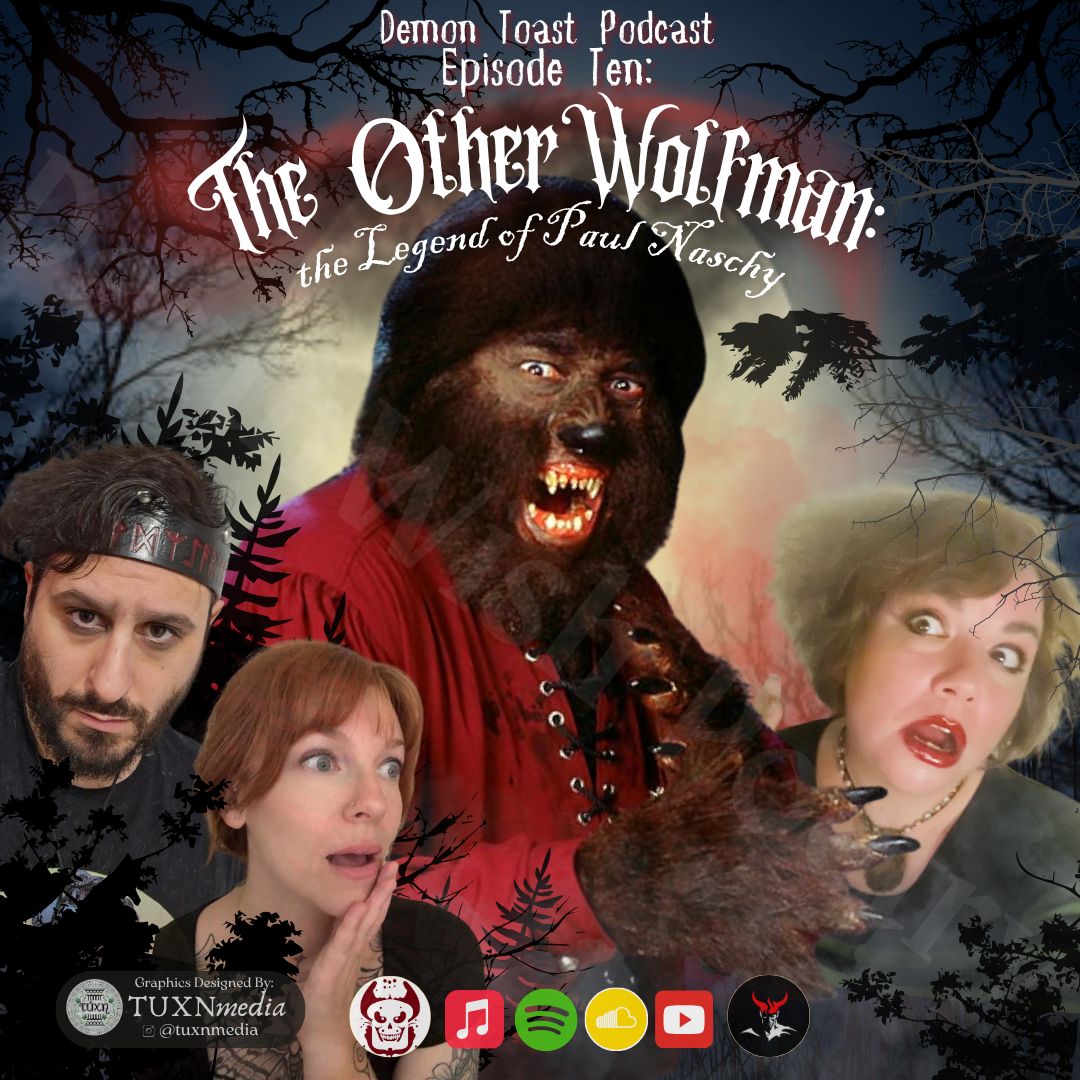
So, yeah, sadly, judging from your incredulity, I guess we're not actually here to talk about the Hamburglar this week. I'm kind of mad about that, but whatever. We're here to talk about Paul Nashi again. Is that right?
[00:01:43] Speaker B: We are part two, baby. We're back.
[00:01:46] Speaker A: We are back. We are back. Yeah. Welcome to Demon Toast, where we talk about the Hamburglar. Or we try to anyway. And you know, King Loki, your host, is accused of stealing hats. This is a horrific, horrific accusations. Burglar. Okay, whatever. Nerd Hashtag at burglar. Yeah, we talk about gothic and horrific literature. This week we're talking about Paul Nashi again, the other wolf man. And, you know, just to get us started, I have a selection from his quote.
This book is called Memoirs of a Wolfman. By the way, if you could find a copy, you should read it.
But, you know, basically, Paul Nashi is A guy who. Adrian, let me know if I get the dates right. Through the 50s through the 80s.
[00:02:25] Speaker C: Yep.
[00:02:25] Speaker A: Yeah. Produced, starred, wrote many, many, many Spanish horror movies, many of which starred a werewolf character named Count Valdemar. These movies rival the Hammer films of the same era in, in terms of production value, atmosphere and thrills and chills, while also incorporating elements of giallo and, I don't know, throw something in there. Give me a buzzword, Adrian.
[00:02:49] Speaker C: Fantasy, horror.
[00:02:50] Speaker A: Fantasy, horror. Thank you. That was his big thing.
[00:02:52] Speaker C: Yes.
[00:02:53] Speaker A: So, as he says in his book, little by little, I was creating a style of my own, what the fans call the Mark of Nashee.
My sources of inspiration were old movie serials. German Expressionism, the Universal films, certain doses of Hammer's Victorian style and a little of the Italian school. You know, the stuff that was big at the time. These were complemented by the influence of age old cultures, ancestral folklore, notably that of the Balkans. The Romantic movement, which had embraced the English ghost story and the German phantasmagoria, the epic poems and medieval folk tales also had an influence. He goes on a bit, you know, he mentions Solana and Goya, the painters, of course, but, you know, I don't want to get lost in the weeds here. Adrian, do you have anything to comment on that quote?
[00:03:39] Speaker C: No, I just think that, like, his films really did kind of mix all of those in such an interesting way. It's kind of magic. And he would fall in love with different stories from different cultures. So.
[00:03:52] Speaker A: Sure.
[00:03:53] Speaker C: Yeah, sure.
[00:03:55] Speaker A: So ca.
Are you.
Have you watched a lot of Jello movies, like Dario Argento and who's the other one?
[00:04:04] Speaker B: Honestly? No, I have. So, I mean, I'm familiar, like. But I don't. I don't. I wouldn't call myself an expert on it at all, but I really enjoyed that description. Just like hearing him talk, like, just self describe his various different influences.
[00:04:21] Speaker A: I agree. I also like how unpretentious he really is because, like, you know, he talked about.
What was that movie? Planet Terror, Project Terror. Right. Which was a disaster. And he's very unpretentious about it. He talks about kitsch, which he's a big fan of. Right. We talked about that in the last episode. And you know, how he melds it with this sort of like gothic style and you get something really special when that's the case.
The first movie. We're going to talk, Adrian, should we move on to the Hunchback?
[00:04:49] Speaker C: It's my favorite.
[00:04:50] Speaker A: It's a pretty great movie. A great movie. Yeah. So, like, obviously we're talking about him in the context of him being the Wolf Man. But, like, I. I would really be remiss if we skipped over the Hunchback of The morg of 1972, El Rodo de la Mor.
Oh, there it is on dvd. See, I watched it on.
On fawm, which is a free streaming service.
Yeah. Adrian, do you want to tell us about Hunchback of the Morgue? I have a quote from. From his book also, but you go ahead, man. This is your thing.
[00:05:21] Speaker C: Well, okay, so I.
One of the things about owning any of his movies, first off on dvd, I just want to say he, like, narrates them before you start the movie. He gives, like, a little intro, and he talks about he hopes you have wonderful dreams and possibly nightmares before every movie starts. And then when I started the Hunchback, oh, my gosh, the imagery, it really does. This one especially has that romanticism and that fantasy to.
Is.
It. Is. It is my personal favorite because the imagery in this film, like her with the flowers, it's so beautiful and horrifying. It's morbidly romantic. That is what this movie, the entirety of this movie, is morbidly romantic. And I mean, you know, for back in the day, I would say some of the gore in this movie is pretty actually epic.
It's like, ooh, okay.
[00:06:20] Speaker A: It's pretty gruesome. I agree. Ca. Did. Did you like this movie? Was it better or worse than Disney's Notre Dame?
[00:06:27] Speaker B: I. I. Don't get me started. I literally love that film, so I'm not gonna try to compare, but I love that movie unironically.
[00:06:35] Speaker A: It's cool. It's cool. I like it.
[00:06:37] Speaker B: So. But this film, I would say, yeah, I. I loved the very, like, gothic nature of it. Like, from start to finish, it was just so, like, dark and romantic and, like, sweeping and, like, epic feeling and sad and tragic and weird and all.
[00:06:58] Speaker C: The freaking things I love.
[00:06:59] Speaker B: You know what I mean? Like, it was just. It ended up feeling very endearing, you know, by the end of it, I just felt like, aw.
[00:07:08] Speaker C: Yeah, it's my.
[00:07:11] Speaker A: It's really sad. Yeah. It's about a hunchback who works in a morgue, and I guess he collects body parts for one of the guys that works there, and he's in love with one of the corpses, and that guy promises him he's gonna bring her back from the dead to love him, and he's not in his right mind, so he. It is really sad. Yeah. He's mentally stunted from isolation, I guess.
And I Have to say it. Paul Nashi is too attractive to play the Hunchback, in my opinion. Like, he's just too attractive, you know.
[00:07:43] Speaker B: He did a good job, though.
[00:07:45] Speaker C: You know, Did a great job.
[00:07:47] Speaker A: So it's funny that he aligns himself with, like, he loves Lon Chaney Jr. So much because much like Lon Chaney Sr. He's played all these roles. Lon Chaney Sr. Was the hunchback of Notre Dame, and that's iconic as hell. Like, that movie is incredible. The makeup on the Hunchback, the acrobatics that he does, phenomenal. Obviously, this is not that role. This is more of a gothic kind of brooding kind of plot. But, yeah, I found this movie to be pretty gruesome myself. Speaking of which, there's that sequence with the rats where they actually burn rats alive. That's pretty sad. But a rat catch fire. I. Adrian, I didn't get to see Paul Nashi introduce any of these movies. They're just thrown on streaming services like they're trash.
So I appreciate that there are DVDs out there that treat them a little more lovingly and actually bothered to get Paul Nashi to fucking introduce his goddamn movies. Because these are distinct, these are unique, these are important.
[00:08:45] Speaker C: It's beautiful. And he does it like, I have three of his DVDs and he introduces every single one of them.
[00:08:52] Speaker A: Cool.
[00:08:53] Speaker C: It's really beautiful. Not know that he burned rats in that movie. For some reason, I just automatically assumed that no animals were hurt in the making of this.
And I was wrong, and I feel very badly about that.
[00:09:03] Speaker A: He did not direct the movie. He probably wrote it, you know, But I'm not going to blame him. He does talk about it briefly. Several things worth mentioning happened. This film was also directed by Javier. Javier Aguirre Aguilar. And once again, the producer was Manuel Laguniche. It was the story of a poor hunchback, Wolfgang Gotho, named after Mozart, who loved a girl beyond death. His mission in this world, it couldn't have been any other, was to be custodian of a macabre mortuary where he'd cut up corpses for subsequent dissection by medical students. The film was mainly shot inside some labyrinth cellars that once belonged to Philippe ii. While the most unpleasant part was filmed in the morgue of Madrid's Hospital Provincial. There was even an homage to Lovecraft with the inclusion of an ancient one in the film. I recall a scene which made a tremendous impact on the audience. I refer to the scene where the hunchback defends himself with a flaming torch from the attack of a pack of starving rats. It was as terrifying as it was real. The Ibis Institute caught a load of rats in the sewers and left them without food for some time. Once loosed on the set, the filthy little beasts proved able to leap up to a meter high, sinking their needle sharp teeth into anything at hand. I felt their bites on several parts of my anatomy and wondered what would have happened to me if I hadn't been wearing protection.
It wasn't a nice scene to shoot. And then he talks about like the. The morgue where they actually, you know, did the work.
So they had a bunch of bodies that were there for dissection and he was supposed to like cut one and he couldn't do it. He cut like one part. So they made a plaster head.
So the head you see them taking apart in the movie is not a real head. It's kind of also. It's a great head. I mean, I recommend watching this movie. He also says the man in charge of the morgue had been repeatedly accused of committing acts of necrophilia with the female corpses and he'd had his hand burned with sulfuric acid. He insisted on showing me his new guests every morning. He used to say, the dead are wonderful. They never complain.
Yeah, this gross, odd character would be the inspiration years later for the macabre butler played by the late, fondly remembered Howard Vernon in Howl of the Devil. I'm not gonna try to read the Spanish.
So, yeah, I love this movie. The way the bodies are disposed of in. I guess sulfuric acid is pretty gruesome and horrific. The end of the movie reminds me a lot of the brain that wouldn't die. Have you guys seen that?
Adrian seen it? Ca.
You have?
[00:11:31] Speaker B: I think you told me about it though.
[00:11:34] Speaker A: It's a B movie.
Yeah, it's where this guy manages to keep his girlfriend's head alive or his wife's head alive after a car accident.
[00:11:42] Speaker B: You were talking about this.
[00:11:45] Speaker A: Yeah, he goes out of his way to like find a new body for her. But that's most of the movie, him just checking out other women.
And the whole time she just wants to die. And also she has psychic powers for no reason. And there's a monster in the other room that's locked away. And at the end of the movie it breaks out and kills the scientist. And the same thing happens here. The ancient one comes busting out of the door for reasons. And it was very similar, wasn't the same, but. But I can't help but wonder if Paul Nashi was like, why don't we do that from the brain that wouldn't die, you know, I don't know.
[00:12:16] Speaker C: Well, he really, he really admired those, like, horror movies, like, around at the time. He was a huge fan of Peter Cushing and especially Vincent Price. So of course he had definitely seen it, you know.
[00:12:31] Speaker A: Oh, yeah.
[00:12:33] Speaker B: Played the. I kind of like how he played the hunchback in this film, which is because it contrasts from, you know, his recurring wolfman character who's this, you know, like, debonair, you know, well respected and all the, you know, the leading man. Right. There's always a beautiful woman that falls in love with him and all of his wolfman, you know, roles. Whereas in this one, he's, you know, a kind of outcast character and as you said, like, to too handsome to play this character. But I actually like that he kind of like, challenged himself and put himself in that role rather than casting somebody else for it.
[00:13:12] Speaker A: You know, he's very versatile. Absolutely. I find him to be endlessly fascinating, actually. This is a story. Adrian, do you want to talk about the panel of judges of 1980, the.
[00:13:24] Speaker C: One where Peter Cushing actually got to give him an award?
[00:13:28] Speaker A: Yeah. Just because you said Peter Cushing. Yeah. Well, people were.
[00:13:31] Speaker C: He literally, like, there are pictures of him. It meant the world to him. Peter Cushing got to give him an award in Spain, which was kind of a big deal because most people don't get, especially in play. I mean, you know, with the Spanish Civil War finally ending and all of that kind of stuff. Like, you know, he actually got honored in Spain and Peter Cushing was the one that gave him the award. And if you see the picture, he is literally looking at Peter Cushing like a kid in the candy store. He's like, it's like pure worship and like magic on his face. And he's just looking at him like it's magic.
[00:14:09] Speaker A: Absolutely, absolutely. So is that the same one where Quentin Tarantino was there?
[00:14:14] Speaker C: I think so, yeah.
[00:14:15] Speaker A: People were mocking his movies because, like, you know, he made all these, like, these movies about, like, these low budget movies about, like, you know, monsters killing each other and werewolves and hunchbacks and Quentin Tarantino. Tarantino is like, I don't know why people are making jokes. This guy is great. That kind of made them stop, you know?
[00:14:34] Speaker C: Yeah.
[00:14:35] Speaker A: I publicly expressed his admiration for my work.
[00:14:37] Speaker C: He says, I'll say that the only time I've ever been cool with Quentin Tarantino opening his mouth and saying something.
[00:14:45] Speaker A: Yeah, he tends To. He tends to run his mouth and say problematic things.
So, yeah, Hunchback of the Morgue, I have to say, like, you know, this is as gothic and gruesome as they come. I. I think, like, of. Of all these movies, this is one that probably has the best, like, most coherent narrative too.
You know, the, The. You know.
Yeah. The stonework of the dungeon, the sewers, the streets of. Where are they supposed to be? Spain, I guess. Right.
Like Catalonia.
[00:15:21] Speaker C: It could never actually in Spain. I think they had to be in Romania.
[00:15:27] Speaker A: Okay.
[00:15:27] Speaker C: Every place in Romania while he was doing the film for that because of his German. Like, the people who were in charge of the film.
[00:15:35] Speaker A: Okay, that makes sense.
[00:15:36] Speaker C: Production company is what the right word is.
[00:15:39] Speaker A: I mean, it's the magic of shooting in Europe or especially Romania. I mean, all these, like, ancient buildings, these ancient falling apart things, and you don't even need a smoke machine a lot of the time. It just looks like that, you know?
[00:15:49] Speaker C: Yeah.
[00:15:50] Speaker A: So definitely recommend Hunchback of the Morgue. Is there anything else you want to say about it? Anything major other than the weird connection between, you know, the brain that wouldn't die?
[00:16:01] Speaker C: I mean, like, visually, like, when she's got the flowers around her, she totally had, like. Like Ophelia vibes from, like, Waterhouse. Like paintings from, like, the 1800s, like the pre Raphaelites, which he did love, which makes me even more happy. Like, he was totally aware of the references in those instances. So, like, when she dies, it's literally a reference to Ophelia?
[00:16:30] Speaker A: Yeah, I think so. And also when her body is destroyed, it's like she has a second death. And it's more tragic because on one hand you're given scenes where the doctor's like, yeah, I'm not doing anything for that hunchback guy.
And he doesn't know that. And when the body is just summarily destroyed, he's like, what do you mean, you killed my friend?
Because to him, she was. She was still there. He was able. He was talking to her. And that depiction of. Of not just sadness, but madness is very Po esque in its way, you know, Agree. Especially because it leads to violence, which, you know, is a staple of these types of things.
[00:17:07] Speaker B: Right.
[00:17:09] Speaker A: That brings us to our next movie. Let's just do it. Let's just do the one with Elizabeth Bathory.
Okay.
[00:17:15] Speaker C: I have it here. This is the American DVD of it right here. Yes, yes.
[00:17:19] Speaker A: Yeah. So in classic inconsistency, Night of the Werewolf, I think I know it as Return of the Wolfman.
[00:17:26] Speaker C: Finding the Actual, like. Like every film and in every country they were released, they had different titles. So, like, when I was giving the suggestions and CA was like, I can't find this, but I found one called this. I was like, yeah, same movie, different title. It's ridiculous list.
Yep. It's so.
[00:17:43] Speaker A: Yeah, the intro to that movie is crazy. It's like Elizabeth Bathory is being held like that. You know, the Inquisition is holding a trial for her because she bathed in the blood of young girls and.
[00:17:57] Speaker B: Right.
[00:17:57] Speaker A: All her people are accused of witchcraft. And Paul Nash is there as Lord Valdemar, her werewolf, like, hitman, I guess.
And, like, she's sentenced to be burned at the stake, whereas he is made to wear the. This metal mask of shame and impaled with. What was it, Adrian? A silver stake.
[00:18:20] Speaker C: Yeah. Yes. Well, I don't think. No, he's not the one that gets staked.
No, they take Elizabeth because that's when they take it out. And she comes back as like.
[00:18:32] Speaker A: Well, he came back, too. All right, whatever.
[00:18:34] Speaker C: Well, they dig him up. They take the silver mat off of him, and that's when he comes back.
[00:18:40] Speaker A: Okay, well, okay.
They're killed in, like, the Middle Ages or something.
And the sequence of him dying and, like, the blood coming out of his mouth through the metal mask is so cool.
[00:18:52] Speaker B: Yeah.
[00:18:52] Speaker A: Intro. Like, it's gross. Yeah. And it feels like a Hammer movie. Like, it really does have that production quality. Sadly, it jumps forward to the 70s, I suppose, and it kind of becomes a slasher movie. But it's a slasher movie with Elizabeth Bathory and Lord Voldemort. And it's like Paul Nashi with, like, a crossbow, and he's actually, like, terrifying.
[00:19:13] Speaker C: Oh, I was just going to say my actual favorite character in that film is the girl. Like, the little nun girl that watches over him with the burns on her face. I think she is a very unusual character for some of his films because usually he likes the overly beautiful women, you know, that always fell in love with him and stuff like that. But this one was a little different. And she was. I don't know. She was kind of like.
She was just my favorite.
[00:19:43] Speaker A: Yeah, fair. Fair. This movie doesn't have a woman fall in love with the wolf man and kill him. Right?
[00:19:50] Speaker C: Yes, it does.
[00:19:51] Speaker A: It does.
[00:19:52] Speaker C: It's Karen.
[00:19:53] Speaker A: It does.
[00:19:54] Speaker B: Yeah.
[00:19:54] Speaker A: I guess I'm mixed up.
[00:19:56] Speaker B: That's okay. But that's how it ends. And they're, like, holding hands as they die together.
[00:20:02] Speaker C: They all die. It's morbidly romantic. But anytime someone makes complaints about Karens. I'm like, well, my Karen is from a Paul Nashie movie and she's a badass. So say what you want, but that's my Karen.
[00:20:13] Speaker A: So I know, like, pulling the stake out of Dracula's heart is like a cliche, but, like, is that a little cheap?
[00:20:19] Speaker C: It's actually based in real mythology, so if you are to take the stake out of a vampire's heart, it can come back. That's why fires usually, like, for example, in Massachusetts, in the Mercy, Brown was thought to be a vampire, and all of her family was dying of what was actually tuberculosis.
But because they dug her up and she looked like she was still alive, they cut off her head and they actually cut out her heart and burned it. So stabbing a vampire in the heart will kill a vampire, but if you pull the stake out, it will resurrect the vampire. This is actually, like, old lore.
[00:21:00] Speaker B: I found it interesting because they were mainly being like, the women were mainly being accused of witchcraft, but they were also vampires. And I was like, maybe. Is it a both and situation where vampirism is a form of witchcraft in this scenario? But, you know, I like that. I love. I love a grab bag. Give me every kind of mythology. We'll just mix it all together.
[00:21:24] Speaker A: I was just going to ask if that works for werewolves too, because Nashi gets dug up by different people who are like, oh, we found the tomb of Lord Voldemort. We're going to make all this money. And then, like, he comes back from the dead also, and I'm just like, you know, I'm in for a penny, I'm in for a pound. I'm not too worried about it. But the only time I've ever seen that happen was obviously the Lon Chaney Jr. Wolfman. Where? And Frankenstein meets the wolfman. The moonlight brings him back from the dead end.
[00:21:50] Speaker B: Didn't the witches bring him back somehow? They had some sort of ritual thing that they had to do to bring him back to life.
[00:21:58] Speaker C: So she sacrifices the professor guy that she's secretly working for and gets the stallion and bring Voldemir back.
[00:22:07] Speaker B: Got it. Got it.
[00:22:08] Speaker C: Okay.
[00:22:08] Speaker B: Because that was the big thing. It was like, once Volodymyr is back, then we can take over the world or something like that, Right?
[00:22:16] Speaker A: Yeah. I didn't really understand how that worked. But again, I mean, you know, I'm not a witch. I don't know. Maybe werewolves are very potent weapons. I don't know.
[00:22:25] Speaker C: Like, the women are witches before they get turned into vampires, but they're Being possessed by Elizabeth Batori. So it's like a whole thing.
[00:22:37] Speaker B: Yeah, she's the orchestrator of the whole.
[00:22:41] Speaker A: Oh, yeah, she's our Dracula. What did I want to say? Okay, so. So, Adrian, how do you.
[00:22:49] Speaker B: I loved her character.
[00:22:50] Speaker A: She's great.
[00:22:52] Speaker C: She was amazing.
[00:22:53] Speaker B: Super scary. Yeah, like creepy. Af for sure.
[00:22:59] Speaker A: I'll roll some B roll of her.
[00:23:00] Speaker B: If I can find. When she sends that crazed, like, look in her eye, like, just. It's. I know. It's so good.
[00:23:08] Speaker A: She was doing the Bella Lugosi eyes, you know.
Adrian, how do you feel. How do you feel about her controlling Paul Nashi?
[00:23:17] Speaker C: Well, I will tell you, it's not the only Paul Nashi movie where this happens, but I think it was actually, especially for the time period, you know, like this big, strong, muscular man being, you know, controlled by this, like, sorceress. There is in history, stuff like mythology, you know, about werewolves being subservient to vampires and stuff like that. But it's not very common. And I don't know how accurate some of that stuff is really. I think that, like, it's a. It's a gothic romance horror fantasy movie. Like, that's what he was going for.
[00:23:52] Speaker A: There is Mark of the. Of the Vampire, where Bela Gosi controls a, you know, werewolf. That's a pretty cool movie.
[00:23:58] Speaker C: Yeah, I mean, it goes. I mean, especially in film, they do it. I mean, you Underworld, where stuff like that happens. I know, I know. At least it's not Twilight. Okay, but I'm sure that happens in Twilight too. I don't know. I haven't read all the books.
[00:24:11] Speaker A: No, no, Twilight's cool, man. You know, it's got. It's got werewolves and vampires and.
[00:24:17] Speaker C: I mean. Yeah, I'm going to tell you, I take Paul Nashi with his potato teeth over sparkling vampire any day of the week.
[00:24:28] Speaker A: You know, the last Howling movie, the Howling eight. I don't remember what the fuck it's called Howling Reborn.
It was a Twilight knockoff. Like, in the worst way possible. Like, it wasn't very good. I mean, it's better than Twilight, but it had like, they were all in high school, you know, the cute guy was a werewolf. Like, it wasn't like a romance or anything. It was trying to be a horror movie, but it had those Twilight influences, you know.
[00:24:52] Speaker C: Speaking of the Howling, in the first Howling, the director actually named a character after, like, as an homage. One of the werewolves is named after Paul Nashie.
His name in the movie is Jack Molina, which of course, Paul Nashie's original. His Real name was Jacinto Molina.
[00:25:16] Speaker A: Right, right, right, right.
[00:25:17] Speaker C: So he literally paid homage to Paul Nashi when he was making the Howling. Yeah, I found really amazing.
[00:25:25] Speaker A: That was Joe Dante, by the way. So, wait, is that character the one who runs the store in the Howling?
Okay, that's a. That's. I think that's Dick Miller. I know this because Mike and Jay. Or. Well, I guess it was Jay and Rich Evans over on Red Letter Media. They. They just made a video about Joe Dante movies, and they talked about the Howling.
But, yeah, yeah, that's a fun bit of trivia, Adrian, and I'm glad you mentioned that, because that's a great homage.
[00:25:48] Speaker C: It was. It was perfection. And Joe Dante's in the documentary, the man that Saw Frankenstein Cry.
[00:25:53] Speaker A: Yeah.
[00:25:54] Speaker C: He talks about his great love for Paul Nashi. So does Joe Landis. Like, it's actually really cool.
[00:26:00] Speaker A: Do you want to tell us about that, by the way? Because I didn't watch it. I don't know if ca watched it. You know, I figured I had his book. That was good enough. But.
[00:26:08] Speaker C: So the documentary is actually one of the most beautiful things that I've seen in a while.
It definitely. Okay, guys, like, I'm not gonna lie. Like, we all know that I cry all the time, and I definitely, like, cried a lot. It has interviews with both of his sons, and they talk about what an amazing man he was, and they interview his. His. His wife that he was in love with. Like, they got married young, and it was, like, a whole thing.
And it's just. It was just very inspiring. And you have these other filmmakers talking about, you know, how much inspiration they got from him. But then you also have filmmakers that he worked with talking about what it was like working with him on set and, like, all of these beautiful stories. It was. It was everything. I'm not gonna lie. Like, it was literally like I was crying, especially the parts with his sons. Like, it was just amazing.
[00:27:02] Speaker A: Where'd you watch it?
[00:27:04] Speaker C: I watched it free on YouTube, guys.
[00:27:06] Speaker A: Cool. Cool. Yeah, check it out, especially if you can't find his book. And this is from. I looked it up. It's from 2010. It was directed by some guy named Angel Agudo. It's probably pronounced differently, but, yeah, that. That director, Javier Aguirre, he's in it too, apparently. That's cool.
[00:27:24] Speaker C: They interviewed a lot of the people that worked with him.
[00:27:27] Speaker A: It was Joe Dante. John Landis.
John Landis made American Werewolf in London, correct?
[00:27:34] Speaker C: Yes, he did.
[00:27:35] Speaker A: Okay.
[00:27:35] Speaker C: Matter of fact.
[00:27:36] Speaker A: Yeah. Yeah. Now, the Howling's My favorite.
With, like, probably one of the Wolfmans behind it, but American Werewolf, I mean, it's a classic classic.
It is. And it is. It is the Wolf man, but, like, in a modern. Well, then modern British setting. I think it's like, what, from the 80s? Like. Yeah, it's got this.
[00:27:55] Speaker C: It is.
[00:27:55] Speaker A: Well, it's got those 80s.
I mean, I don't know. Let's have a look, shall we?
[00:28:03] Speaker C: I probably actually have that information.
[00:28:04] Speaker A: Right.
[00:28:05] Speaker B: Fire up the Google machine.
[00:28:08] Speaker C: Fire it up.
[00:28:10] Speaker A: According to Rabbi Google, it's from 1981.
[00:28:13] Speaker C: 1981. Okay.
[00:28:14] Speaker A: An American Werewolf in Paris was a. I'm pretty sure that was made in the 90s. That's another classic.
[00:28:19] Speaker C: It was definitely the 90s, and I definitely saw it in a movie theater.
[00:28:22] Speaker A: Great, great, great cgi. That's really aged incredibly.
[00:28:26] Speaker C: That is sarcasm, guys, in case you're curious.
[00:28:29] Speaker A: No, no, it's good. It's a cool movie. I saw that when I was little, you know, and I. You know, I was so excited, you know?
[00:28:35] Speaker C: Yeah, no, Frank Oz, who does the voice of Miss Piggy and Yoda, is actually one of the police detectives in American Werewolf in London.
No, guys, no joke.
[00:28:50] Speaker A: That's like.
Yeah, it's like Hugo Weaving being the inspector in the Wolfman from 2010, you know? Whoa, whoa, whoa. I just had a brain blast. I'm a little dumb. So, Adrian, do you think that this. This movie was made because they were remaking the the Wolfman in 2010?
Like, they didn't put the Wolf man in the title because they're dumb.
[00:29:11] Speaker C: But, like, you know, I think it's highly possible.
[00:29:15] Speaker A: Anything's possible with Trump in the White House.
[00:29:16] Speaker C: All right, Like, I will say something good.
[00:29:19] Speaker B: Werewolf.
[00:29:19] Speaker C: I mean. Okay, I'm being unkind.
The 2010 the Wolfman or whatever wasn't bad.
[00:29:28] Speaker A: No, it had some questionable uses of cgi, but Benio is great. Anthony Hopkins is great. Hugo Weavings. Emily Blunt is great. The setting, it looks so great. It's. It's. Some of the carnage is a little unfortunate.
[00:29:43] Speaker C: No. Like, I used to hate that movie really bad. And then, yeah, it's a remake of the Wolfman.
[00:29:48] Speaker A: I mean, you know, it's. It's fair to have my thing. Here's my thing. Here's my big thing. They make a Dracula movie every week. They make Frankenstein every week. They don't make the Wolfman every week. So, you know, like, I'm not gonna get bent out of shape on principle because they made a Wolfman remake. In fact, I really liked it for My money, that's the Wolf Man. He's terrifying. He's got the big claws. He walks like a wolf man. Speaking of which, as much as I like the return of the Wolf Man, Night of the Werewolf, whatever the one with Elizabeth Bathory is called. You keep saying, but Batory. Is that correct?
[00:30:21] Speaker C: It is the correct pronunciation.
[00:30:23] Speaker A: Well, someone better tell Ghost they got a song about Elizabeth Bathory and they say it wrong.
Cradle of Filth. They got an entire album about her. You know, I know.
[00:30:34] Speaker C: I'm a nerd, guys, I'm sorry I'm like this.
[00:30:37] Speaker B: No, never apologize.
We need to know these things.
[00:30:42] Speaker A: I agree. I agree. You're right. And that's all that matters.
[00:30:45] Speaker B: In the documentary, did they talk at all?
Sorry, I'm fully switching ADHD gear here. I was going to ask, in the documentary, do they touch at all on, like, his, like, weightlifting career prior to Paul Nash's weightlifting, like, champion? Like, how did he make you switch? Like, why did he go from I'm a professional wrestler to I'm going to make films? Just because of his love of art and monsters.
[00:31:15] Speaker C: He walked into a movie theater as a child, and his mom wouldn't let him see it. He saw, actually it was Frankenstein versus the Wolfman, and he wanted to go and see it super bad.
And his mom was like, absolutely not. And so the next day he ran to the cinema, managed to. He managed to convince the guy to let him in and see the movie. Even though he was, like, young. You know, he was like 12 or 13. And he was obsessed from then on. His parents wanted him to go into, like, architecture.
That's what they wanted him to be as he grew up. But instead he was. And he had to fight super hard to be able to, like, tell him, like, no, I want to make movies. This is what I want to do. Like, he fell madly in love with films. So, like, monster films.
[00:32:02] Speaker A: I think his first movie role actually was on the old movie, the King of Kings, the Jesus movie. He's one of the Roman centurions just standing there in his armor. And I think that's how he really got his start, like, meeting directors and set designers and stuff and doing grunt work.
[00:32:17] Speaker B: Because part of me was wondering if, like, his physical build inspired why he wanted to focus so much on Wolfman specifically, like, and play that role over and over again. Because, you know, he. He has the build for it, right? Like, to be this, like, grrr, like, brute kind of character versus being something like a vampire character or something else.
[00:32:41] Speaker A: Yeah, I just think he liked The.
[00:32:42] Speaker B: Wolf man could be just that. You know what I mean? But.
[00:32:48] Speaker A: Well, no, I. I say that because Adrian can fill me in, but I have pictures of him playing, like, hang on, here's him as the Mummy, and it's. It's fantastic. I mean, look at this. It's great. You know, and if you. If you're not on. If you're listening to this on a podcast, just Google Paul Nashi and the Mummy's Revenge. I mean.
Oh, and here's him as, I guess, the devil, you know.
[00:33:12] Speaker C: Oh, yeah, he's done that a couple times, actually.
[00:33:14] Speaker A: Yeah. But, like, look at this. I mean, his horns.
It's phenomenal.
Yeah.
[00:33:20] Speaker B: I do think he's so good.
[00:33:22] Speaker A: Oh, is that the movie? That's cool.
Yeah. Well, the fact remains that I think that the Wolfman was his favorite. And it's hard not to love the Wolf man because, like. Like, I. I love the Frankenstein monster. He's my favorite of the classic monsters.
But, like, the Wolfman is sympathetic, and he has that element of doomed love and, like, you know, tragic death. And he's also a werewolf, and that's delightful. So, I don't know. I do think that our next. Our last movie, the Werewolf in the Yeti, has the best werewolves of any of these movies. It's not the best movie. It's. It's kind of a piece of junk. But I do really like the Return of the Wolf man or Night of the Werewolf, as it were. I like the fact. I love when there are. I love when vampires are, like, Dr. Doom. They're, like arch villains who can do more than just drink blood and hypnotize people. I love when they're super powerful and just the embodiment of ultimate evil.
[00:34:19] Speaker B: Yeah.
[00:34:20] Speaker C: So sparkly.
[00:34:21] Speaker B: I think I loved that one the most of the ones we've. I mean, I really loved Hunchback, but I really liked the, you know, Return of the Wolf man, whatever, because it had so many different female characters versus, like, a lot of the other movies that we watch for this. There's just kind of like this one sort of very, you know, stereotypical type of a role for the women to play. Whereas in this one, as you pointed out, you know, we have this, like, little, like, nun character who is a very unique personality, and then you have, like, multiple different, like, which vampire characters. So I just felt like I. I enjoyed that because we actually got to see, like, a broad range of the feminine in that movie versus a lot of the other Nashi films that we watched. So that's probably why I liked it the most.
[00:35:11] Speaker C: He gets better about that too. Like, there's a lot more women in a lot more of his films.
Like, that's cool. He did over a hundred, right?
[00:35:21] Speaker B: Yeah.
[00:35:21] Speaker A: I get the sense that. I get the sense that Paul Nashi.
[00:35:24] Speaker C: I think you have. Actually two of the actresses are in Night of the Werewolf or, you know, whatever the title is, but two of the actresses are in this and then there's several others.
And it's also kind of like a 60s, like spy movie @ one point. It's really.
But Paul Nashi is one of. He's the only actor that's actually played like every single, like hammer monster. Like every single one. He did the Mummy, he did Frankenstein, he did the Werewolf. He did that. Like. Yeah, it's pretty magical, honestly.
[00:36:01] Speaker A: Yeah.
He's also in a movie called El transsexual.
That was 77. I just, I'm just, you know, like, do I need.
[00:36:10] Speaker C: This sounds like a movie I need.
[00:36:12] Speaker A: I don't know.
He. He considers it an ill fated movie. But like, my thing with Paul Nashi is that I get the sense that he really cared about people that, like, he didn't just date women or cast them in movies or star with them. I think he cared. I think he cared about other people's perspectives. You know, like movies like that, that have, like transsexual people. Obviously we don't use that word anymore, but transgender people. Right.
They tend to be exploitation movies back then. I mean, if you look at Edwood's movie, Glenn or Glenda, which I shouldn't go there, that's kind of a special case. It's. It's an exploitation movie. It was made to be laughed at, you know, And I don't get the sense that El Transsexual is supposed to be a comedy or anything like that. So, you know, my thing is that, like, this movie does have a lot of female characters in it and that is definitely a strength of it. It's not just the villains and it's not just. It's not just his love interest.
There's. There's that. That very tense sequence where they get jumped in their car by a bunch of hillbillies with shotguns and there's almost a rape scene and it's treated as like something really horrific. It's not shot in an exploitative way. It's not I spit on your grave where you watch this horrific rape scene and you're supposed to have your dick out because you're gross. You know, like, it's It's a gruesome scene. No one gets raped. They get Adrian. Doesn't Paul Nashi come out and shoot one of the guys?
[00:37:36] Speaker C: He does, and that leads them to the castle where all hell breaks loose.
[00:37:42] Speaker A: He's not the savior of girls here or anything, but it's a pretty wonderful sequence. And he's scary. Like, he's standing there with this crossbow and he's just like. He's got his beard, and when his.
[00:37:52] Speaker B: Hair is perfect, the crossbow is sick.
I love the crossbow in this movie, for sure.
Weapon of choice.
[00:38:01] Speaker A: Yeah.
Crossbows are very dangerous. Have either of you ever shot a crossbow?
[00:38:06] Speaker B: I have. Yep.
[00:38:09] Speaker A: Yeah. Isn't it, like, surprising how hard it flies out and slams into the thing?
[00:38:15] Speaker C: It's intense.
[00:38:16] Speaker B: Yeah. Scary.
[00:38:18] Speaker A: Yeah.
[00:38:20] Speaker C: Kind of like them, though. I know.
[00:38:21] Speaker A: Yeah, me too. Me too. Now, being accurate with it is a different story, of course. And I wouldn't want Cole Nashley to be shooting at me.
Yeah.
All right, shall we move on?
Yeah. Okay. Well, our last movie before we move on to Adrian's treasure trove is the Werewolf in the Yeti, which is kind of a misleading title, sadly.
[00:38:44] Speaker B: Right.
I was like, I don't even know where to start the movie. I kept being like, where's the yeti?
[00:38:51] Speaker C: Where's the yeti?
[00:38:53] Speaker A: There's no Yeti.
[00:38:55] Speaker B: And then I think there's a yeti because.
[00:38:57] Speaker A: Right.
[00:38:57] Speaker B: I kept getting confused because, like, every time there was like, you know, the werewolf or whatever on screen, I was like, is this the yeti? Cuz, like, you know what I mean? Like, the costuming and makeup at the time, like, I'm like, it could very well be that, I guess. But, yeah, it wasn't. It was always just the werewolf.
[00:39:14] Speaker A: But, yeah, yeah, it's like. It's like Paul Nashi is a guy who gets lost in the Tibetan mountains and, like, finds his way to some shrine of Kali or something like that. There's some Orientalism going on here. Of course.
[00:39:29] Speaker B: For sure.
Okay, I just remembered. So there's two women. There's two women there, and they're like, this is sacred ground. We are protectors of the temple, blah, blah, or whatever. Right.
[00:39:40] Speaker A: And that's great.
[00:39:41] Speaker C: Okay.
[00:39:42] Speaker A: Yeah, yeah. They're, like, using Paul Nashi as a slave, I guess.
[00:39:47] Speaker B: Right?
[00:39:48] Speaker A: Yeah, yeah.
I don't know. I think one of them is aware.
[00:39:53] Speaker B: I was like, okay, I. That's what I was gonna say. I thought. I was like. When that sequence started playing out, I was like, oh, are these the yetis? Like, are people confused? You know, because they're like these, like, man eating women and maybe they're gonna transform. I kept waiting for a yeti scene and it never happened. But anyways, that's not the case. They were just crazy ladies in the cave, you know, being scary.
[00:40:17] Speaker A: Well, yeah, well, they were taking orders from some weird guy. He was the. The great con or something.
He was a white guy, though. I don't. I really don't know what was going on, but great con.
[00:40:29] Speaker B: I remember that now.
[00:40:32] Speaker A: Yeah, it's. It's a weird movie. It's a weird movie. A lot happens and there's like another group of people that are.
It's like another group of people trying to find Paul Nashley. But then there's another werewolf out there in the wilderness tracking them and. And they think it's a yeti.
Wonder if they wanted to do a yeti movie, but they didn't have, like a costume, so they started doing a werewolf and we're like, oh, I guess this is what it is. I don't know. Adrian, do you have some insight?
[00:40:59] Speaker C: Oh, my gosh, I have so much.
[00:41:01] Speaker A: Why you had to talk so much.
[00:41:03] Speaker C: I literally just told you. I was like, stressed.
Paul Nashy worked for a German production company for a very long time. But then finally the world started changing, you know, and the production company finally let him go and he found this Japanese production company, which is why it has a whole lot of that influence in it and everything is because he started working with them and they loved him and he worked for them, like, for six years. But this particular movie actually has the best werewolf makeup.
Makeup and everything. Like the best werewolf effects of any of his werewolf films.
[00:41:51] Speaker A: Yeah.
[00:41:51] Speaker C: And he was like. That was. He was so proud of that. I think it was originally because if you watch enough of his movies, you know that, like, in a lot of them, Voldemort gets turned into a werewolf by getting bit by a yeti.
And he has that, like, hexagon bite mark on his chest, like in almost every film. It's pretty ridiculous. I'm not going to lie. Don't ask. There is no mythological there that, like, there's nothing. Okay. He just made it up. It's fine. It's literally fine. I love him. It's okay.
He just made up the story.
Like, the yeti is in, like the first two seconds of the movie, or it was supposed to be with the makeup for it was so absolutely awful and terrible.
[00:42:35] Speaker A: He has an epic fight with the other werewolf in it. You know, like, I. Yeah, that's true.
I think I Got like, there were 10 minutes left in the movie. And I'm like, there's no Yeti.
[00:42:46] Speaker C: I told you. It was in, like, the first two seconds. I was like, you missed it.
[00:42:50] Speaker A: Yeah, yeah, don't blink.
[00:42:52] Speaker B: It's an opening sequence.
[00:42:55] Speaker A: So what you're saying is this movie is very. Is very close to reality where yetis are out there. We just never get to see them. Right.
[00:43:03] Speaker B: Funny, hey.
[00:43:05] Speaker C: Yeah, well, it's because they're interdimensional travelers. It's fine.
[00:43:09] Speaker A: I think in Harry Potter they have the power to turn invisible. Like the invisibility cloak is made out of yeti hair.
Yeah, that's true. I didn't even make that up. Like, honestly.
Yeah, okay.
[00:43:21] Speaker C: I've never heard.
[00:43:22] Speaker A: You know, I believe in Yetis, by the way. I don't believe in Bigfoot, but I believe in Yetis. I think they're out there. I think that those Tibetan farmers have no reason to lie. I trust the Tibetan farmers.
[00:43:33] Speaker C: I mean, I don't believe in Big.
[00:43:35] Speaker B: I do.
[00:43:37] Speaker C: Oh, you missed it. Ca. There was a whole thing.
[00:43:41] Speaker A: All right, all right, all right and all. Oh, yeah, that's right. Well, I mean, I. That's right. We did. We did talk about Bigfoot when we did. When we talked about De Evolution, the Max Brooks novel. Oh, well, yeah. I mean, I watch a lot of mountain monsters and that's real. You know, it's reality tv. They can't put it on TV if it isn't real, right?
[00:43:58] Speaker B: Oh, it's so real. Every one of those.
[00:44:00] Speaker A: I mean, Bigfoot pans. Bigfoot's arm, like his rubber gorilla arm, busts through the wall once and grabs one of them.
[00:44:06] Speaker B: Absolutely.
[00:44:07] Speaker A: They crossed the line. They went too far there, man.
[00:44:09] Speaker B: What I love about this film, and one could say this about, like, all Paul Nashley films, is like, the absolute, like, fearlessness of just doing weird shit. Like, let's just, like, throw in whatever weird sequence we want to. Cuz, like, I have, like, I just. Like, in his mind, he's like, I have this cool idea. Let's make a scene where blank and blank happens and it's so fucking weird and out of pocket and everyone's just like, let's go. Like, we'll figure out a way to work it into the plot. And even if it doesn't work in the plot, it's a good scene. Let's just film it because it will look cool.
[00:44:43] Speaker A: You know, that whole. Yeah, the whole ending where, like, he has to fight the con guy or whatever is totally ridiculous. Like, he grabs a Sword off the wall, and he grabs a sword and they're fighting. And then there's this, like. There's, like, this death trap that opens up and there's just, like, a dead guy down there. It's like, what?
[00:45:01] Speaker C: I feel like Paul Nashley was always to keep his, like, childlike sense of wonder and imagination.
Like, a lot of his movies are like stories that a kid would tell you, like, really excited. Oh, yeah. And then this and this and this happens. And then they, like, sword fight and then.
[00:45:18] Speaker B: Exactly what I'm saying.
[00:45:22] Speaker C: And then, like, wouldn't it be cool if there was this, like, really, really.
[00:45:25] Speaker B: Like, hot lady, but then she started, like, eating the man's guts, like, you.
[00:45:29] Speaker C: Know what I mean?
[00:45:30] Speaker B: Like, it's so funny.
Yeah.
[00:45:34] Speaker C: But then, like, in every single role, he 100%, like, commits to it. It takes it, like, way over the top sometimes. Serious. Like, he's just, like, in it to win every time.
[00:45:46] Speaker B: Yep.
[00:45:47] Speaker C: It's amazing.
[00:45:49] Speaker A: Yeah.
Yeah.
[00:45:50] Speaker C: Also, the Yakuza wanted to hire him to smuggle guns while he was working for the production company, and that's when he left.
[00:45:58] Speaker A: That's a pretty good reason to leave.
[00:46:00] Speaker C: Yeah. He's like, no, I don't think I want to do that. I don't really like violence in real life. That's.
[00:46:06] Speaker A: It's a shame. It's a shame he never. It's a shame he never worked for, like, Roger Corman or something, you know, because that would have been his ticket to the big time. That's. That's where Joe Dante got his start.
That's where Cameron got his star. You know what I mean? Like, yeah, looking for the schlockmeister. But it's steady work. And those movies get into theaters. Well, they used to, but. Yeah. So, Adrian, would you recommend the Werewolf and the Yeti?
[00:46:35] Speaker C: Oh, heck, yeah. It's a good time. Like, I know it's schlock.
Like, they're all, like, be cheesy, crazy movies, but there's so much magic and wonder in them that you kind of get lost to it. Even just, like, the. Oh, my gosh. How did anyone even think of this kind of thing, you know?
[00:46:54] Speaker A: Yes.
[00:46:55] Speaker C: Like.
Like, it's beautiful. I don't know. The way I love him.
[00:47:00] Speaker A: Yeah, yeah, I agree. So before we move in, move into our last segment here. I do just want to say that, like, we don't love him despite him being schlock. We like him because it's schlock, but it's a type of schlock. Like, we just. Me and Justin just watched a movie called Ebola Rex, right? It was a piece of. You know, it wasn't. It wasn't. It's not even worth telling you about, you know, cgi, T. Rex, bad acting, people on webcams, like, you know, or the. The modern classic War of the Worlds with, like, Ice Cube, which, you know, I'm a big fan of, but I. I have mental problems.
I have legendarily bad taste. Garbage, right? Garbage movie. You know, Dracula 3000, another classic favorite of mine. Garbage movie. Paul Nash is not in that class of schlock. It's aiming for the stars. It's doing what it does very well. Every one of these movies, that's. That Shrine to Kali is awesome.
[00:47:52] Speaker B: It's so good.
[00:47:54] Speaker A: There is, like a. There is a dead body with fangs laying on the altar.
Like, it looks wonderful. It's covered in cobwebs. And the. You know, the. The monstrous ladies are fearsome. I mean, they look like some of my ex girlfriends, you know? I mean, serious, you know, no lie here. But. Yeah, that's my point. Paul Nashi is great. He's fantastic, and he deserves to be talked about by more people. Speaking of which, Adrian, you've got some artifacts, don't you?
[00:48:19] Speaker C: Well, I have several, including a painting of Mr. Nashie that I have done myself because I don't even like him, but I will.
Oh, look, it's Poldashi's autograph in Fangoria magazine from 1988. 1988, obviously.
Yep. 1998.
[00:48:45] Speaker A: 98.
[00:48:45] Speaker B: 98, yes.
[00:48:48] Speaker C: Yeah.
And then let's see if we can see it. There's the painting.
There's the kitty.
I don't even like him. It's fine.
[00:48:59] Speaker A: Yeah, he's pretty cool.
[00:49:02] Speaker C: I can't believe I actually have, like, an entire article. Like, it's an interview with him, and he signed it, and it's pretty cool. A friend of mine sent that to me a while ago.
[00:49:12] Speaker A: Yeah, I'll never forget, like, where I saw some movie from the 70s called, like, Mark of the Werewolf or Mark of the Wolfman. And I'm like, all right, this is what we're watching. And I just clicked it, and it was this, like, insane phantasmagoria of werewolf effects and, like, creepy music and shots of the moon and a plot that made no sense. Like, I was like, adrian. And you're like, oh, yeah, that's Paul Nashi. He's a bad motherfucker. And I'm like, what the fuck?
[00:49:34] Speaker C: That's literally what happened. He was watching a movie. He's like, I don't even know what to do with this. Like, it's amazing. But what is this? I was like, well, you just stumbled upon one of my favorites ever. That would be Paul Nashi. He was my screensaver for my phone for like two years.
[00:49:51] Speaker B: Well, I have both of you. It's really for my now introduction to Paul Nashi because I really didn't know much about him at all before we came up with the concept of this episode. And so, yeah, I love it. Thank you guys for introducing me to Paul Nashi.
[00:50:07] Speaker A: Yeah. And I'll just read this quote here. Apart from in 2000, I still live on in the memories of ordinary people. What can I say? That unfair and unjust laws have prevented me from doing practically anything, while others, either smarter or more influential than me, have had a field day. That Spanish producers and directors have typecast me as the horror man and can't envisage me in any other roles. As if my 30 years in the business, the more than 20 international awards I've won, and the countless different roles I've played count for nothing. I've been everything from a Roman general to. To a priest, a desperate father, a terrorist, a policeman, a newspaper boss, a death wish vigilante, a trapeze artist and a secret agent. In short, I've worked every genre. Melodrama, comedy, historical drama, thriller, action adventure, documentary, and of course, horror, fantasy in all these different genres. I have years of experience not only as an actor, but also as a director and a producer.
He goes on for a while. Also, at the time, he had a dog named Lon. Named after Lon Chaney, of course. Yeah. Oh. You see, the wolf man's most faithful, understanding and affectionate friend is a floppy eared golden cocker spaniel with the sweetest, saddest, most intelligent expression you can imagine.
[00:51:25] Speaker C: And he's right.
[00:51:27] Speaker A: Good place to leave Mr. Nashi. As he writes. As.
As he writes, Paul Nashi bides his time and trusts in the full moon. He's awesome. He's great. And you should watch at least one of these movies. I don't care if you like it.
It's worth watching. If you consider yourself a fan of horror movies, as Nashi calls it. Horror fantasy movies.
If you like the classic monsters, do yourself a big favor and watch Paul Nashi.
[00:51:54] Speaker C: They have a lot of the dubbed versions. They have, like, films on Tubi, I believe.
[00:51:59] Speaker A: Awesome.
[00:52:00] Speaker C: You can watch those for free. There's at least two or three on Shudder, which we love. And you can find the documentary on YouTube.
[00:52:10] Speaker A: Yeah, I should add him to my hat. To my hat. You know, I should. I should, like, you know, my hat. Well, I. I should add, like, Frank, you know, Adrian, you say this is your hat, but, like, you know, you don't like Freddy Krueger or the Halloween guy.
[00:52:24] Speaker C: Freddy, my favorite. Thank you very much.
[00:52:27] Speaker A: Why isn't Paul Nashi on on this hat? If this is your hat.
[00:52:30] Speaker C: Wrong. If it was a Paul Nashi hat, I'd fight you over it.
[00:52:34] Speaker A: So what you're saying is you let me take this hat. I did not steal this hat.
[00:52:39] Speaker C: No, you definitely stole it. But what I will say is that I will graciously let you keep it. It doesn't have Paul Nashi on it.
[00:52:45] Speaker B: So it's disappointing, you know.
[00:52:47] Speaker A: All right, all right, well.
[00:52:49] Speaker B: Well, we'll keep our eyes sealed for hat 2.0. Expect to see a Paul Nashy hat on your head at some point. Adrian, in the future, I am going.
[00:52:59] Speaker C: To find a Paul hat. Right now, actually. This is actually that I need one in my life.
[00:53:05] Speaker A: We have fun here.
So, you know. So, Adrian, is there any truth to the rumors that Ozzy's song Bark at the Moon was about Paul Nashi and not Lon Chaney Jr.
[00:53:17] Speaker C: If you watch the music video, it sure like, it looks like watching a Paul Nashee like movie. It 100% has the entire feel of a Paul Nashley movie. Even, like the Dr. Jekyll, Mr. Hyde like, thing with the werewolves. That's literally what the entire music video is. So my argument personally would be, is definitely inspired by Paul Nashi, at least partially shocking.
[00:53:41] Speaker A: All right, well, that's Paul Nashi. Do read. Do, do check him out. Obviously, I'm. I'm King Loki. That's Old Norse for Daniel Sokoloff.
Death Wish Poetry magazine has its first physical edition. By the time this airs, you could probably buy your own copy. At this point, they're only $10 each. You can find my books and
[email protected] Adrian is, of course, the chairperson and founder of the Horror Film Art Society, where they pick a movie every month and solicit paintings and other works of art from, well, artists. They did the Toxic Avenger this. This month, which is very cool. We should probably be talking about that, but nuff said. Adrian, did I miss anything? Do you want to elaborate?
[00:54:27] Speaker C: The movie for next month, guys, is going to be she is Conan.
[00:54:33] Speaker A: Cool. Yeah, she is Conan. Weird movie.
[00:54:37] Speaker C: It's made. Blood and Glitter, guys. Blood and Glitter.
[00:54:40] Speaker A: French arthouse feminist movie. I. I couldn't do anything with it mentally. Very cool.
Tell us what you got to plug.
[00:54:49] Speaker B: Site site is launched. It's officially live. So. So I got some offerings opened up for different types of coaching. It's sort of a combination of life coaching, spiritual coaching, creative consulting, whatever you need help with to like level up. Most of my clients are creatives and entrepreneurs like ourselves, so other coaches, artists, writers, musicians, things of that nature. So if that is of interest to.
[00:55:14] Speaker A: You, check it out.
[00:55:15] Speaker B: I will have. We'll put the link in the description of the episode so you can book a session with me.
[00:55:20] Speaker A: Yeah, it's a lot. Wonderful. Yeah. I'm super excited for that. You were talking. Talking about it, I think like a few weeks ago. So I'm glad that you actually followed through and.
Yeah, man, me too. That's that right? Poetry, make art, watch werewolf movies, watch Paul Nashi movies and love your demons. Obviously, it's on us.
[00:55:36] Speaker C: Awesome.